
Home EV Charging Station Corona: The 2026 Homeowner’s Buying Guide
/
Article by
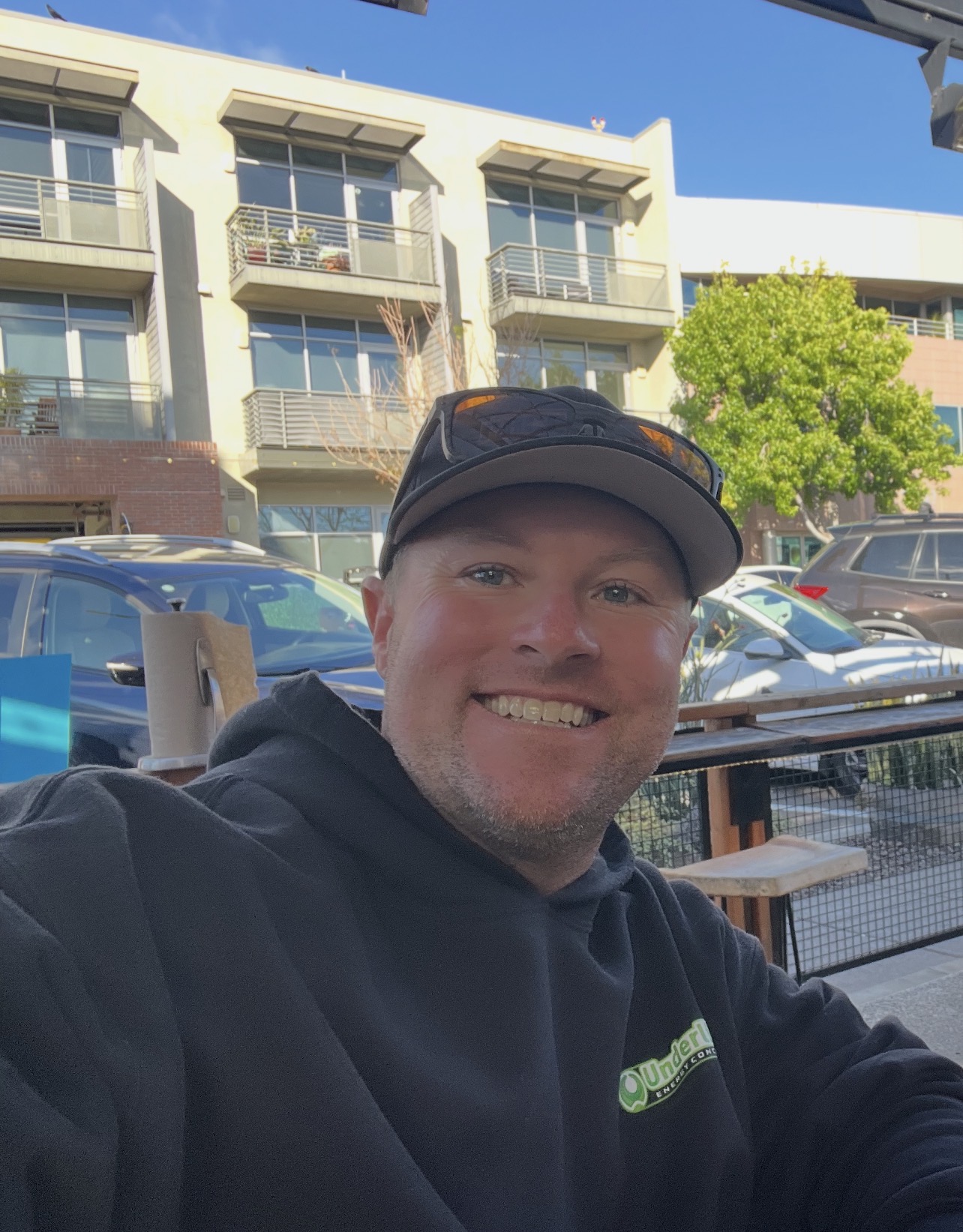
Jesse Malone
Jesse Malone
CEO & Partner, Underline Energy Concepts
Jesse Malone is the CEO and Partner of Underline Energy Concepts, a Southern California energy services company that has been serving homeowners since 2002. Since joining the company and becoming a partner in approximately 2015, Jesse has helped lead its growth into one of Southern California’s most trusted providers of residential energy efficiency and home improvement solutions.
Throughout his tenure, Jesse and the Underline Energy team have completed more than 2,500 energy upgrade projects for homeowners across Southern California. These projects include solar energy systems, roofing, battery storage, EV charging stations, electrical panel upgrades, water heater replacements, attic insulation, retrofit windows, and other energy-efficient home improvements designed to lower utility costs and increase property value.
Jesse holds a Bachelor’s Degree from California Southern University and brings more than 20 years of experience in emergency services through his service with the fire department. His background in public service has shaped his leadership style, emphasizing integrity, accountability, safety, and a commitment to serving the community.
A lifelong advocate for efficiency and practical solutions, Jesse is passionate about helping homeowners make informed decisions that improve both their homes and their financial future. His interests extend beyond energy efficiency into financial literacy, budgeting, investing, and long-term wealth-building strategies. He believes that reducing unnecessary expenses and maximizing efficiency are key components of financial success.
As CEO, Jesse continues to focus on delivering exceptional customer experiences, building high-performing teams, and helping Southern California homeowners achieve greater comfort, energy independence, and long-term savings through smart home investments.
Imagine waking up on a Monday morning in Corona, grabbing your coffee, and finding your EV topped off and ready for the commute without ever visiting a public charger. It's frustrating to rely on standard 120V outlets that barely add three miles of range per hour. You bought an electric vehicle for autonomy and savings, not to be tethered to a garage wall for two days straight. We understand that the jump to a professional home EV charging station Corona residents can rely on feels complex. You might worry about your electrical panel capacity or the maze of City of Corona building permits.
Underline Energy Concepts has helped Southern California homeowners master their power since 2002. As an employee-owned partner based in Lake Elsinore, we know how a proper Level 2 setup transforms your driving experience into a tool for financial freedom. This 2026 buying guide simplifies the entire process. We will explain why a 200 amp upgrade is often the smartest move for your home's value. You'll discover how to navigate SCE regulations and leverage current rebates to lower your installation hurdles. This article provides a clear roadmap to faster charging and a home that's ready for the future of energy.
Key Takeaways
- Discover how a home EV charging station Corona homeowners trust can eliminate public charging fatigue and ensure a full battery every single morning.
- Compare Level 1 and Level 2 charging speeds to find the right balance of performance and efficiency for your specific driving habits.
- Assess your current electrical capacity to determine if a 200 amp or 400 amp panel upgrade is necessary for safe, continuous power delivery.
- Navigate the 2026 landscape of SCE rebates and federal tax credits to significantly offset your upfront equipment and installation costs.
- Understand the importance of professional permitting and expert installation to safeguard your home and maintain your manufacturer's warranty.
Why a Home EV Charging Station is Essential for Corona Drivers
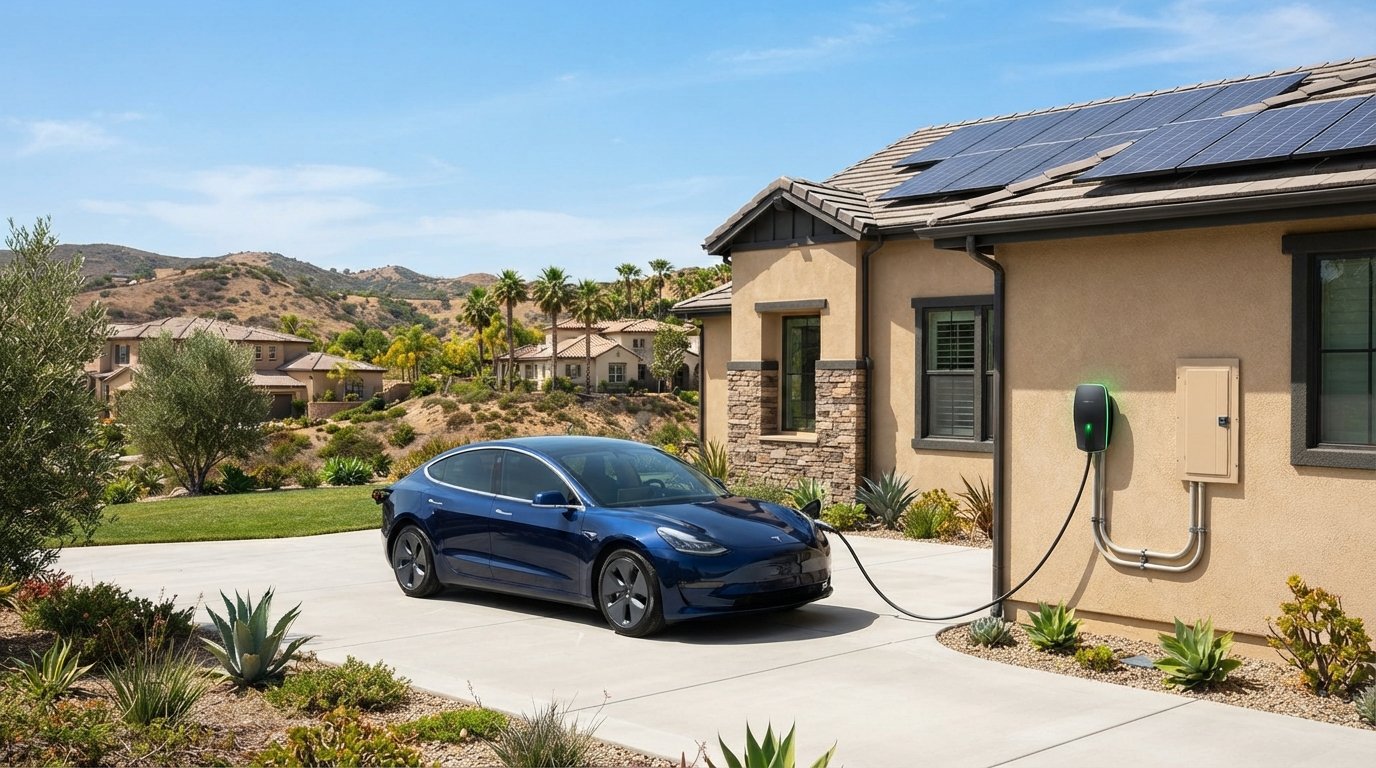
A home EV charging station Corona homeowners install is a dedicated, high-capacity appliance designed specifically for safe and rapid residential use. Technically referred to as electric vehicle supply equipment (EVSE), a Level 2 station operates on a 240V circuit, similar to your clothes dryer or oven. It replaces the slow, emergency-style charging from a standard wall outlet with a robust system that fuels your car up to ten times faster. This upgrade isn't just about convenience; it's a strategic move toward total energy autonomy.
Investing in this technology also bolsters your property's standing in the Inland Empire real estate market. As electric vehicle adoption accelerates, "EV-ready" homes are becoming a standard requirement for savvy buyers. By installing a professional station now, you're improving your home's long-term value while securing several immediate benefits:
- Price Protection: Shield yourself from volatile gas prices and the rising service fees at public charging networks.
- Predictable Fueling: Turn your car's energy needs into a manageable part of your monthly utility budget.
- Daily Readiness: Ensure your vehicle is always at 100% capacity before you even pull out of the driveway.
The Convenience Factor: Ending "Range Anxiety" in the Inland Empire
Commuting from Corona to Orange County or Los Angeles means spending significant time on the 91 or 15 freeways. Relying on public stalls often results in "range anxiety," where you're constantly hunting for an open, working charger after a long work day. A Level 2 home station eliminates this stress entirely. You'll wake up to a full battery every morning, removing the need for mid-week stops at crowded shopping center chargers. During Southern California heatwaves, when the grid is under pressure and public chargers may be congested, having your own reliable fuel source in the garage provides a level of certainty that public networks can't match.
Financial Logic: Home Charging vs. Public Networks
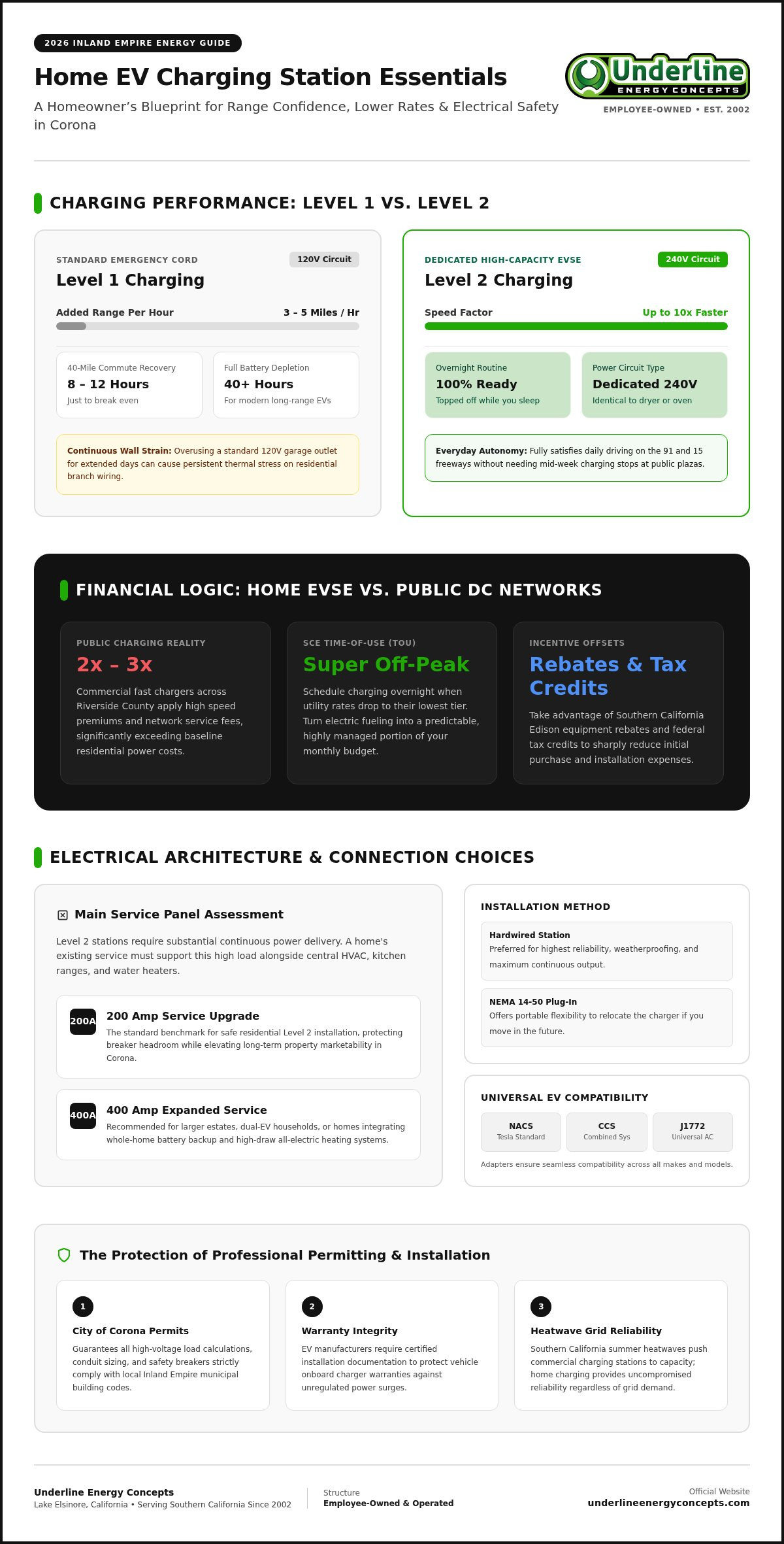
Fueling your vehicle at home is significantly more affordable than using commercial DC fast-chargers across Riverside County. Public networks often charge a massive premium for speed, sometimes double or triple the cost of residential electricity. By switching to a home setup, you can take advantage of Southern California Edison's Time-of-Use (TOU) rates. These plans allow you to schedule charging during "super off-peak" hours, typically overnight, when electricity prices are at their lowest. Home charging effectively pays for itself through these consistent fuel savings over time.
Level 1 vs. Level 2: Choosing the Best Station for Your Home
Selecting the right hardware is the first step toward energy independence. Most new electric vehicles come with a basic Level 1 cord, but this is rarely a permanent solution for active households. A professional home EV charging station Corona drivers install typically refers to Level 2 equipment. The primary difference lies in the voltage. Level 1 uses a standard 120V household outlet, while Level 2 requires a 240V circuit. This jump in power dramatically changes your daily experience, moving you from days of waiting to just a few hours of charging.
Compatibility is no longer the hurdle it once was. Whether you drive a Tesla using the North American Charging Standard (NACS) or another brand utilizing CCS or J1772 connectors, modern stations offer universal support or simple adapters. You also have a choice in how the unit connects to your home. Hardwired stations are often preferred for their reliability and higher power output, while NEMA 14-50 plug-in stations offer flexibility if you need to move the unit later. For a deeper look at these technical requirements, you can review the Department of Energy's home charging guide.
Level 1: Why the "Emergency Charger" Isn’t Enough
Level 1 charging is often called "trickle charging" for a reason. It only adds about 3 to 5 miles of range per hour. If you commute from Corona to nearby cities and drive 40 miles a day, you'd need at least 8 to 12 hours just to break even. Modern long-range EVs with large batteries can take over 40 hours to reach a full charge this way. Beyond the slow speed, overusing a standard garage outlet for high-amperage draws for days at a time can stress older wiring. It simply isn't a viable strategy for anyone with a daily commute exceeding 30 miles.
Level 2: The Gold Standard for Residential Charging
Level 2 is the industry standard for a reason. By utilizing a 240V connection, these stations deliver 25 to 40 miles of range per hour. This allows almost any EV to reach 100% capacity overnight. These units also offer smart features that Level 1 cords lack. You can use WiFi connectivity to monitor your sessions and schedule charging when rates are lowest. For homeowners looking to pair their vehicle with clean energy, SolarEdge provides excellent integrated solutions that allow you to charge directly from your solar panels. If you're unsure which hardware fits your garage best, speak with one of our local experts to evaluate your home's layout.
Electrical Requirements: Does Your Corona Home Need a Panel Upgrade?
The success of your home EV charging station Corona project depends entirely on the "brain" of your house: the main electrical panel. While many homeowners focus on the charger itself, the panel's capacity is the most common bottleneck in the installation process. A standard Level 2 charging station typically requires a dedicated 50-amp double-pole circuit. This draw is significant; it's equivalent to running a large central air conditioning unit or a commercial-grade kitchen range. If your home's electrical infrastructure isn't prepared to handle this continuous load, you risk frequent outages or equipment damage.
Underline Energy Concepts has served as a licensed electrical contractor since 2002. We've seen firsthand how Southern California's housing stock has evolved. Many older homes in the Inland Empire were built with 100-amp or 125-amp service, which was sufficient before the era of high-draw electric appliances. As an employee-owned local partner based in Lake Elsinore, we prioritize your safety by ensuring your panel meets the U.S. Department of Energy's home charging guide standards for safe, code-compliant operation.
Assessing Your Current Amperage
You can usually identify your panel's capacity by looking at the main breaker, which is the large switch at the top of your electrical box. If that switch says "100," you're likely at your limit. Adding a high-amperage EV charger to a 100A panel often leads to frequent breaker trips when you try to charge your car while running the microwave or the dryer. This isn't just an inconvenience; it's a sign that your system is overloaded. If you're planning for solar alongside your vehicle, understanding the Cost of Electric Panel Upgrade for Solar is a vital step in your budgeting process.
The Benefits of a 200 Amp Service Upgrade
Upgrading to 200-amp or 400-amp service is a powerful way to future-proof your Corona property. This extra capacity allows you to add other energy-efficient technology, such as hybrid water heaters, without worrying about capacity limits. Beyond the functional gains, a modern panel ensures your home remains compliant with current fire codes and safety standards. In the competitive Southern California real estate market, a 200-amp upgrade is a high-value asset. It signals to future buyers that the home is ready for a modern, electrified lifestyle, directly increasing your home's resale value and long-term stability.
Maximizing Your Investment: Rebates, Solar, and Savings
Installing a home EV charging station Corona residents choose involves more than just mounting hardware; it's a financial strategy. The Section 30C federal tax credit currently offers 30% of total installation costs up to $1,000 for homeowners in eligible census tracts. Additionally, the South Coast AQMD provides rebates of up to $250 for standard residential applicants, or up to $500 for low-income residents, specifically for Level 2 equipment. Navigating these incentives requires precise documentation, starting with an electrical permit through the City of Corona's eTRAKiT portal. Our team manages the load calculations and plan checks required by the Building Division to ensure your installation is fully compliant and eligible for every available dollar.
Professional handling is vital because improper permitting can disqualify you from local incentives. As an employee-owned contractor serving the region since 2002, we understand the nuances of Inland Empire utility regulations. We ensure your project meets the strict safety standards required to secure your rebates and maintain your home's insurance coverage. By stacking federal credits with local district incentives, you can significantly reduce the upfront cost of your energy upgrade.
SCE Rebates and Time-of-Use (TOU) Rates
Southern California Edison provides several programs to lower your long-term fueling costs. Through the SCE Charge Ready Home program, income-qualified households may access rebates up to $4,200 for panel upgrades, while those in state-designated Disadvantaged Communities can receive up to $2,100. Once your station is operational, switching to the TOU-D-PRIME rate plan is the most effective way to save. This plan slashes off-peak energy costs to approximately 24 to 25 cents per kWh, a massive discount compared to the 55 cents or more charged during peak evening hours. Check your specific SCE account for pre-approval to ensure you qualify for these 2026 incentives.
Solar Integration: Charging with the Sun
The ultimate path to energy independence is pairing your vehicle with a rooftop solar system. This combination allows you to generate your own "fuel" and offset 100% of your EV's energy consumption. To learn more about how this works in our region, explore our guide on Solar Panel Installation Southern California. We frequently install REC Solar Panels for homeowners who want premium, high-efficiency output to handle the heavy demands of daily vehicle charging. Schedule a home electrical inspection today to see how we can integrate these savings into your Corona home.
Professional EV Charger Installation in Corona with Underline Energy Concepts
Attempting a DIY project for a high-voltage appliance is a risk to your home and your family's safety. A professional home EV charging station Corona installation requires precise wiring and a deep understanding of electrical load management. If you bypass a licensed professional, you likely void the manufacturer’s warranty on your expensive new charger. Underline Energy Concepts provides a seamless, turnkey solution that ensures your system is safe, legal, and optimized for performance. As an employee-owned company based in Lake Elsinore, we take personal pride in every circuit we pull and every panel we upgrade. We've served the Inland Empire since 2002, and we treat every home as if it were our own.
Choosing a professional installer also protects your home's insurance coverage. Most insurance providers require that major electrical modifications are performed by a licensed contractor and signed off by the local building authority. Our team bridges the gap between technical necessity and administrative compliance. We ensure that your installation isn't just functional, but also a long-term asset that adds genuine value to your Corona property.
Our "White Glove" Installation Process
We believe that a premium energy upgrade should be stress-free for the homeowner. Our process begins with a rigorous load calculation to verify that your existing infrastructure can handle the new demand. We then manage the entire permitting process through the City of Corona’s eTRAKiT system, handling all the paperwork and utility notifications for you. Our technicians focus on aesthetic integration, ensuring that the conduit and hardware are mounted cleanly to match your home’s exterior or garage layout. Once the physical install is complete, we coordinate the final city inspection to ensure everything is strictly up to code.
Trust the Local Energy Experts
With over 20 years of experience in Riverside County, Underline Energy Concepts understands the specific needs of Southern California homeowners. We aren't just installers; we're your neighbors. Because we are employee-owned, every member of our team is personally invested in the quality of our workmanship and the satisfaction of our community. We provide ongoing support to ensure your charging station remains reliable for years to come. If you're ready to achieve energy independence, schedule your Corona home EV charging consultation today. Don't forget to ask about our referral program, which allows you to earn rewards while helping your friends and neighbors make the switch to clean, efficient power.
Take Control of Your Home’s Energy Future
Achieving total energy independence starts with making informed choices about how you power your life. Transitioning to a high-speed Level 2 system ensures your vehicle is always ready for the Inland Empire commute, while a 200 amp or 400 amp panel upgrade secures your home’s electrical foundation for years to come. By leveraging Southern California Edison rebates and pairing your charger with solar, you transform an everyday necessity into a savvy financial investment.
Underline Energy Concepts has served as a licensed electrical contractor since 2002. As an employee-owned partner based in Lake Elsinore, we provide the localized expertise and quality assurance you deserve. We handle the technical load calculations, the City of Corona permitting process, and the optimization of your utility incentives so you don't have to. It's time to stop hunting for public stalls and start enjoying the convenience of a full battery every morning.
Take the next step toward a more efficient, autonomous home today. Get a Professional EV Charger Installation Quote in Corona and discover how simple the transition to a home EV charging station Corona residents trust can be. We look forward to helping you power a brighter future.
Frequently Asked Questions
How much does it cost to install a Level 2 EV charger in Corona?
Costs for a home EV charging station Corona installation vary based on your property's unique electrical layout and the specific hardware you select. Factors such as the distance between your main electrical panel and the garage, as well as whether you require a 200 amp or 400 amp panel upgrade, will influence the total investment. We recommend a professional on-site inspection to provide an accurate assessment that accounts for local permitting and safety requirements.
Do I need a permit to install an EV charging station at my home?
Yes, the City of Corona requires a building permit for all new residential EV charging station installations. This ensures the added electrical load is safe and complies with current California building codes. Our team manages this entire process through the City’s eTRAKiT online portal, handling the load calculations and scheduling the final inspection. Proper permitting is also essential for maintaining your home insurance coverage and qualifying for local utility rebates.
Can I install an EV charger myself if I have a 240V outlet?
While it's tempting to plug a charger into an existing 240V outlet, we strongly advise against DIY installation. EV charging is a continuous, high-amperage load that places significant stress on your home's wiring. A licensed electrical contractor must verify that the outlet, circuit breaker, and wire gauge are rated for sustained use. Professional installation protects your manufacturer warranty and ensures your system operates safely without risking electrical fires or equipment failure.
How long does it take to charge a Tesla or other EV with a Level 2 home station?
Charging speeds depend on the vehicle's battery size and the station's amperage, but most Level 2 chargers add 25 to 45 miles of range per hour. For a Tesla or similar long-range EV, this means you can reach a full charge from near-empty in about 4 to 8 hours. This efficiency allows you to replenish your battery completely overnight, ensuring your car is ready for the morning commute without any downtime at public stations.
Will an EV charger work with my existing solar panel system?
Yes, a home EV charging station Corona residents install integrates seamlessly with an existing solar panel system to provide clean, low-cost fuel. By charging during the day when your panels are producing peak energy, you can power your vehicle directly from the sun. If you have a battery backup system, you can even store that solar energy to charge your car overnight. This combination maximizes your energy independence and protects you from rising utility rates.
What happens if my electrical panel is full and I want an EV charger?
If your electrical panel has no remaining space, you'll likely need an electric panel upgrade to 200 amps or 400 amps. This upgrade provides the necessary capacity to support a dedicated 50-amp circuit for your charger without overloading your system. As specialists in Southern California energy infrastructure since 2002, we can assess your current panel and provide a safe path forward that accommodates your car and future energy-efficient appliances like hybrid water heaters.
Does Southern California Edison offer rebates for home EV chargers in 2026?
Southern California Edison continues to offer incentives through programs like Charge Ready Home in 2026. These rebates often cover a significant portion of the costs for necessary electrical panel upgrades and circuit installations, especially for residents in designated communities. We stay current on all SCE requirements to help you secure the maximum financial support available. It's best to verify your specific account eligibility through the SCE Marketplace before beginning your project.
Is a hardwired charger better than a plug-in NEMA 14-50 station?
Hardwired chargers are generally considered superior for long-term residential use because they allow for higher charging speeds and increased reliability. A hardwired unit can support a 48-amp continuous draw on a 60-amp breaker, whereas plug-in units are limited to 40 amps. Hardwiring also eliminates the risk of "nuisance tripping" often caused by GFCI breakers on outlets, providing a more stable and permanent connection for your daily charging needs.