
Energy-Efficient HVAC in Perris: Your Summer Inspection Checklist
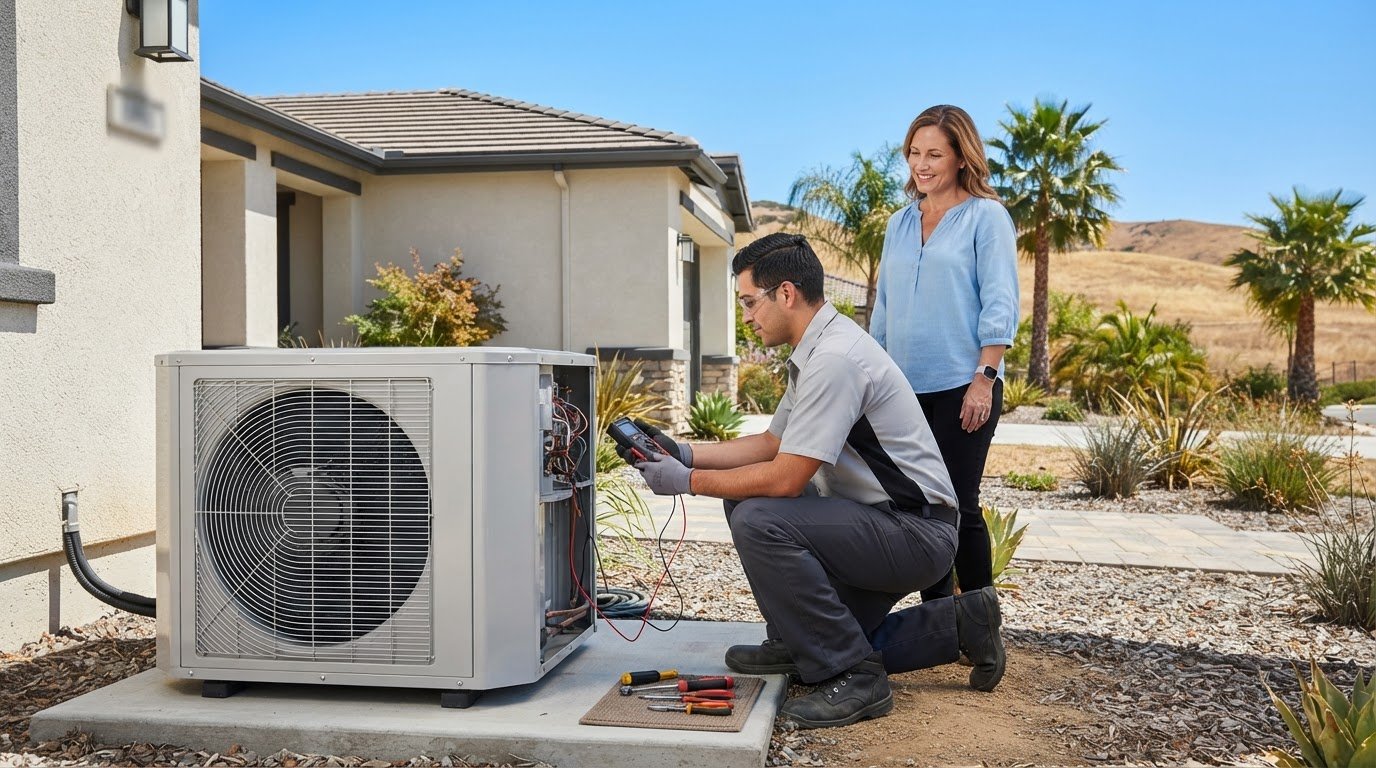
/
Article by
Jesse Malone
Jesse Malone
CEO & Partner, Underline Energy Concepts
Jesse Malone is the CEO and Partner of Underline Energy Concepts, a Southern California energy services company that has been serving homeowners since 2002. Since joining the company and becoming a partner in approximately 2015, Jesse has helped lead its growth into one of Southern California’s most trusted providers of residential energy efficiency and home improvement solutions.
Throughout his tenure, Jesse and the Underline Energy team have completed more than 2,500 energy upgrade projects for homeowners across Southern California. These projects include solar energy systems, roofing, battery storage, EV charging stations, electrical panel upgrades, water heater replacements, attic insulation, retrofit windows, and other energy-efficient home improvements designed to lower utility costs and increase property value.
Jesse holds a Bachelor’s Degree from California Southern University and brings more than 20 years of experience in emergency services through his service with the fire department. His background in public service has shaped his leadership style, emphasizing integrity, accountability, safety, and a commitment to serving the community.
A lifelong advocate for efficiency and practical solutions, Jesse is passionate about helping homeowners make informed decisions that improve both their homes and their financial future. His interests extend beyond energy efficiency into financial literacy, budgeting, investing, and long-term wealth-building strategies. He believes that reducing unnecessary expenses and maximizing efficiency are key components of financial success.
As CEO, Jesse continues to focus on delivering exceptional customer experiences, building high-performing teams, and helping Southern California homeowners achieve greater comfort, energy independence, and long-term savings through smart home investments.
What should a summer HVAC inspection tell you before Perris heat puts your system to work? When considering energy efficient HVAC installation Perris homeowners need clear information about the equipment already in their home, not broad promises about efficiency.
A useful report records which components were inspected, the readings taken, the system’s overall condition, and any repair priorities. Reviewing those details can help you understand what the technician observed and what questions to ask before deciding on next steps.
This checklist explains what a residential HVAC inspection records and how to review the findings. You’ll see how the Customer Report Card organizes system condition, remaining-life fields, and repair priorities, and how to distinguish recorded observations from general efficiency claims. The aim is practical clarity for homeowners in Perris and nearby Southern California communities.
Key Takeaways
- Review the indoor, outdoor, and heating-related components included in the inspection.
- Read recorded temperatures, voltage, amp draws, capacitor values, pressures, and static pressure as findings for the inspected system, not universal targets.
- Use documented condition and repair priorities to understand what may need attention when considering energy efficient HVAC installation Perris decisions.
- Work through the report in order: review component condition, read the measurements, note repair priorities, and consider the documented recommendations.
- Underline Energy Concepts’ Premium Residential HVAC Annual Maintenance & Inspection includes system checks, performance readings, and a Customer Report Card.
Perris Summer HVAC Tune-Up Checklist: What an Inspection Can Tell You
Before your home moves into regular summer cooling, look for documented observations and measurements rather than assumptions about lower bills or guaranteed efficiency gains. An inspection gives you a record of what the technician found, so you can review it before deciding what needs attention.
Underline Energy Concepts provides Premium Residential HVAC Annual Maintenance & Inspection for Southern California homeowners. The service records residential HVAC component checks, system readings, condition, remaining-life fields, and repair priorities. The report describes findings from the inspection. It does not predetermine repairs or promise a particular result. For general background on system design and energy use, see this overview of HVAC systems and energy efficiency.
Start with the HVAC system’s overall condition
The Customer Report Card groups findings under Overall Condition, Estimated Remaining Life, and Priority Repairs. Overall Condition is recorded as Excellent, Fair, or Needs Repair. These labels summarize the assessment; read them alongside the component observations and measurements that provide context.
Remaining-life fields appear as Indoor ___ yrs and Outdoor ___ yrs. They are blank placeholders unless the report contains an entered value. Don’t treat them as estimates or fill them in yourself. For energy efficient HVAC installation Perris decisions, reviewing the system’s recorded condition and any documented priorities is more useful than relying on a general efficiency claim.
Use the checklist to prepare for an inspection
Before the visit, write down comfort concerns or changes in how the system operates. Note the rooms affected and the nature of the concern, without trying to diagnose the cause. These observations give you a focused starting point when you review the technician’s findings.
After the inspection, compare your notes with the recorded condition, measurements, and repair priorities. The report includes Customer and Technician signature fields. Review the completed record and make sure you understand what each entry describes. The purpose is to document the system’s condition and findings, not to decide on a repair before the inspection is complete.
What a Perris HVAC Inspection Checks Before Summer
A residential HVAC inspection follows the system from indoor equipment to the outdoor unit, recording observations and measurements. For homeowners considering energy efficient HVAC installation Perris options, this component-by-component record can help separate documented conditions from assumptions. A component’s presence on the checklist does not mean it has failed or needs repair.
Indoor components and drainage checks
The indoor checklist includes the filter, blower, evaporator coil, drain line, and float switch. The technician records observations about these components as part of the inspection and maintenance report. A checked item is not automatically a repair recommendation; any priority should be supported by the documented finding.
If you have noticed a comfort or operating concern, mention it during the inspection. The technician’s observations can then be reviewed alongside the concern you reported. This helps keep the conversation specific without assuming in advance which component, if any, needs attention.
Outdoor, electrical, and heating components
Outdoor inspection points include the capacitor, contactor, electrical connections, outdoor coil, condenser fan, compressor, disconnect, and refrigerant lines. The report records observations about these items and applicable system readings. Reviewing the list helps you see which parts of the equipment were checked; the recorded findings, not the checklist alone, indicate whether an issue was noted.
The inspection also covers heating-related items: burners, heat exchanger, and flame sensor, as well as defrost and reversing valve. Their inclusion means the report covers listed heating functions as well as summer cooling. It does not imply that a problem was found. Any condition or repair priority depends on the technician’s documented findings.
For general context on installation and maintenance quality, the Air Conditioning Contractors of America outlines policy priorities, including ACCA Quality Installation and Maintenance Standards. Use that background alongside your own inspection report, which records observations about your system.
Underline Energy Concepts’ Premium Residential HVAC Annual Maintenance & Inspection documents indoor and outdoor component checks as part of its residential inspection and maintenance reporting. To discuss an inspection for your home, connect with Underline Energy Concepts.
How to Read HVAC Performance Measurements and Repair Priorities
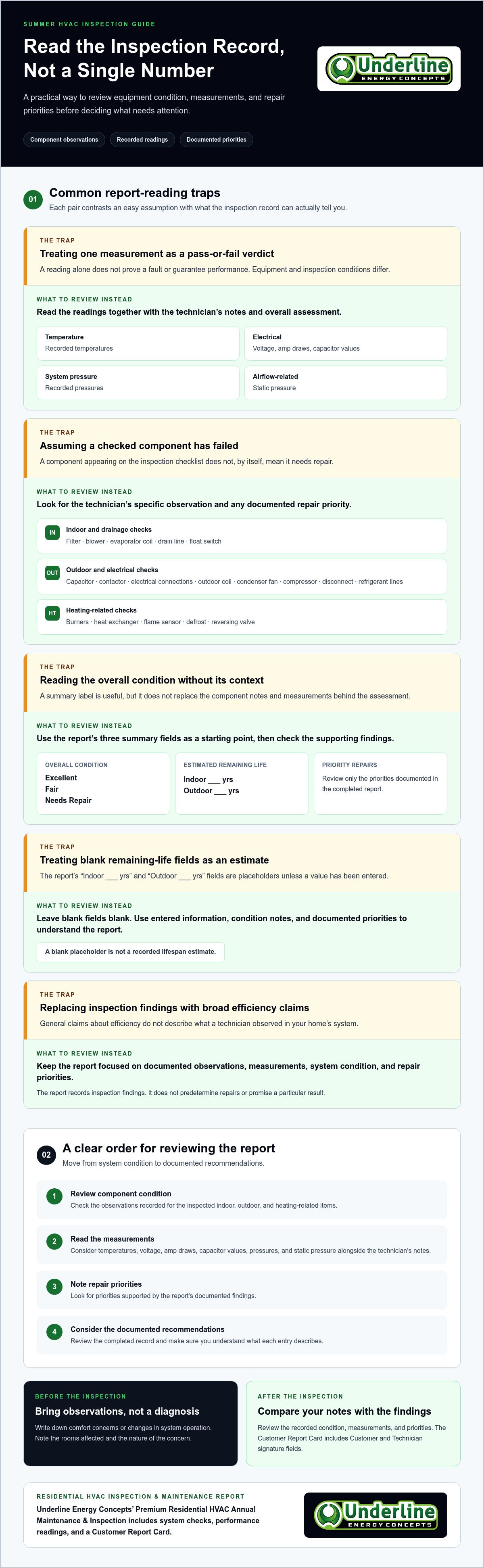
Measurements document what the technician recorded during the inspection. They are not universal pass-or-fail targets by themselves. Equipment and inspection conditions differ, so read each value alongside the technician’s notes and overall assessment. This is a more grounded way to consider energy efficient HVAC installation Perris decisions than treating a single number as proof of a fault or a promise of performance.
Read the measurements recorded in the report
The report organizes readings across temperatures, electrical measurements, system pressures, and airflow-related measurements. Review the entries as a group and use the accompanying notes to understand what they describe:
- Temperatures: Outdoor Temperature, Return Air Temperature, Supply Air Temperature, and Temperature Split.
- Electrical readings: Voltage, Compressor Amps, Fan Amps, Blower Amps, and Capacitor Rated and Actual values.
- System readings: Suction Pressure, Head Pressure, Superheat, Subcool, and Static Pressure.
- Gas-system entry: CO Reading (Gas), recorded as a measurement in the report. Use the result entered for the system rather than assuming or supplying a value.
For example, Return Air Temperature and Supply Air Temperature are separate entries, and Temperature Split is recorded as its own measurement. Review the values actually entered and the technician’s assessment. Without those results and notes, don’t assign a meaning, acceptable range, or repair to a measurement yourself.
Understand condition and repair priority
Overall Condition summarizes the recorded assessment as Excellent, Fair, or Needs Repair. It is different from an individual measurement: a reading records a value, while the condition label provides an overall assessment based on the inspection.
Priority Repairs uses High, Medium, and Low categories. A priority label helps organize the report, but it is not a diagnosis by itself. Check which finding or recommendation the category relates to, then review the observation and measurement together. If an entry is unclear, discuss what it refers to with the technician before deciding on maintenance. This keeps next steps tied to the inspection record rather than an assumed performance value or repair need.
A Practical Perris Homeowner Checklist for Reviewing Summer HVAC Findings
Reviewing the report in a consistent order makes it easier to connect the overall assessment with the observations behind it. Start with the condition, then read the measurements and repair priorities. Finish by reviewing any documented recommendations and noting questions that remain.
Review the report in a clear sequence
Use this sequence to work through the HVAC findings:
- Check Overall Condition. Read the recorded grade, then review the component observations that provide context.
- Read the measurements. Consider each entered value alongside its notes. Don’t turn a number into a diagnosis or performance claim on your own.
- Review repair priorities. Note the priority category and the finding connected to it. Use the report details to understand what the category refers to.
- Discuss recommendations. Ask which documented observations support a recommendation and what the proposed next step addresses.
Leave the Estimated Remaining Life fields, Indoor ___ yrs and Outdoor ___ yrs, blank unless the report provides values. For homeowners considering energy efficient HVAC installation Perris options, an inspection can document the current system’s condition, but it does not automatically recommend replacement.
Use documented findings to plan next steps
The Customer Report Card also includes a Whole Home Inspection section. These are the listed categories in the record; a category alone does not indicate a concern or repair recommendation:
- Roof
- Solar
- Electrical
- Water Heater
- QuietCool
- Gutters
- Smoke/CO
- Attic
- Window
Keep your notes together as you review the report. Mark entries you understand, flag readings or recommendations you want explained, and distinguish observed conditions from possible next steps. This approach helps you prioritize questions and make maintenance decisions based on the findings rather than assumptions.
To discuss a residential HVAC inspection and its documented findings, discuss a residential HVAC inspection with Underline Energy Concepts.
Underline Energy Concepts' Residential HVAC Inspection and Maintenance Report
Underline Energy Concepts provides the Premium Residential HVAC Annual Maintenance & Inspection, a residential HVAC system inspection and maintenance reporting service for Southern California homeowners. The report includes component checks, performance readings, system condition, estimated remaining-life fields, and repair priorities. It records what was observed during the inspection; it does not guarantee energy savings or predetermine repairs.
For homeowners considering energy efficient HVAC installation Perris options, the report provides a record of the existing system’s condition and a clear basis for discussing maintenance findings.
What the Customer Report Card records
The Customer Report Card organizes findings into categories. Overall Condition uses Excellent, Fair, and Needs Repair. Component observations and performance readings provide context for that assessment.
Estimated Remaining Life fields appear as Indoor ___ yrs and Outdoor ___ yrs. These are placeholders, not fixed estimates. Use a value only if it is entered in the report. Priority Repairs are categorized as High, Medium, or Low. Read each category alongside its documented notes.
Move from inspection information to a conversation
The report records indoor and outdoor component checks and system readings for review. Compare those entries with the condition assessment and any listed repair priorities. If an observation or reading is unclear, discuss the specific entry with the technician so you understand what the report says before considering next steps.
Customer and Technician signature fields are included in the report. Review the completed information and discuss recommendations in light of the documented findings, without assuming a particular repair or result.
To discuss the documented inspection and maintenance reporting, contact Underline Energy Concepts about a residential HVAC inspection.
Make Your Next HVAC Decision With Clearer Information
Before summer cooling becomes routine in Perris, a documented inspection can help you understand what the technician observed, which readings were recorded, and how repair priorities are categorized. Consider those details together rather than treating a measurement or condition label as a repair decision on its own.
Underline Energy Concepts’ Premium Residential HVAC Annual Maintenance & Inspection includes documented residential HVAC inspection and maintenance reporting. The Customer Report Card organizes condition and repair priorities, providing a clear starting point for questions and maintenance decisions. If you’re weighing energy efficient HVAC installation Perris options, the findings can help you understand the existing system without promising a particular outcome.
Contact Underline Energy Concepts to discuss a residential HVAC inspection and review your system’s documented findings.
Frequently Asked Questions
What does a summer HVAC tune-up inspection check?
The inspection documents the condition of listed system components and records performance readings. Checks include the filter, blower, evaporator coil, drain line, float switch, electrical connections, outdoor coil, condenser fan, and compressor. The report also covers listed heating and refrigerant-system points. A checked component is not automatically faulty; refer to the recorded observation to see whether a finding was noted.
Can an HVAC inspection tell me whether my system needs repairs?
The report documents overall system condition and repair priorities, helping you understand what the technician observed. The Customer Report Card uses Excellent, Fair, or Needs Repair for Overall Condition, and High, Medium, or Low for Priority Repairs. These labels do not identify a specific repair on their own. Review them alongside the related observations and recommendations before deciding how to proceed.
What HVAC measurements are recorded during the inspection?
The report can record Outdoor Temperature, Return Air Temperature, Supply Air Temperature, Temperature Split, Voltage, Compressor Amps, Fan Amps, Blower Amps, Capacitor Rated and Actual values, Suction Pressure, Head Pressure, Superheat, Subcool, Static Pressure, and CO Reading (Gas). These are measurement fields, not guaranteed results or universal targets. Review the entries documented for your system and discuss their context with the technician.
How do I understand HVAC repair priority labels?
The report uses High, Medium, and Low to organize Priority Repairs. The category helps you locate the recorded priority, but it does not explain the issue or its impact by itself. Read it alongside the documented observation and recommendation, and discuss anything unclear with the technician. Treat the report as the record of its stated findings, not as a diagnosis beyond those findings or a prediction of future system performance.
Does an HVAC inspection report estimate how many years my system has left?
The Customer Report Card includes Estimated Remaining Life fields for Indoor ___ yrs and Outdoor ___ yrs. These are placeholders, not fixed estimates or general lifespan guidance. Use a value only if the technician has entered it in the report. If a field remains blank, the estimate is unspecified. Don’t fill in a number based on the system’s age or an assumed typical lifespan.
Does a summer HVAC inspection guarantee lower energy bills?
No. The inspection documents components, readings, system condition, and repair priorities; it does not promise a specific energy-bill reduction or efficiency result. The findings can help you understand what was observed and consider maintenance decisions with more information. Treat the report as an account of the inspection, not as a savings forecast for your home.
What happens after the technician completes the HVAC inspection?
Review the recorded condition, observations, readings, and repair priorities with the technician. The Customer Report Card includes Estimated Remaining Life fields and Customer and Technician signature fields. Base next steps on the findings and recommendations entered in the report rather than filling blank fields with assumptions. Underline Energy Concepts provides residential HVAC inspection and maintenance reporting for homeowners in Perris, Canyon Lake, Menifee, Temecula, Murrieta, Wildomar, Corona, Moreno Valley, Lake Elsinore, and Winchester.