
Solar Panel Installation Southern California: The 2026 Homeowner’s Guide
/
What if your monthly utility bill was the smallest expense in your household budget, even during a record-breaking Inland Empire heatwave? If you've been waiting for the right moment for solar panel installation Southern California, 2026 presents a unique window of opportunity that requires a sharper strategy than years past. You likely feel the sting of rising rates and the frustration of decoding complex NEM 3.0 rules while worrying about the long-term health of your roof.
We agree that the shifting landscape of California energy can feel like a gamble, but the path to autonomy is actually more predictable than ever. This guide empowers you to master the current market, from securing the 30 percent federal tax credit before property tax exclusions expire to understanding why a battery-first approach is the fastest route to a return on your investment. You'll learn how to identify a licensed partner who manages your solar, roofing, and electrical needs to ensure a seamless, high-performance transition. We'll explore the specific steps to lower your bills and gain total control over your home's power.
Key Takeaways
- Learn why a battery-first strategy is now essential to maximize your return on investment under the current NEM 3.0 Solar Billing Plan.
- Discover how to avoid common pitfalls by choosing a partner who manages roofing and electrical upgrades as part of your solar panel installation Southern California.
- Explore specialized cooling solutions like Quietcool Battery Charge Mounts that protect your energy storage systems from extreme Inland Empire heat.
- Gain clarity on the local permitting timelines for cities like Menifee and Lake Elsinore to ensure a smooth transition to the grid.
- Find out how integrating whole-home efficiency upgrades like attic insulation and hybrid water heaters can further slash your monthly utility costs.
Navigating Solar Panel Installation in Southern California (2026 Edition)
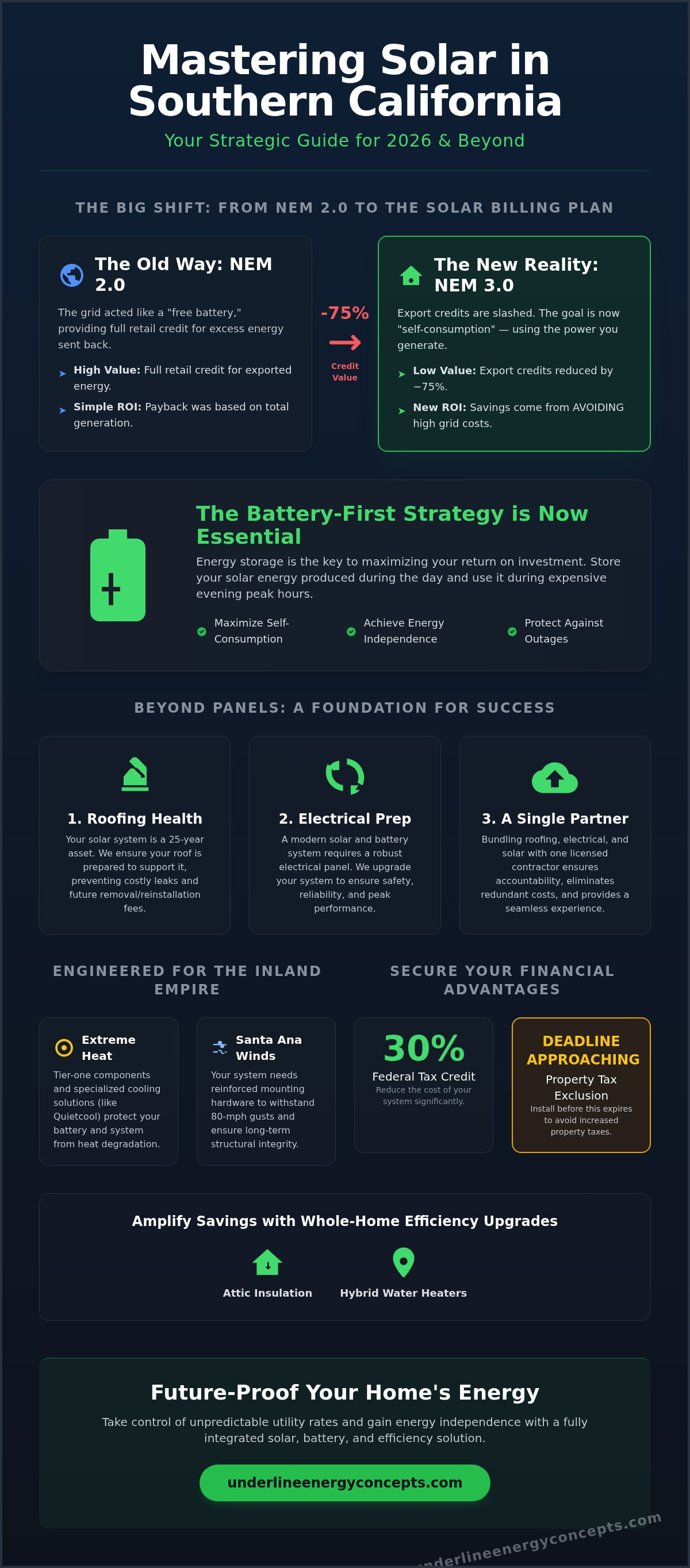
2026 is a year of transition for homeowners across the Inland Empire. If you're researching solar panel installation Southern California, you've likely noticed the rules of engagement have shifted significantly. It's no longer just about mounting panels on a roof and watching a meter spin backward. It's about building a fortress of energy autonomy. This year marks a deadline for several key incentives, including the property tax exclusion for solar systems, which makes the timing of your project more critical than ever for long term financial stability.
Successful energy projects in this region now require a holistic approach. The old "panel-only" model is obsolete. A modern system must be designed as an integrated machine that accounts for your roof's health, your electrical panel's capacity, and your home's overall efficiency. By understanding solar power and its interaction with our local environment, you can build a system that produces results for decades. We don't just look at the sun; we look at the whole house.
Our specific climate dictates your hardware choices. In Southern California, we deal with extreme heat that can degrade low quality components and Santa Ana winds that put immense physical stress on racking systems. You need tier-one equipment and reinforced mounting that can withstand 80-mph gusts. Choosing the right hardware ensures your system remains a high performing asset rather than a maintenance liability during our toughest weather months.
The Shift from NEM 2.0 to the Solar Billing Plan
The transition to the Solar Billing Plan, often called NEM 3.0, changed the math for Southern California Edison (SCE) customers. Under the old rules, the grid acted like a free battery where you received full retail credit for the energy you exported. Those days are gone. Today, export credits are reduced by roughly 75 percent, which makes "self-consumption" your primary goal. You want to keep every kilowatt you produce. The Solar Billing Plan is a fundamental shift toward battery-centric ROI where your savings come from avoiding expensive evening grid rates rather than selling power back to the utility.
Rising Utility Costs in Riverside and San Bernardino Counties
Residents in Riverside and San Bernardino counties face some of the most aggressive rate hikes in the state. These increases make solar panel installation Southern California a common sense move despite the new billing rules. Your savings are now measured by the "Avoided Cost Calculator," a utility metric that determines the value of the energy you don't have to buy from the grid. We've reached a tipping point. When utility rates climb faster than the cost of high efficiency equipment, solar becomes a financial necessity. It's the only way to lock in your energy costs and protect your family's budget from unpredictable price spikes.
Roofing and Electrical Prep: The Invisible Keys to Solar Success
A high performing solar system is only as reliable as the surfaces and circuits supporting it. Many "solar-only" companies prioritize installation speed over structural health, which often leads to expensive roof leaks or electrical failures just a few years down the line. If your roof fails after solar panel installation Southern California, you'll face the heavy financial burden of paying to remove the panels, fix the leak, and reinstall the hardware. We advocate for a holistic approach where your roof and electrical system are treated as the foundation of your energy independence.
Choosing a single partner for roofing, electrical, and solar creates a seamless experience and ensures accountability. Bundling these services isn't just about convenience; it's a savvy financial move. When you address roof repair and solar simultaneously, you eliminate redundant labor costs and ensure that every penetration is sealed by experts who understand both trades. This integrated strategy aligns with California's solar energy initiatives, which emphasize long term system safety and efficiency.
The Roof Inspection: Don’t Build on a Shaky Foundation
We start with a rigorous inspection to determine if your roof can support a 25 year asset. For tile roofs common in the Inland Empire, we look for cracked underlayment and slipping tiles. For shingle roofs, we check for granule loss and structural sagging. We ensure that solar standoffs and flashings are compatible with your specific material to prevent moisture intrusion. Additionally, we verify that your attic ventilation meets current California fire codes, as proper airflow prevents heat buildup that can degrade both your roof and your solar efficiency. If you want to ensure your home is ready for a new array, it's a smart move to schedule a professional roof assessment before moving forward.
The 200-Amp Upgrade: Powering Modern Solar and EV Needs
Your main electrical panel is the gatekeeper of your energy future. Many older homes in Riverside and San Bernardino counties have 100-amp or 125-amp panels that simply cannot handle the load of a modern solar array and a whole home battery backup. Signs of an undersized panel include flickering lights or breakers that trip when the AC kicks on. Upgrading to a 200-amp panel provides the necessary headroom for high demand appliances like hybrid water heaters and EV chargers. This upgrade ensures your main breaker can support the two-way flow of electricity required for a battery-centric system, making your home truly future-proof.
Beating High Utility Rates: The Battery-First Strategy in SoCal
Relying on the grid for storage is a strategy of the past. Under the current Solar Billing Plan, the financial success of your solar panel installation Southern California depends almost entirely on your ability to store the power you produce. Without a battery, you're forced to sell your excess energy to the utility at a deep discount, only to buy it back at full price once the sun goes down. A whole home battery backup flips this script, allowing you to use your own clean energy during the expensive evening peak hours.
This approach is known as Time-of-Use (TOU) arbitrage. By discharging your battery when utility rates are at their highest, you avoid the most aggressive charges on your bill. It's a method that transforms your home into a self-sustaining power plant. You can choose between a whole home battery backup, which keeps your entire property running during an outage, or a critical loads setup that prioritizes essential appliances like your refrigerator and medical equipment. Both options provide a level of security that the aging California grid simply cannot guarantee.
Maximizing ROI with Whole-Home Battery Systems
Batteries are the bridge that spans the gap created by reduced export credits. Homeowners should leverage the Self-Generation Incentive Program (SGIP) to offset initial costs. We prioritize Lithium Iron Phosphate (LFP) chemistries for their stability in Southern California’s heat. Smart Home integration further automates discharge, ensuring you avoid grid power when rates are highest. This level of control defines modern energy autonomy and ensures a faster return on your investment.
Quietcool and Innovative Mounting Solutions
Thermal management is vital for battery health in sweltering areas like Moreno Valley. Excessive heat causes premature degradation, which is why Quietcool Battery Charge Mounts are a specialized advantage for your solar panel installation Southern California. These mounts improve airflow and maintain system efficiency. Whether you choose solar ground mounts for easy access or wall mounts to save space, protecting your storage from the sun ensures your system delivers the long term performance you expect.
Local Permitting and Installation: What Inland Empire Homeowners Need to Know
Success with solar panel installation Southern California requires more than just high quality hardware; it demands local bureaucratic fluency. If you live in Menifee, Temecula, or Lake Elsinore, you're dealing with specific Authorities Having Jurisdiction (AHJs) that each have unique solar requirements. While some cities have streamlined digital permitting, others still rely on manual reviews that can add weeks to your project. We handle these local hurdles so you don't have to, ensuring your system meets every local code from the start.
Once the physical install is complete, you enter the "Permission to Operate" (PTO) waiting period. This is the final stage where your utility company, such as Southern California Edison, verifies the installation and grants you the legal right to turn the system on. During this time, your equipment is ready, but it must remain off until the utility gives the green light. We stay in constant communication with utility reps to move your project through the queue as quickly as possible.
Our region’s climate also dictates specific installation techniques. We use UV-resistant conduit and heavy duty racking systems designed to withstand the intense Santa Ana winds that frequently sweep through the Inland Empire. Standard installs might fail under the pressure of 80-mph gusts, but our reinforced mounting ensures your investment stays secured to your roof. Protection against UV degradation is equally vital, as the high solar index in our area can bridge or crack inferior materials over time.
The 5-Step Professional Installation Timeline
Your journey follows a structured path to ensure safety and compliance:
- Site Assessment & Engineering: We map your roof's structural integrity and electrical capacity.
- Permitting: We secure approvals from local inspectors in cities like Corona or Murrieta.
- Physical Installation: Our team mounts the panels and integrates your battery storage.
- Final Inspection: City officials verify the system meets all safety standards.
- Interconnection: The utility company grants PTO, and your system goes live.
The average timeline from contract signature to receiving your official PTO letter typically spans two to three months depending on your local utility's current backlog.
Maintenance and Performance Optimization
Maintaining your system is critical in our dusty environment. Inland Empire dust can significantly reduce your energy production if left unaddressed, making a regular professional solar cleaning schedule a necessity rather than an option. We also look at the bigger picture of your home’s efficiency. By installing attic insulation and a whole house fan, you reduce your home's overall cooling load, which may allow for a smaller, more cost-effective solar system. After a major wind storm, we recommend a quick visual inspection to check for debris or any signs of electrical wear. If you’re ready to start your project with a team that knows your neighborhood, request a local site evaluation today.
Future-Proofing Your Home with Underline Energy Concepts
Our philosophy at Underline Energy Concepts is simple: we prioritize energy efficiency first and solar second. Many homeowners jump into solar panel installation Southern California without addressing the energy leaks in their homes. This often leads to oversized, expensive systems that work harder than necessary. By upgrading your attic insulation or installing high efficiency windows first, you lower your home's total energy demand. This strategic order of operations ensures your solar investment is optimized for performance rather than just compensating for a drafty house.
We provide a single point of contact for your entire energy ecosystem. Instead of juggling a separate roofing contractor, an electrician, and a solar company, you partner with one team that understands how these systems interact. We integrate high performance heating and cooling upgrades with hybrid water heaters to create a cohesive plan that slashes your utility reliance. This unified approach eliminates the finger pointing between different contractors and gives you total peace of mind regarding your home's long term stability and comfort. For those also considering accessibility upgrades, you can explore Grab Bar Installation to make your home safer for everyone.
Total Home Efficiency Beyond the Panels
QuietCool whole house fans are a game changer for the Inland Empire climate. These systems pull cool evening air into your living space and flush out the scorching heat trapped in your attic. This process drastically reduces the solar capacity you need to purchase because your air conditioner doesn't have to run nearly as often. When you combine this with high efficiency windows, your ROI accelerates. Your home retains its temperature more effectively, meaning you keep more of the energy your panels produce. For families in Menifee, our hybrid water heater installations are a top choice. These units use significantly less electricity than standard tanks, allowing your solar array to power more of your home for less money.
Your Local Partner in Energy Autonomy
We are deeply committed to the communities of Canyon Lake, Temecula, and Murrieta. As your local partner, we provide more than just hardware; we offer expert level advocacy in an ever changing energy market. The Underline Advantage means you receive transparent pricing and a custom strategy tailored to your specific roof and electrical needs. We avoid aggressive sales tactics in favor of logic and long term financial savvy. During your professional consultation, we analyze your energy history, inspect your structural foundation, and design a system built for autonomy. Take the first step toward permanent relief from rising utility rates and schedule your expert solar and roofing evaluation today.
Secure Your Energy Independence Today
The window of opportunity in 2026 is clear. You now have the knowledge to master the Solar Billing Plan by prioritizing a battery-first strategy and ensuring your home’s structural foundation is ready. Remember that successful solar panel installation Southern California depends on more than just panels; it requires a healthy roof, an upgraded electrical panel, and a commitment to whole-home efficiency.
By addressing energy leaks with Quietcool whole house fans or attic insulation before you mount a single panel, you maximize your ROI and minimize your reliance on the grid. As a licensed roofing, electrical, and general contractor, we bring local accountability to every project across the Inland Empire. We specialize in Quietcool battery charge mounts and whole-home battery systems to ensure your technology performs even in the toughest heat.
Stop letting rising utility rates dictate your family's budget. Take control of your energy future with a partner who understands the unique demands of our region. Get Your Custom Solar & Energy Efficiency Quote and experience the relief of true energy autonomy. You've done the research, and now it's time to build a home that works for you.
Frequently Asked Questions
Is solar still worth it in Southern California with NEM 3.0?
Yes, solar remains a powerful financial tool because local utility rates continue to climb. While export credits are lower than they were under previous rules, your savings now come from avoiding expensive peak hour charges. By pairing your panels with a whole home battery backup, you achieve a level of autonomy that protects your household budget for decades to come.
How much does a typical solar panel installation cost in Riverside County?
Your total investment depends on your home's unique energy demand, the complexity of your roof, and the quality of the equipment you choose. Factors like the need for an electric panel upgrade or specific mounting hardware will also influence the final cost. You should focus on the net investment after applying the 30 percent federal tax credit, which remains available to homeowners throughout 2026.
Do I need to replace my roof before getting solar panels?
You should replace your roof if it shows signs of wear or is nearing the end of its functional life. Installing a 25 year solar array on a roof with only five years left is a costly mistake. We recommend a professional inspection to ensure your foundation is solid before starting a solar panel installation Southern California project, as bundling these services often saves you money on labor. To see how professional contractors evaluate complex roof features, check out SYNERGY ROOFING - ROOFING & SKYLIGHT SPECIALIST for a comparison of mounting techniques that can impact long-term roof health.
How long does the solar installation process take in Menifee or Temecula?
The physical mounting of your hardware typically takes one to three days of on site work. However, the full journey from engineering and permitting to final Permission to Operate (PTO) often spans eight to twelve weeks. This timeline accounts for the varying permit review speeds in cities like Menifee and the final safety inspections required by your utility provider.
Can I add a battery backup to my existing solar system?
Yes, you can add a whole home battery backup to an existing array to increase your energy independence. Most modern systems are compatible with AC coupled storage solutions that don't require you to replace your current solar inverter. Adding a battery is the most effective way to upgrade an older system and maximize your savings under the current utility billing rules.
Will solar panels work during a Southern California power outage?
Standard solar systems shut down during an outage to prevent backfeeding electricity into the grid while utility crews are making repairs. To keep your lights on when the grid goes down, you must integrate a battery or a generator backup power system. These solutions allow your home to operate as an independent microgrid, ensuring your essential appliances stay powered during local blackouts.
What incentives or tax credits are available for SoCal solar in 2026?
The primary incentive is the 30 percent federal Residential Clean Energy Credit, which applies to the total cost of your equipment and labor. You may also be eligible for the Self-Generation Incentive Program (SGIP) if you include a battery in your project. It is important to act soon because the California property tax exclusion for solar systems is scheduled to expire after 2026.
How often should I have my solar panels cleaned in the Inland Empire?
You should schedule a professional cleaning at least twice a year to maintain peak performance. The Inland Empire's high dust levels and seasonal Santa Ana winds create a layer of grime that can significantly reduce your energy harvest. Regular maintenance ensures your solar panel installation Southern California continues to deliver the maximum possible savings by keeping your panels clear of debris and buildup.