
Cost to Install EV Charger at Home in California: 2026 Homeowner’s Guide
/
Article by
Jesse Malone
Jesse Malone
CEO & Partner, Underline Energy Concepts
Jesse Malone is the CEO and Partner of Underline Energy Concepts, a Southern California energy services company that has been serving homeowners since 2002. Since joining the company and becoming a partner in approximately 2015, Jesse has helped lead its growth into one of Southern California’s most trusted providers of residential energy efficiency and home improvement solutions.
Throughout his tenure, Jesse and the Underline Energy team have completed more than 2,500 energy upgrade projects for homeowners across Southern California. These projects include solar energy systems, roofing, battery storage, EV charging stations, electrical panel upgrades, water heater replacements, attic insulation, retrofit windows, and other energy-efficient home improvements designed to lower utility costs and increase property value.
Jesse holds a Bachelor’s Degree from California Southern University and brings more than 20 years of experience in emergency services through his service with the fire department. His background in public service has shaped his leadership style, emphasizing integrity, accountability, safety, and a commitment to serving the community.
A lifelong advocate for efficiency and practical solutions, Jesse is passionate about helping homeowners make informed decisions that improve both their homes and their financial future. His interests extend beyond energy efficiency into financial literacy, budgeting, investing, and long-term wealth-building strategies. He believes that reducing unnecessary expenses and maximizing efficiency are key components of financial success.
As CEO, Jesse continues to focus on delivering exceptional customer experiences, building high-performing teams, and helping Southern California homeowners achieve greater comfort, energy independence, and long-term savings through smart home investments.
What if the most expensive part of your new electric vehicle isn't the monthly payment, but the hidden infrastructure costs waiting in your garage? For many Southern California homeowners, the excitement of driving a zero-emission car is often dampened by the realization that their home's electrical system isn't ready for the demand. Determining the actual cost to install EV charger at home California residents face can feel like a moving target. Between unpredictable labor rates in SoCal and confusing local permitting requirements, it's easy to feel overwhelmed before you even plug in.
We agree that you deserve total transparency when it's time to upgrade your home's energy capabilities. This guide provides a clear breakdown of installation expenses, from basic Level 2 hardware to necessary 200 amp or 400 amp panel upgrades. You'll learn about available California-specific rebates and federal tax credits that help lower your initial investment. We'll also explain how to navigate the permitting process and ensure your setup is safe, reliable, and optimized for long-term savings. You'll finish this guide with a realistic budget and a plan to power your vehicle without the stress of unexpected electrical hurdles.
Key Takeaways
- Understand the three primary pillars of the cost to install EV charger at home California homeowners should expect, including hardware, labor, and local permitting.
- Determine if your current electrical system requires a 200 amp or 400 amp panel upgrade to safely support a high-speed Level 2 charging station.
- Learn how to maximize your savings by combining the 30% Federal Tax Credit with specific Southern California Edison rebates available in 2026.
- Explore how integrating solar panels and battery backup systems can allow you to charge your vehicle for free using stored sunshine.
- Discover why hiring a licensed local specialist ensures compliance with Southern California building codes and protects your home's long-term value.
Breaking Down the 2026 Cost to Install an EV Charger in California
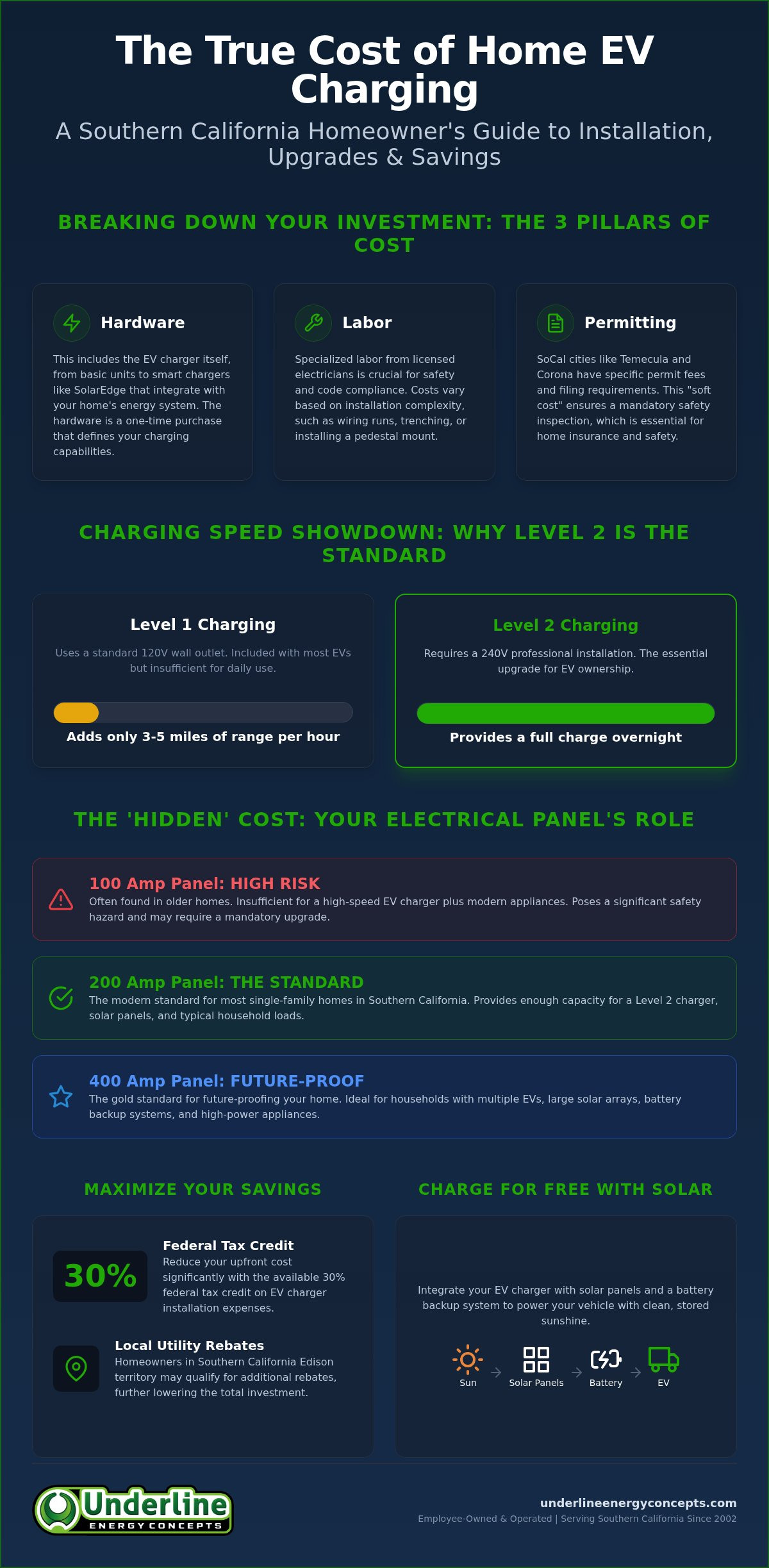
Understanding the cost to install EV charger at home California homeowners encounter requires looking past national averages. Most online estimates ignore the reality of our state's strict electrical codes and regional labor markets. Your total investment is split between three main pillars: the hardware you select, the specialized labor required for a safe installation, and the existing infrastructure of your home. While hardware is a one-time purchase, the infrastructure and labor costs vary significantly based on the age of your property and the complexity of the wiring run.
In Southern California, labor rates reflect the high demand for licensed electricians who understand local utility standards. Beyond the base installation, the physical location of your charger dictates a large portion of the budget. Mounting a unit on a garage wall near your electrical panel is a direct process; however, installing a charger on a standalone pedestal in a driveway often requires trenching and extensive conduit runs. These additional requirements increase both material costs and the total labor hours needed to complete the project safely.
Hardware vs. Soft Costs: What You're Paying For
Hardware choices range from basic non-connected units to premium smart chargers like those from SolarEdge. Smart chargers offer better control, allowing you to monitor energy usage and sync with your solar production for maximum efficiency. Don't overlook "soft costs" like permitting fees. Cities such as Temecula, Corona, and Moreno Valley have specific filing requirements and fee structures that must be factored into your budget. These permits ensure a mandatory safety inspection, which is non-negotiable for maintaining your home insurance coverage and guaranteeing the system handles the high electrical load without risk.
Level 1 vs. Level 2 Charging: A Value Comparison
Many new EV owners start with the Level 1 cord that came with their car, but they quickly find it insufficient for daily needs. A standard 120V outlet only adds a few miles of range per hour, which fails to keep up with the long-range batteries found in 2026 vehicle models. Upgrading to a 240V Level 2 system provides the speed needed to fully charge overnight, ensuring you're ready for the daily commute without relying on expensive public charging stations. Level 2 charging is the standard for California commuters in 2026 who require reliability and efficiency. This upgrade transforms your home into a private fueling station that works on your schedule, providing the ultimate sense of autonomy and relief from rising gas prices.
The 'Hidden' Cost: Why Your Electrical Panel Matters
While hardware and labor are visible expenses, the most critical factor in the total cost to install EV charger at home California residents face is often the electrical panel. A high-speed 50 amp EV charger pulls a massive amount of power. If your home still operates on an older 100-amp service, adding this load is like trying to force a fire hose through a drinking straw. You risk tripping breakers constantly; even worse, you create a potential safety hazard by pushing your system beyond its design limits.
Older communities in Lake Elsinore and Perris frequently feature homes built with Zinsco or Federal Pacific panels. These specific brands are known to have high failure rates and don't meet modern safety standards. Simply adding a new circuit to an outdated or maxed-out panel isn't just a technical hurdle; it's a safety liability. A full main panel upgrade ensures your home handles the EV load while keeping your family safe and your power reliable.
200 Amp vs. 400 Amp Upgrades
For most single-family homes in Southern California, a 200 amp electric panel upgrade provides enough headroom for a Level 2 charger and solar. This upgrade lets you run your AC and charger simultaneously without stress. If you plan on having two electric vehicles, a 400 amp electric panel upgrade is the gold standard for future-proofing. Investing in these upgrades early helps stabilize the total cost to install EV charger at home California families encounter by preventing future emergency repairs.
Bundling Upgrades for Maximum Efficiency
Bundling a panel upgrade with your EV charger installation is the most cost-effective path. When Underline Energy Concepts handles both projects at once, we eliminate redundant permitting fees and minimize labor hours. As an employee-owned, Lake Elsinore-based contractor, we've seen how these proactive improvements pay off immediately. Upgrading your electrical infrastructure is a common-sense investment that significantly boosts property resale value and marketability in Southern California's tech-forward real estate market.
If you're unsure about your home's current capacity, schedule a professional electrical assessment to identify the safest path forward for your home.
Maximizing ROI with California Rebates and Tax Credits
Investing in a home charging station shouldn't break your budget. While we've discussed the technical requirements, the financial side is where you find the most relief. California leads the nation in green energy incentives, making the net cost to install EV charger at home California families pay much lower than the sticker price suggests. By stacking federal credits with local utility rebates, you can often recover a significant portion of your upfront investment within the first year of ownership. This turns a simple home improvement into a strategic move toward long-term financial stability.
Navigating the SCE Rebate Landscape
Southern California Edison (SCE) offers robust support through programs like Charge Ready. This initiative aims to help you transition away from gasoline by offsetting the price of qualified Level 2 chargers for residential customers. Visit the SCE Marketplace to find current rebate forms and a list of approved hardware. Timing is everything; these funds are often distributed on a first-come, first-served basis. We recommend checking the current funding status before you purchase your hardware to ensure you meet all the latest utility requirements and program deadlines.
The Federal Alternative Fuel Infrastructure Tax Credit
The federal government provides a major boost through the Section 30C tax credit. This allows you to claim 30% of the total project cost on your federal tax return. Unlike some smaller grants, this credit is comprehensive. It covers the charger itself, the labor for installation, and even the electrical panel upgrades we discussed earlier. While Underline Energy Concepts provides the detailed invoices and technical documentation you'll need for your records, you should consult with a tax professional to confirm how this credit applies to your specific tax liability. This credit effectively lowers the barrier to entry for high-performance home charging.
Beyond state and federal help, local entities like the South Coast Air Quality Management District (SCAQMD) occasionally offer additional grants for residents in specific Southern California communities. To qualify for almost any of these programs, you must use a licensed contractor. Using an unlicensed worker for your installation usually disqualifies you from these savings immediately. We prioritize your financial well-being by ensuring every installation meets the strict documentation standards required by these agencies. This professional approach protects your investment and maximizes your return on energy independence.
The Synergy of Solar, Battery, and EV Charging
While hardware and panel upgrades represent the initial cost to install EV charger at home California homeowners must manage, the real magic happens when you look at the entire energy ecosystem. An EV charger is the perfect companion to a Southern California solar installation. Instead of simply trading a monthly gas bill for a higher utility bill, you can achieve true autonomy by "driving on sunshine." By generating your own power, you effectively eliminate the fuel cost of your vehicle, turning your home into a self-sustaining power plant that provides long-term financial relief.
At Underline Energy Concepts, we integrate SolarEdge technology to give you total control over this process. These smart energy management systems allow your solar panels to communicate directly with your charger. This ensures your car prioritizes clean, home-generated energy over expensive grid power. It's a practical, common-sense way to protect yourself from the rising electricity rates that Southern California Edison (SCE) customers face every year. This integration turns your EV from a new expense into a tool for energy preservation.
Smart Charging and Time-of-Use (TOU) Rates
Southern California's utility rates are highest during the afternoon and early evening. Smart chargers navigate these fluctuations automatically. You simply plug in when you get home, and the system waits until the cheapest off-peak rates kick in at night to start the heavy lifting. Pairing this with a whole home battery backup allows you to store excess solar energy during the day and use it to charge your car after the sun goes down. This strategy helps you avoid "Demand Charges" and ensures you never pay peak prices for your daily commute. Explore our Whole Home Battery Backup Guide to see how storage completes your path to energy autonomy.
Future-Proofing Your Home Energy System
Think about your energy needs five or ten years from now. Many families eventually add a second EV, so your first installation should account for that growth. We recommend scalable solutions that won't require you to rip out and replace your equipment later. We're also seeing the rise of bidirectional charging (V2H), where your car's battery can actually power your home during a blackout. By planning for these advancements today, you preserve your home's value and ensure your system remains relevant as technology evolves. Our team focuses on building robust systems that provide stability and safety for your family's future.
Ready to see how solar and charging work together for your home? Contact our local experts for a custom energy design today.
Why Professional Installation in SoCal Saves You Money
Professional installation isn't just a safety requirement; it's a financial safeguard. Choosing a licensed expert dramatically reduces the long-term cost to install EV charger at home California residents face by preventing equipment failure and ensuring strict code compliance. Since 2002, Underline Energy Concepts has served as a trusted partner for families across Lake Elsinore, Murrieta, and the surrounding region. As an employee-owned company, our technicians are personally invested in the quality of every connection. We prioritize your home's stability over high-volume sales, ensuring your system performs reliably for decades.
Licensed vs. Unlicensed: The Real Cost of 'Cheap' Labor
Hiring an unlicensed worker might save a few dollars today, but the hidden risks are substantial. Unlicensed electrical work frequently leads to failed home inspections during a property sale or, even worse, a total denial of insurance claims if an electrical fire occurs. Our team provides a comprehensive guarantee of expert workmanship that meets all Southern California building codes. This professional oversight protects your vehicle's warranty and your home's insurance eligibility. We believe in building strong community ties, which is why our Referral Program offers a way to share these benefits with friends and family while earning community-based savings.
Getting Started with Your Custom Quote
We begin every project by evaluating the specific electrical needs of your home in cities like Temecula or Corona. Our process is designed to be seamless, moving from a detailed electrical inspection to the final charger activation without the stress of managing multiple contractors. We handle the technical heavy lifting, the city permits, and the final inspection coordination. This turnkey approach provides the autonomy and relief you need when transitioning to electric driving. You'll receive a transparent breakdown that accounts for your home’s unique infrastructure, ensuring there are no surprises on installation day.
When our team arrives for your installation, we treat your property with the respect it deserves. We explain the operation of your new charger and show you how to monitor your energy usage. This focus on education ensures you get the most out of your investment from day one. By choosing a local specialist with over two decades of regional experience, you're investing in the future value of your property. Schedule your professional EV charger consultation today!
Take Control of Your Home's Energy Future
Transitioning to an electric vehicle is more than just a lifestyle change; it's a strategic investment in your home's long-term autonomy. By understanding the true cost to install EV charger at home California residents can navigate hardware choices, essential panel upgrades, and available rebates with confidence. You've learned how bundling infrastructure work with smart solar and battery systems protects you from rising utility rates while increasing your property's value. This transition doesn't have to be complex when you have a reliable local partner to guide you through every permit and technical requirement.
Underline Energy Concepts has served Southern California since 2002 as a licensed electrical and solar specialist. We're an employee-owned and operated team that prioritizes quality workmanship and customer education above all else. We're ready to help you build a safe, efficient, and future-proof charging solution tailored to your home's specific needs. Schedule your professional EV charger consultation with Underline Energy Concepts and start driving on your own terms. Your path to energy independence begins today.
Frequently Asked Questions
Is it worth installing a Level 2 charger at home in California?
Yes, it's absolutely worth the investment for the time savings and convenience alone. A Level 2 charger adds about 25 to 35 miles of range per hour, whereas a standard outlet only provides about 4 miles. This speed ensures your car is always ready for the morning commute. Additionally, home charging allows you to utilize off-peak utility rates, which significantly lowers the long-term cost to install EV charger at home California homeowners often find.
How much does a typical EV charger permit cost in Riverside County?
Permit fees vary depending on your specific city within Riverside County, such as Lake Elsinore or Temecula. Most municipalities charge a flat fee for residential EV installations that covers the initial filing and the final safety inspection. These permits are mandatory to ensure the work meets California Electrical Code. We handle the entire permitting process for you, ensuring your installation is fully documented for your home insurance provider and future property appraisals.
Can I install an EV charger myself to save on costs?
You shouldn't attempt a DIY installation because a 50 amp circuit carries a high electrical load that requires professional precision. Errors can lead to house fires, fried vehicle batteries, or voided equipment warranties. Most importantly, California utility rebates and federal tax credits require proof of installation by a licensed contractor. Saving a few dollars on labor now isn't worth the safety risks or the loss of significant financial incentives that offset your costs.
Do I need a 200-amp panel to charge my Tesla or Ford F-150 Lightning?
Most modern EVs, especially high-capacity vehicles like the Ford F-150 Lightning, perform best with a 200 amp electric panel upgrade. If your current panel is only 100 or 125 amps, the charger's heavy pull could overload your system when the AC or dryer is running. Upgrading your panel provides the necessary headroom to charge safely and efficiently. This infrastructure improvement also future-proofs your home for solar panels or additional electric vehicles down the road.
Are there still federal tax credits for home EV chargers in 2026?
Yes, the Section 30C federal tax credit remains available in 2026 for qualified homeowners. This credit allows you to deduct 30% of your total project expenses, including the hardware, labor, and any required electrical panel work. It's a powerful tool for reducing the net cost to install EV charger at home California residents pay. We provide the detailed, itemized invoices you'll need to claim this credit accurately when you file your federal tax return.
How long does the actual installation of a home charging station take?
A standard installation typically takes between four and six hours to complete. This timeframe includes mounting the charging unit, running the conduit, and testing the system for safety. If your project requires a main panel upgrade or complex trenching to reach a detached garage, the process might extend into a second day. Our team coordinates the schedule in advance to minimize disruption to your home life, ensuring a fast and clean activation of your charger.
What happens if my EV charger needs repair or maintenance later?
You have the support of a local, brick-and-mortar partner when you choose Underline Energy Concepts. Because we're employee-owned and based in Lake Elsinore, we stand behind our workmanship for the long haul. If your charger experiences a hardware failure or a software connectivity issue, our technicians can diagnose and repair the system quickly. Unlike national retailers, we offer ongoing local service to ensure your home energy ecosystem remains reliable and safe for years to come.
Does SCE offer special electricity rates for EV owners?
Southern California Edison offers specific Time-of-Use (TOU) rate plans designed specifically for EV owners, such as the TOU-D-PRIME plan. These plans provide much lower electricity rates during overnight hours when demand on the grid is low. By scheduling your charger to run during these windows, you maximize your savings and reduce the strain on the local grid. We can show you how to sync your smart charger with these rates to achieve the highest possible return on investment.