
Solar Tax Credit in 2026: How Southern California Homeowners Can Still Save
/

Article by
Jesse Malone
Jesse Malone
CEO & Partner, Underline Energy Concepts
Jesse Malone is the CEO and Partner of Underline Energy Concepts, a Southern California energy services company that has been serving homeowners since 2002. Since joining the company and becoming a partner in approximately 2015, Jesse has helped lead its growth into one of Southern California’s most trusted providers of residential energy efficiency and home improvement solutions.
Throughout his tenure, Jesse and the Underline Energy team have completed more than 2,500 energy upgrade projects for homeowners across Southern California. These projects include solar energy systems, roofing, battery storage, EV charging stations, electrical panel upgrades, water heater replacements, attic insulation, retrofit windows, and other energy-efficient home improvements designed to lower utility costs and increase property value.
Jesse holds a Bachelor’s Degree from California Southern University and brings more than 20 years of experience in emergency services through his service with the fire department. His background in public service has shaped his leadership style, emphasizing integrity, accountability, safety, and a commitment to serving the community.
A lifelong advocate for efficiency and practical solutions, Jesse is passionate about helping homeowners make informed decisions that improve both their homes and their financial future. His interests extend beyond energy efficiency into financial literacy, budgeting, investing, and long-term wealth-building strategies. He believes that reducing unnecessary expenses and maximizing efficiency are key components of financial success.
As CEO, Jesse continues to focus on delivering exceptional customer experiences, building high-performing teams, and helping Southern California homeowners achieve greater comfort, energy independence, and long-term savings through smart home investments.
If you think you missed the boat on the federal solar tax credit because the calendar turned to 2026, you're only looking at half the picture. It's frustrating to watch Southern California Edison rates climb toward 35 cents per kilowatt-hour while the incentives you were counting on seemingly vanish. We understand the pressure of wanting energy independence while facing high upfront costs for battery backups and panels.
The good news is that your path to savings hasn't closed; it's simply shifted. You can still secure a more affordable energy future by navigating the new landscape of indirect credits and local SoCal programs. We'll explain how third-party ownership models still capture a 30% credit, why battery storage is now your smartest investment under NEM 3.0, and which specific rebates remain available for Lake Elsinore and the surrounding communities. It is time to take back control of your utility bill with a strategy built for today's market.
Key Takeaways
- Navigate the expiration of the residential solar tax credit by leveraging Section 48E incentives available through strategic third-party ownership models.
- Discover why the July 4, 2026, "begin construction" deadline is the most important date for Southern California homeowners to secure maximum federal savings.
- Learn how to bypass high SCE rates by integrating solar with a whole home battery backup to maximize self-consumption under the NEM 3.0 framework.
- Identify the essential electrical panel upgrades and efficiency improvements that prepare your home for long-term energy independence and EV charging.
- Calculate your true 2026 payback period by looking beyond upfront tax checks to the long-term financial stability of a whole-home energy strategy.
The Federal Solar Tax Credit in 2026: Status and Changes
The rules for saving on clean energy changed overnight on January 1, 2026. For years, the 30% Residential Clean Energy Credit was the primary driver for homeowners looking to offset the cost of panels. This direct incentive, known as Section 25D, allowed you to deduct a massive portion of your system cost from your federal taxes. However, that specific door has closed for those who want to purchase and own their systems outright this year.
At Underline Energy Concepts, we've seen these cycles before. Since 2002, our team in Lake Elsinore has guided Southern California families through every regulatory shift in the industry. While the expiration of the residential solar tax credit feels like a setback, it's actually a transition into a more sophisticated energy market. Understanding the difference between customer-owned and third-party owned systems is now the key to unlocking financial benefits that still exist under the surface of the new law.
What Happened to the 30% ITC?
The Investment Tax Credit (ITC) served as one of the most successful financial incentives for solar in United States history. Its purpose was to jumpstart the industry, and it succeeded. To claim it, your system had to be "placed in service" by December 31, 2025. This means the installation was finished and the system was ready to generate power. If your project was only halfway done when the ball dropped on New Year's Eve, it likely missed the cutoff for the direct residential credit. As of January 1, 2026, the federal solar tax credit for homeowner-owned systems under Section 25D is 0%.
Who Still Qualifies for Direct Credits?
You might still see a benefit on your tax return if you installed your system in previous years. If the credit you earned was larger than your tax liability at the time, you were allowed to carry that balance forward. Check your previous IRS Form 5695 filings to see if you have an unused credit amount waiting to be applied to your 2026 taxes. This carry-forward provision remains a valuable asset for those who acted before the deadline.
Some specialized technologies still carry direct incentives, such as certain fuel cells or geothermal heat pumps, but these are rare for the average SoCal home. For most residents in cities like Temecula or Riverside, the strategy has shifted away from direct ownership credits and toward commercial pass-through savings. We're here to help you decipher these tax codes so you don't leave money on the table while trying to escape rising utility rates. Relying on an employee-owned local partner ensures you get the facts without the high-pressure sales pitch.
How the 'Indirect' Solar Tax Credit Works via Leases and PPAs
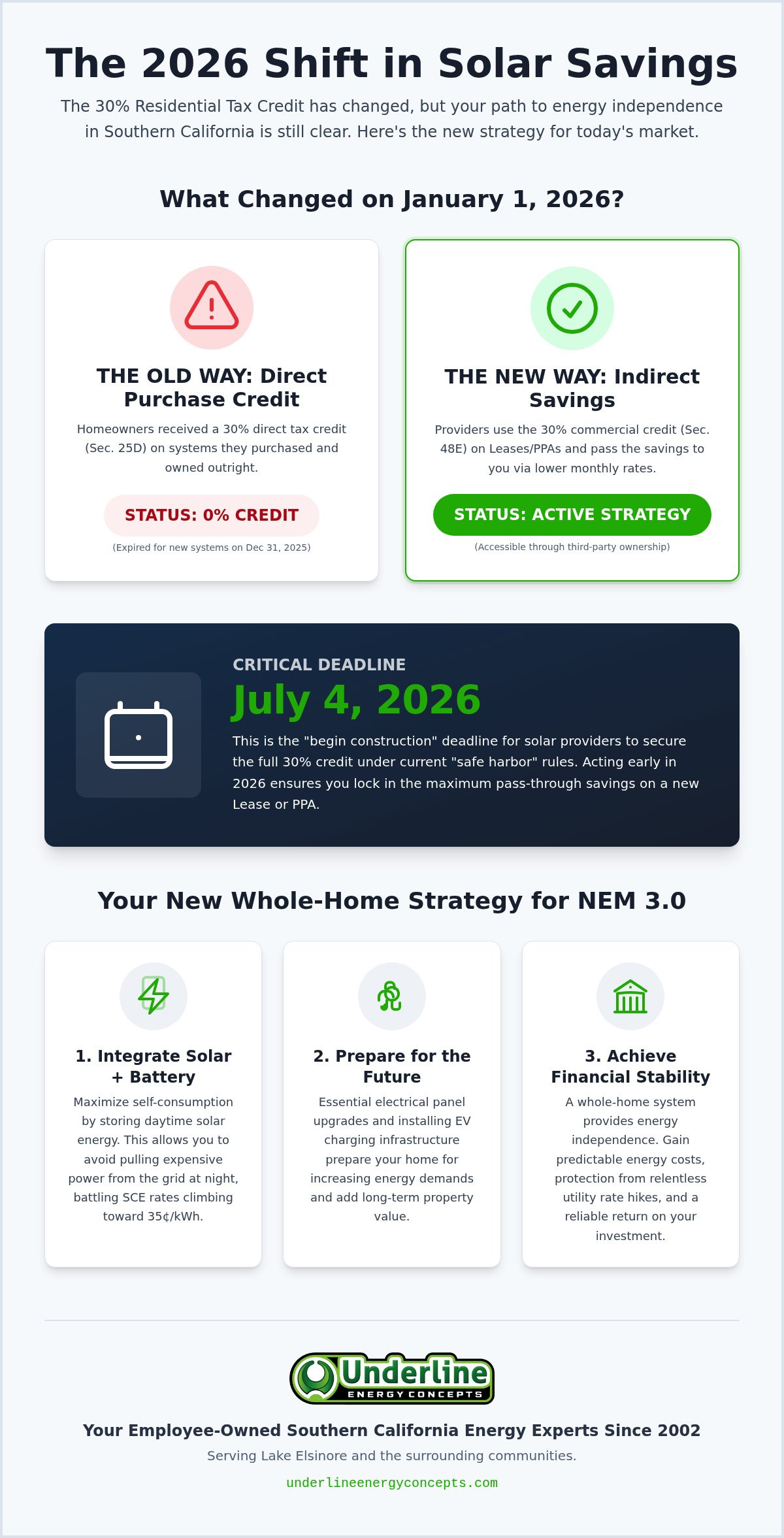
Many homeowners feel discouraged when they learn the direct solar tax credit for purchased systems has sunset. However, a powerful alternative remains active through Section 48E, the Commercial Investment Tax Credit. This provision allows solar developers and installers to claim a 30% credit on the systems they own and operate on residential rooftops. By choosing a lease or Power Purchase Agreement (PPA), you allow a third-party provider to capture this incentive and pass the savings directly to you through lower monthly energy costs.
This "indirect" benefit is often more accessible than the old purchase model. Under the previous Residential Clean Energy Credit rules, you needed significant tax liability to realize the full value of a tax credit. If you didn't owe the IRS enough, the credit sat unused. In 2026, third-party ownership removes this barrier. The solar provider uses their tax appetite to offset the equipment costs, which results in a lower starting rate for your home's power. It's a practical way to secure energy independence without waiting for a tax refund that might never come.
Timing is critical this year. For third-party systems to qualify for the full 30% credit under current "safe harbor" rules, the provider must have begun construction by July 4, 2026. Projects started after this date might face reduced incentives, which could lead to higher monthly payments for the homeowner. Acting early in the year ensures you lock in the maximum pass-through value before these federal windows tighten.
The Section 48E Advantage
The commercial credit offers a level of stability that direct homeowner credits often lacked. Because the solar company owns the equipment, they are highly motivated to ensure it performs at peak efficiency. Most third-party agreements include comprehensive maintenance, professional monitoring, and insurance at no extra cost. For retirees or households with fixed incomes in Lake Elsinore and the surrounding Riverside County area, this model provides predictable savings without the risk of unexpected repair bills. You gain the benefits of clean energy while the provider carries the technical and financial responsibility of system ownership.
Choosing Between Lease and PPA in 2026
Deciding between a lease and a PPA depends on how you prefer to pay for your power. A solar lease usually involves a fixed monthly payment for the equipment itself. A PPA allows you to pay only for the electricity the panels produce at a set price per kilowatt-hour. Both models leverage the commercial solar tax credit to keep your rates significantly lower than Southern California Edison’s current prices.
When reviewing these options, pay close attention to the annual escalator clauses. These determine how much your rate might increase over time. Because we've served Southern California since 2002, our team can help you run the numbers on these contracts. You can contact Underline Energy Concepts for a custom lease versus buy analysis to see which path offers the best long-term return for your specific property.
Beyond Panels: Credits for Batteries and Electrical Upgrades
While solar panels often take center stage, the true power of a 2026 energy strategy lies in the supporting hardware. Your home's ability to store power and manage high loads is what truly breaks the cycle of utility dependence. Even though the direct solar tax credit for homeowner-owned panels has expired, other federal incentives for energy efficiency still provide a path to lower net costs. Taking a whole-home approach ensures you don't just generate power, but you also preserve and optimize it for maximum financial benefit.
Battery Storage Credits and Resilience
The landscape for battery storage has shifted alongside panel incentives. For systems you own outright, the standalone credit under Section 25D has also hit 0%. However, if you choose a third-party ownership model as discussed earlier, the 30% commercial credit still applies to the battery hardware. This makes a Whole Home Battery backup more than just a safety net; it's a financially savvy move to combat the high export rates of NEM 3.0.
In Southern California, a battery is no longer a luxury. With SCE rates sitting near 35 cents per kilowatt-hour, storing your own midday solar power for evening use is the only way to avoid the most expensive time-of-use windows. We specialize in integrating Quietcool battery charge mounts to maximize this efficiency. These mounts ensure your storage system operates at peak performance, helping you maintain autonomy during grid outages or peak demand periods. For more details on the process, we invite you to consult our Whole Home Battery Backup Installation Guide.
Electric Panel Upgrades and HVAC Credits
Many older homes in Lake Elsinore and Riverside aren't equipped for the demands of a modern energy system. A 200 amp or 400 amp electric panel upgrade is often the first step toward true energy independence. These upgrades frequently qualify for the Energy Efficient Home Improvement Credit, which remains a viable tool for homeowners in 2026. Upgrading your electrical panel alongside a solar installation can qualify you for separate federal efficiency credits while ensuring your home safely handles the increased load of modern battery storage and EV charging.
Beyond the panel, consider your total home consumption. Hybrid water heaters and high-efficiency HVAC systems are essential components of a reduced energy footprint. When you bundle these upgrades with a solar project or a necessary roof repair, you create a cohesive system that preserves your home's value and lowers your monthly overhead. Our employee-owned team focuses on these long-term stability goals, ensuring every component from the attic insulation to the EV charger works in harmony. This comprehensive strategy protects your investment against future utility hikes while providing the comfort and safety your family deserves.
Southern California Solar Incentives: SCE Rebates and Local Perks
Federal tax laws set the baseline for your savings, but your utility provider and local municipality determine the real-world math of your investment. In Southern California, the shift to the Net Billing Tariff, often called NEM 3.0, has fundamentally changed how you should approach energy. Under these rules, the compensation you receive for sending excess solar power back to the grid is significantly lower than in previous years. This makes a whole home battery backup a non-negotiable component for any system installed in 2026. You don't just want to generate power; you need to store it to avoid SCE’s peak rates, which now hover around 34.5 cents per kilowatt-hour.
SCE Rebates and Financial Assistance
While broad federal incentives like the direct solar tax credit for purchased systems have changed, Southern California Edison continues to offer targeted programs. You can find specific opportunities to lower your costs through the SCE Rebates and Marketplace. These programs often focus on energy efficiency upgrades that complement your solar installation, such as hybrid water heaters or smart thermostats. Stacking these local rebates with remaining federal efficiency credits for electrical panel upgrades is a smart way to reduce your total project cost.
The Self-Generation Incentive Program (SGIP) remains a critical piece of the puzzle for battery storage. In 2026, general market funding is extremely limited, but significant rebates are still reserved for homeowners in high fire-threat districts or those with specific medical needs. Our team helps you determine if your property in Riverside County qualifies for these higher incentive tiers. We ensure your application is accurate and submitted quickly before local funding cycles close.
The 'Local Expert' Advantage in Riverside and Corona
Every community in the Inland Empire has unique requirements for clean energy projects. Homeowners in Menifee or Temecula often have the space for solar ground mounts, while residents in Corona or Lake Elsinore might prioritize high-efficiency roofing alongside their panels. Because Underline Energy Concepts is an employee-owned company based right here in Lake Elsinore, we understand the specific permitting processes for local building departments. We handle the paperwork and inspections so your project moves from design to activation without unnecessary delays.
Our 20 plus years of experience in the region also mean we know how to address local environmental challenges. We often recommend bundling solar with attic insulation or fire code ventilation upgrades to protect your home from the intense Southern California heat. These improvements don't just save money; they preserve the structural integrity of your roof and improve your indoor comfort. If you want to see which local perks and utility programs apply to your specific zip code, contact our local experts today for a comprehensive home energy assessment.
Maximizing Your Solar ROI in 2026 Without the 30% ITC
Waiting for a new federal solar tax credit to appear is a gamble that costs you money every single day. While the direct incentive for homeowner-owned systems has expired, the financial burden of staying on the grid has never been higher. With Southern California Edison rates sitting near 34.5 cents per kilowatt-hour, your utility bill is likely your most volatile household expense. Solar isn't just about tax checks anymore; it's about locking in a fixed energy cost that protects your family from future inflation.
The "Cost of Delay" is a real financial metric. Every month you spend paying retail utility rates is money that could have been used to pay down a solar asset. In growing real estate markets like Menifee and Murrieta, energy-efficient homes are becoming the standard. Buyers look for properties that offer relief from high SCE bills. By installing a system now, you protect your home's long-term value and position it as a premium asset in the competitive Southern California market.
The Real Math of Energy Independence
To calculate your true return on investment in 2026, you must look at the levelized cost of energy over the next 25 years. Grid power will continue to climb. By investing in high-quality components like REC Solar Panels and SolarEdge Inverters, you ensure your system produces the maximum amount of electricity possible. Efficiency is the new solar tax credit. The more power you generate and store, the less you rely on the utility, which shortens your payback period regardless of federal incentives.
Ongoing performance is just as important as the initial install. Regular solar cleaning and professional maintenance ensure your system hits its production targets year after year. We provide the technical expertise to keep your hardware running at peak efficiency, ensuring your ROI remains on track. When your system performs better, your savings grow faster.
Taking Control of Your Energy Future
Shift your mindset from chasing temporary government handouts to achieving permanent energy autonomy. Our employee-owned team at Underline Energy Concepts has been helping neighbors in Lake Elsinore and the surrounding region since 2002. We don't just install panels and disappear. We provide the maintenance and long-term support needed to keep your system performing for decades. Because we are owned by the people who do the work, our commitment to your home's stability is personal.
Don't let another high summer bill catch you off guard. Take the first step toward a predictable energy future. Schedule your 2026 energy audit and solar consultation today to see exactly how much you can save by making the switch.
Take Control of Your Energy Independence Today
The 2026 energy landscape requires a smarter, more holistic approach than simply chasing a single tax check. By leveraging indirect benefits from the solar tax credit via third-party ownership and prioritizing battery storage to combat rising utility rates, you can still achieve significant financial relief. Focusing on whole-home efficiency ensures your investment remains stable and productive as external economic pressures continue to shift.
Underline Energy Concepts has served Southern California since 2002 as a licensed roofing, electrical, and general contractor. Because we're employee-owned and operated, we take personal pride in providing the education and quality workmanship our neighbors deserve. We're here to help you navigate these regulatory changes and build a system that delivers genuine energy autonomy for your family.
The path to lower bills and a more resilient home starts with a single conversation. We look forward to being your partner in this journey toward long-term stability and environmental responsibility.
Frequently Asked Questions
Is the federal solar tax credit still available for Southern California homeowners in 2026?
No, the direct residential solar tax credit for homeowner-owned systems, known as Section 25D, expired on December 31, 2025. However, you can still access a 30% benefit indirectly through solar leases or Power Purchase Agreements (PPAs). Under these third-party ownership models, the solar provider claims the commercial credit and passes the savings to you through significantly lower monthly energy payments.
Can I still get a tax credit for home battery backup systems like the Tesla Powerwall?
If you purchase a battery backup system outright in 2026, it no longer qualifies for a direct federal tax credit. To secure a 30% incentive on storage hardware this year, the battery must be part of a third-party owned solar system. This remains the most effective way for Lake Elsinore residents to offset upfront costs while maximizing savings under California's current net billing rules.
What is the difference between Section 25D and Section 48E tax credits?
Section 25D was the residential credit for systems owned by the homeowner, which has now sunset. Section 48E is the commercial investment credit available to businesses that own solar assets. In 2026, homeowners utilize Section 48E by partnering with a solar developer who owns the equipment. This allows the provider to claim the credit and reduce your overall energy costs through a lease or PPA.
How do I claim a solar tax credit if I lease my panels instead of buying them?
You don't actually file for the solar tax credit yourself when you lease panels. The solar provider, as the legal owner of the equipment, claims the 30% commercial credit on their own tax returns. They then pass through this value to you by lowering your monthly lease or PPA rate. This removes the requirement for you to have a large tax liability to see the financial benefits.
Do electric panel upgrades qualify for any federal tax incentives in 2026?
Yes, electric panel upgrades often qualify for the Energy Efficient Home Improvement Credit. This incentive is separate from solar-specific credits and encourages homeowners to modernize their electrical systems for high-efficiency appliances and EV charging. Upgrading to a 200 amp or 400 amp panel ensures your home is safe and ready for a comprehensive energy strategy while potentially reducing your net project costs through these separate federal incentives.
Can I carry forward my unused solar tax credit from 2025 into the 2026 tax year?
Yes, if you installed solar before the 2025 deadline and had a credit amount that exceeded your tax liability, you can carry that balance forward. The IRS allows you to apply unused portions of your previous solar tax credit to future tax years. We recommend reviewing your past Form 5695 filings with a tax professional to confirm the exact amount available to reduce your 2026 tax burden.
Are there specific solar rebates for SCE customers in Riverside County?
There are no broad, general solar rebates for all SCE customers in 2026, but targeted programs remain. The Self-Generation Incentive Program (SGIP) provides rebates for battery storage to homeowners in high fire-threat areas or those with specific medical needs. Additionally, low-income residents in specific Riverside County communities may qualify for the DAC-SASH program, which offers incentives of $3 per watt for qualifying solar installations.
What happens to my solar tax credit if I sell my home in Murrieta or Temecula?
If you previously claimed a credit for an owned system, that tax benefit stays with you even after the sale. For leased systems in Murrieta or Temecula, you typically transfer the lease agreement to the new buyer. This allows the new homeowner to take over the lower monthly payments and benefit from the indirect tax savings already baked into the contract, which often increases the home's market appeal in Southern California.