
Whole Home Battery vs Generator: Which Backup is Best for Southern California in 2026?
/
Article by
Jesse Malone
Jesse Malone
CEO & Partner, Underline Energy Concepts
Jesse Malone is the CEO and Partner of Underline Energy Concepts, a Southern California energy services company that has been serving homeowners since 2002. Since joining the company and becoming a partner in approximately 2015, Jesse has helped lead its growth into one of Southern California’s most trusted providers of residential energy efficiency and home improvement solutions.
Throughout his tenure, Jesse and the Underline Energy team have completed more than 2,500 energy upgrade projects for homeowners across Southern California. These projects include solar energy systems, roofing, battery storage, EV charging stations, electrical panel upgrades, water heater replacements, attic insulation, retrofit windows, and other energy-efficient home improvements designed to lower utility costs and increase property value.
Jesse holds a Bachelor’s Degree from California Southern University and brings more than 20 years of experience in emergency services through his service with the fire department. His background in public service has shaped his leadership style, emphasizing integrity, accountability, safety, and a commitment to serving the community.
A lifelong advocate for efficiency and practical solutions, Jesse is passionate about helping homeowners make informed decisions that improve both their homes and their financial future. His interests extend beyond energy efficiency into financial literacy, budgeting, investing, and long-term wealth-building strategies. He believes that reducing unnecessary expenses and maximizing efficiency are key components of financial success.
As CEO, Jesse continues to focus on delivering exceptional customer experiences, building high-performing teams, and helping Southern California homeowners achieve greater comfort, energy independence, and long-term savings through smart home investments.
If you had to choose between an emergency backup that sits idle 99% of the year and a smart asset that lowers your bills every single day, which would you pick? Most Southern California homeowners are asking this exact question as they face the reality of a fragile grid and skyrocketing utility costs. You likely feel the mounting pressure of SCE rates that have climbed to an average of 34.4 cents per kWh, combined with the annual anxiety of wildfire season power shutoffs. It's exhausting to pay more for less reliability.
As your local, employee-owned energy partner based in Lake Elsinore, we're here to help you regain control. This guide settles the whole home battery vs generator debate by analyzing the performance of both systems in the current 2026 market. You'll learn how the expiration of federal tax credits and the shift to NEM 3.0 have changed the math for local families. We compare the daily savings, long-term maintenance, and emergency reliability of these two distinct technologies to help you find the perfect energy security for your home.
Key Takeaways
- Understand the fundamental shift from simple power generation to smart energy storage and how each technology integrates with your existing solar setup.
- Evaluate the long-term financial impact of a whole home battery vs generator, including hidden costs like fuel, maintenance, and utility bill offsets under NEM 3.0.
- Learn why a 200 amp or 400 amp electric panel upgrade is the essential foundation for any reliable whole-home backup system in Southern California.
- Discover how to navigate local noise ordinances and permitting requirements in communities like Corona and Temecula to ensure a compliant installation.
- Identify the specific reliability benefits of an "indefinite backup" loop that allows your home to recharge and remain powered during extended wildfire-related shutoffs.
Home Battery vs Generator: Understanding the Core Technology
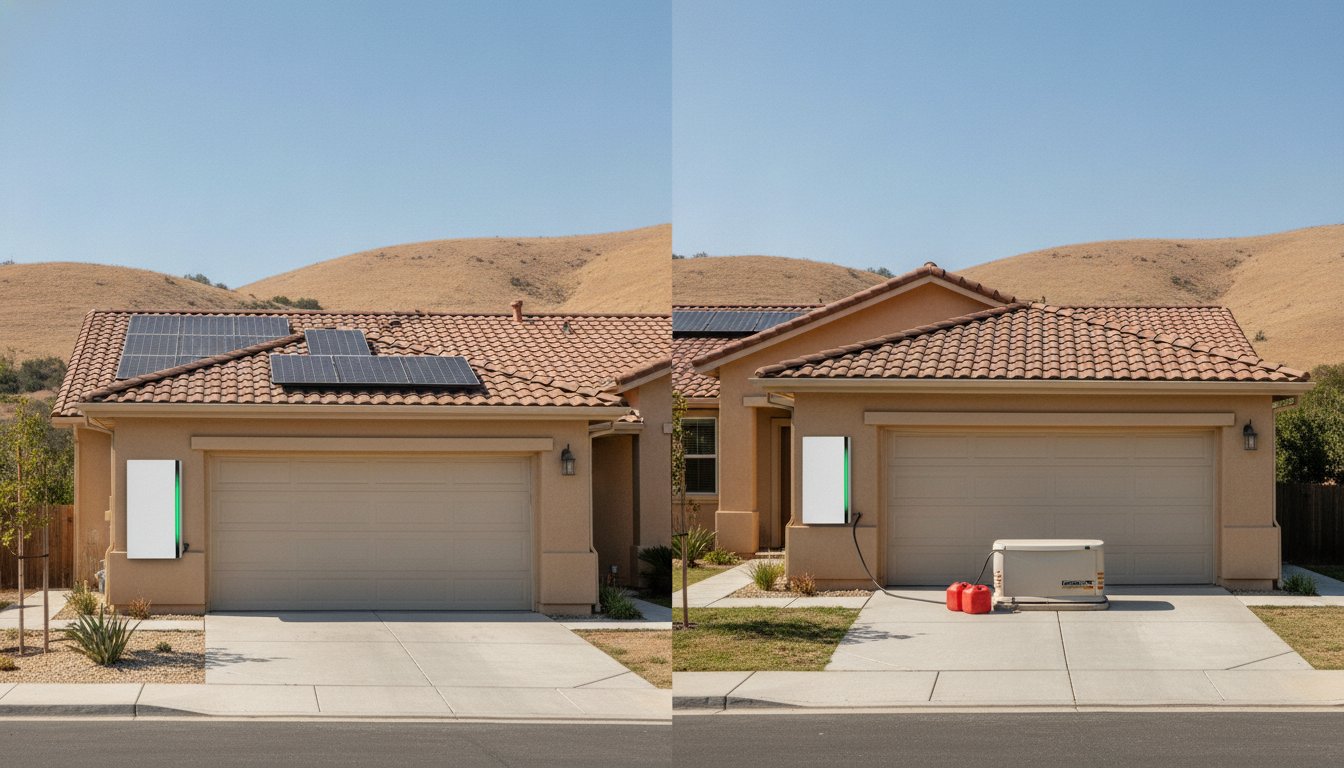
The primary choice in the whole home battery vs generator debate comes down to whether you want to produce power or store it. A generator creates electricity on the spot using an engine and a fuel source. A battery stores electricity you've already harvested from the sun or the grid. In Southern California, this distinction is critical because our environment offers an abundance of one resource (sunlight) while often restricting the other (fuel) during regional emergencies.
To keep your home running when the grid goes down, both systems use a transfer switch to perform a process called "islanding." This safely disconnects your home from the utility lines so you don't backfeed power into the grid while crews are working. For a battery, this transition is nearly instantaneous. For a generator, there's a mechanical process involved. Understanding these mechanics helps you choose the right level of protection for your family's needs.
What is a Whole Home Battery Backup?
Modern home energy storage systems typically use lithium-ion technology to manage your daily power needs. These units don't just sit waiting for an outage; they work every day to help you avoid SCE's expensive 4 PM to 9 PM peak rates. Your solar panels charge the battery during the afternoon, and the battery powers your home once the sun sets. Solar-plus-storage acts as a decentralized power plant for your home. This creates a self-sustaining loop where your home recharges itself every morning, providing a level of independence that traditional systems simply can't match.
How Does a Backup Generator Work?
Standby generators rely on internal combustion engines fueled by natural gas, liquid propane, or diesel. When the power fails, the system detects the loss, cranks the engine, and begins generating electricity. This process creates a brief delay, often called the "flicker," where your home stays dark for 10 to 30 seconds before the power returns. It's a reliable method for generating massive amounts of power, but it comes with a mechanical cost.
While generators provide high output, they face unique challenges in Southern California. During regional disasters or Public Safety Power Shutoffs (PSPS), natural gas lines can be throttled for safety. Local gas stations often lose power during these events too, making it difficult to refill propane or diesel tanks if an outage lasts more than a day. Additionally, the mechanical nature of a generator requires regular "exercise" cycles and professional maintenance to ensure the engine doesn't seize after months of sitting idle.
Financial Analysis: Upfront Costs vs. 10-Year ROI
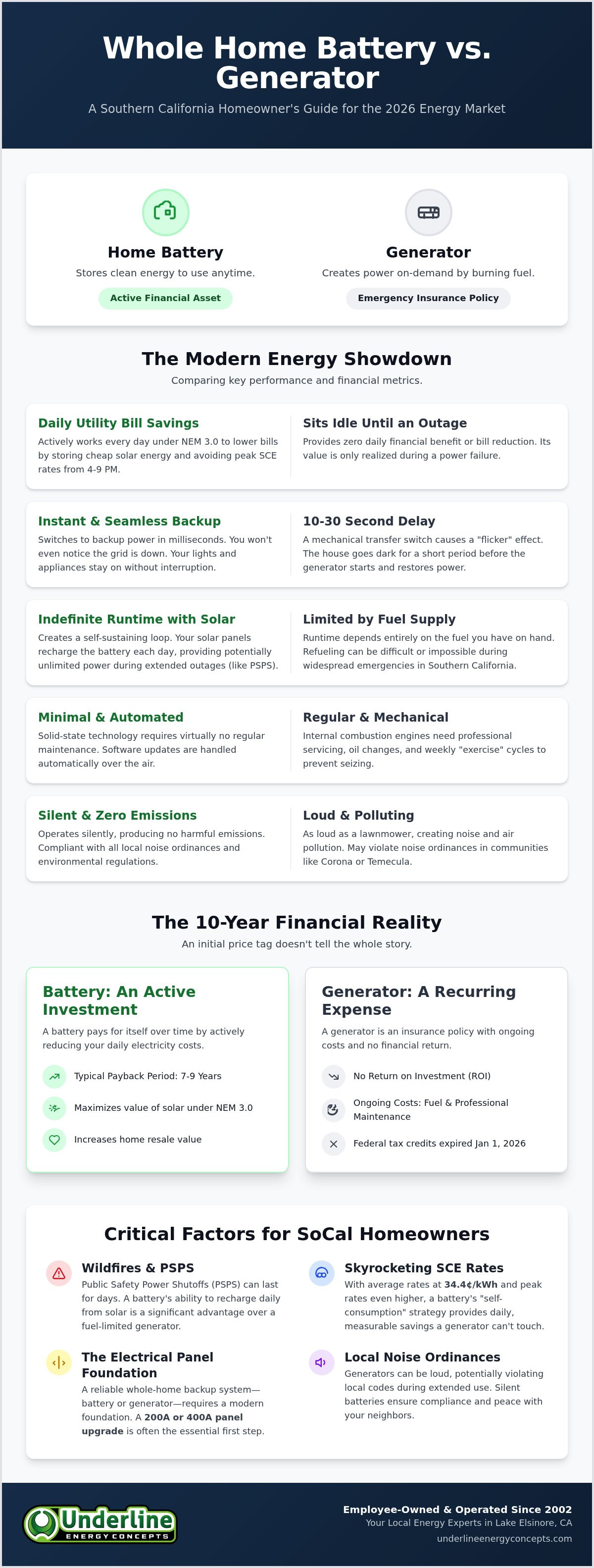
Deciding between a whole home battery vs generator requires looking past the initial price tag to see the long-term financial trajectory. A generator is essentially "dead money." It's an insurance policy that only provides value during an outage. In contrast, a battery system is an active financial asset. While the entry point for a battery is often higher, its ability to offset daily utility costs creates a return on investment that a generator simply can't match. By 2026, the financial landscape has shifted significantly, making it vital to understand how these systems pay for themselves or drain your wallet over a decade.
It's also important to recognize that as of January 1, 2026, the 30% federal tax credit for homeowner-purchased clean energy systems has expired. This change places a greater emphasis on the daily operational savings and state-level incentives for zero-emissions backup power options. Without that federal cushion, the decision rests on which system works harder for your bottom line every single month.
The Daily Earning Power of Batteries
Under the current NEM 3.0 rules, the value of the solar energy you export to the grid has dropped by roughly 75%. Sending power back to SCE for a measly 5 to 8 cents per kWh while they charge you over 34 cents is a losing game. A battery changes the math by allowing for "self-consumption." You store your midday solar production and use it during the expensive 4 PM to 9 PM peak window. This strategy effectively "earns" you the difference in utility rates every day. For a deeper dive into the logistics, check out our Whole Home Battery Backup Installation Guide. This daily utility hacking often leads to a payback period of 7 to 9 years, whereas a solar-only system might take 13 years to break even.
The Depreciation of a Standby Generator
A generator never pays a dividend. Beyond the purchase price, you face significant "hidden" costs that accumulate over ten years. You'll pay for monthly exercise runs to keep the engine lubricated and professional maintenance to ensure it starts when you need it. During a multi-day Public Safety Power Shutoff (PSPS), fuel costs can skyrocket, especially if you're relying on propane or diesel. Because 60% of a generator's project cost goes toward installation, permits, and gas lines, you're investing heavily in infrastructure that depreciates the moment it's bolted to the concrete pad. If you're ready to see how these numbers apply to your specific roof and electrical panel, we invite you to speak with one of our employee-owners today.
Reliability and Performance in Southern California
When evaluating a whole home battery vs generator, reliability isn't just about the moment the lights flicker. It's about day three of a Public Safety Power Shutoff (PSPS) in Temecula or Menifee. While a generator is a powerhouse, its reliability is tethered to a physical fuel supply. A battery system, when paired with solar, offers a different kind of endurance. It transforms your home into a self-sustaining island that doesn't rely on outside deliveries to keep the refrigerator running.
As a local, employee-owned team based in Lake Elsinore, we've seen how regional disasters can disrupt even the best-laid plans. Choosing between these technologies requires looking at how they perform under the specific pressures of the SoCal climate, from extreme heatwaves to wildfire-related grid instability.
Managing Long-Term Outages
Wildfire season often brings road closures and restricted access. If your generator runs on propane or diesel, you're one tank away from a dark house if the delivery truck can't reach you. Even natural gas lines can be throttled or shut off during seismic events or high-risk fire windows to prevent explosions. A battery system thrives in these scenarios. Your solar panels act as a fuel pump for your battery, replenishing your storage every time the sun comes up. To maximize this, you can use a smart panel to prioritize essential loads like medical devices and refrigeration. This ensures your most critical needs are met indefinitely, regardless of how long the utility company keeps the power off.
The Quiet Factor: Noise and Community Living
Living in a tight-knit community like Canyon Lake or Corona means your energy choices affect your neighbors. A standby generator can roar at 65 to 75 decibels, which is similar to a loud vacuum cleaner running constantly in your side yard. This often triggers HOA complaints or local noise ordinance violations, especially during overnight outages. Batteries operate in total silence. There are no fumes, no vibrations, and no localized smog. This silent operation pairs perfectly with a Whole House Fan. You can use your stored energy to run a Quietcool system during the cool evening hours, purging heat from your home without the deafening drone of a gas engine in the background.
Maintenance is the final piece of the reliability puzzle. Generators are mechanical machines with spark plugs, oil, and filters that require regular attention. If you skip a service, the engine might seize when you need it most. Batteries are solid-state technology with no moving parts. They offer a "set it and forget it" experience that provides peace of mind without the greasy upkeep. It's a cleaner, quieter, and more predictable way to protect your home.
Installation Requirements: Panels, Roofs, and Permits
When deciding on a whole home battery vs generator, many homeowners overlook the backbone of their energy system: the main electrical panel. Your existing panel acts as the gateway for all power entering your home. If it's outdated or undersized, it can't safely manage the high-current demands of a modern backup system. This is especially true for older homes in established Riverside County neighborhoods that still operate on 100-amp service. Without the right infrastructure, even the most advanced backup system won't function correctly.
Our team at Underline Energy Concepts has been serving Southern California since 2002. We've seen firsthand how an inadequate electrical foundation can stall a project. Because we are licensed in roofing, electrical, and general contracting, we look at your entire home as a single, integrated system. This ensures that your backup solution is not only powerful but also compliant with every local building code.
The Critical Role of the Electric Panel
A standard 100-amp panel is rarely sufficient for a whole-home backup solution. If you notice flickering lights when your AC kicks on or see crowded breakers with no room for new circuits, your panel is likely a bottleneck. We frequently recommend a 200 amp or 400 amp electric panel upgrade to ensure your home can handle the simultaneous load of charging a battery or starting a generator while running your daily appliances. For a detailed breakdown of what to expect during this process, read our guide on the Cost of Electric Panel Upgrade for Solar. In some cases, we can also install a smart sub-panel to help you shed non-essential loads, which significantly extends your battery life during a prolonged outage.
Permits and Local Regulations
Navigating the building departments in the City of Lake Elsinore or Murrieta requires local expertise. California has strict fire safety codes regarding the placement of lithium-ion batteries. These regulations often dictate specific clearance distances from windows, doors, and vents to ensure your family stays safe. Similarly, standby generators must meet specific setback requirements and exhaust venting rules to comply with local ordinances. Attempting a DIY installation or hiring an unlicensed contractor can void your equipment warranty and lead to insurance claim denials if a failure occurs.
Because we are employee-owned and operated, our technicians take personal pride in every permit we pull and every wire we pull. We ensure that any roof-mounted solar components or exterior equipment pads are integrated perfectly with your home's structure to prevent leaks and preserve your property value. If you want to ensure your home's infrastructure is ready for the future, schedule a professional panel and roof inspection with our local team today.
The Underline Advantage: Specialized SoCal Energy Solutions
Choosing between a whole home battery vs generator isn't just a technical decision; it's a long-term partnership. Many national solar companies sub-contract their electrical work or roofing repairs to the lowest bidder. This often leads to a "finger-pointing" game if a leak occurs or a breaker trips. At Underline Energy Concepts, we eliminate that risk. We are a local, brick-and-mortar company based in Lake Elsinore, and we've served the Inland Empire since 2002. Our employee-owned structure means the technician at your door has a personal stake in the quality of your installation and the longevity of your system.
We provide a unique "one-stop" benefit by holding licenses in roofing, electrical, and general contracting. This comprehensive expertise allows us to perform customized energy audits that look at your home as a complete ecosystem. We don't just sell equipment; we optimize your entire property for energy independence. Whether you need a 400-amp panel upgrade to support a massive backup system or a minor roof repair before mounting panels, our team handles it all under one roof.
Quietcool Battery Charge Mounts
Space and efficiency are often the biggest hurdles when installing backup power in Southern California. To solve this, we specialize in Quietcool battery charge mounts. These specialized mounting solutions allow for a cleaner, more organized installation that maximizes your available wall or floor space. By utilizing these mounts, we ensure your battery system remains accessible for maintenance while maintaining a professional aesthetic that preserves your home's value. Integrating these mounts into your comprehensive energy plan ensures that your storage system is both physically secure and thermally optimized for our high Inland Empire temperatures.
Local Service and Long-Term Reliability
Working with a local partner means you aren't just a number in a database. If you have a question about your warranty or need a system check after a major storm, you can reach our Lake Elsinore office directly. We've spent over two decades building a reputation for reliability in communities like Temecula, Murrieta, and Menifee. We believe in the power of local connections, which is why we've developed the Underline Referral Program. It's our way of encouraging Southern California neighbors to help each other achieve energy autonomy while being rewarded for building a more resilient community.
Our commitment to you doesn't end when the final permit is signed. We provide the ongoing support and education you need to navigate changing utility landscapes. As your energy needs evolve, from adding an EV charger to upgrading your attic insulation, we remain your grounded, local expert in the home energy sector.
Take Control of Your Home's Energy Future
Deciding on a whole home battery vs generator is about more than just backup power; it's about choosing between a passive expense and an active investment. While a generator provides reliable emergency coverage, a battery system works for you every day by offsetting high SCE rates and maximizing your solar production under NEM 3.0. Success starts with a solid foundation, which often includes a 200 amp or 400 amp electric panel upgrade to handle your home's modern demands.
As an employee-owned and operated company serving Southern California since 2002, we understand the specific grid challenges in the Inland Empire. We hold licenses as roofing, electrical, and general contractors, ensuring your installation is seamless from the roof to the panel. Our local technicians take personal pride in every project, providing the quality workmanship you expect from a community partner. You don't have to navigate these technical decisions alone. We're here to help you find a solution that protects your family and your wallet.
Schedule your free Southern California energy audit and backup consultation today. We're ready to help you build a more resilient, cost-effective home for the years ahead.
Frequently Asked Questions
Is a whole home battery better than a generator for power outages?
It depends on your specific goals, but batteries are generally superior for the frequent, shorter outages common in Riverside County. A battery provides an instant transition with zero noise or emissions, ensuring your electronics stay powered without a "flicker." While generators can handle massive loads for days, batteries paired with solar create a self-sustaining loop that recharges daily without needing external fuel deliveries during a regional wildfire crisis.
Can a battery backup run my air conditioner in Southern California?
Yes, a properly sized battery system can run your air conditioner, but it requires careful management of your "essential loads." High-draw appliances like central AC units consume significant power, so we often recommend a 200 amp or 400 amp electric panel upgrade to manage the startup surge. Using a whole house fan alongside your battery can also reduce the cooling load, allowing your backup power to last much longer. To see how professionals approach these complex electrical and air conditioning challenges, you can find out more from Redlec Energy Solutions.
A home battery can potentially last indefinitely if paired with solar, whereas a generator is strictly limited by its fuel supply. During a Public Safety Power Shutoff (PSPS) event, solar panels recharge the battery every morning, providing a continuous cycle of power for critical needs. A generator typically runs for 24 to 48 hours on a single tank of propane, which is a liability if road closures prevent refills.
Do I need solar to have a whole home battery backup?
You don't strictly need solar to install a battery, but it's highly recommended to maximize your financial return. Without solar, the battery can only charge from the grid, which limits its usefulness during long-term outages. When you compare a whole home battery vs generator, the solar integration is the "game changer" that allows for true energy independence and protects you from SCE's rising peak-hour electricity rates every day.
What are the maintenance differences between batteries and generators?
Batteries are virtually maintenance-free, while generators require regular mechanical upkeep to remain reliable. A generator is an internal combustion engine that needs oil changes, filter replacements, and monthly "exercise" runs to stay operational. If a generator sits idle for too long, the engine can seize or the fuel can degrade. Modern home batteries are solid-state systems with no moving parts, offering a reliable, "set it and forget it" solution.
Are there local SCE rebates for home battery installations in 2026?
Rebate availability fluctuates, so you should check the SCE marketplace for the most current opportunities available in 2026. While the 30% federal tax credit expired at the end of 2025, California continues to prioritize energy storage through various state-level programs. As your local energy partner, we help you navigate these shifting incentives to ensure you capture every available dollar while upgrading your home's resilience and long-term property value.
Can I install a backup generator if I have a solar panel system?
Yes, you can integrate a generator with your solar system, but it requires specialized transfer switches to ensure the two systems don't conflict. This setup is often more complex than a whole home battery vs generator choice because the generator cannot recharge from the sun. Most homeowners find that adding a battery to their solar array is a more efficient way to create a seamless, self-sustaining energy loop.
How much noise does a whole-home standby generator actually make?
A typical standby generator produces between 65 and 75 decibels of noise, which is comparable to a loud vacuum cleaner running in your side yard. This constant drone can be disruptive in quiet neighborhoods like Menifee or Temecula, especially during overnight outages. In contrast, battery systems are completely silent. This makes batteries the preferred choice for homeowners who want to maintain peace and quiet for themselves and their neighbors.