
California Solar Incentives 2026: The Complete SoCal Homeowner’s Guide
/

Article by
Jesse Malone
Jesse Malone
CEO & Partner, Underline Energy Concepts
Jesse Malone is the CEO and Partner of Underline Energy Concepts, a Southern California energy services company that has been serving homeowners since 2002. Since joining the company and becoming a partner in approximately 2015, Jesse has helped lead its growth into one of Southern California’s most trusted providers of residential energy efficiency and home improvement solutions.
Throughout his tenure, Jesse and the Underline Energy team have completed more than 2,500 energy upgrade projects for homeowners across Southern California. These projects include solar energy systems, roofing, battery storage, EV charging stations, electrical panel upgrades, water heater replacements, attic insulation, retrofit windows, and other energy-efficient home improvements designed to lower utility costs and increase property value.
Jesse holds a Bachelor’s Degree from California Southern University and brings more than 20 years of experience in emergency services through his service with the fire department. His background in public service has shaped his leadership style, emphasizing integrity, accountability, safety, and a commitment to serving the community.
A lifelong advocate for efficiency and practical solutions, Jesse is passionate about helping homeowners make informed decisions that improve both their homes and their financial future. His interests extend beyond energy efficiency into financial literacy, budgeting, investing, and long-term wealth-building strategies. He believes that reducing unnecessary expenses and maximizing efficiency are key components of financial success.
As CEO, Jesse continues to focus on delivering exceptional customer experiences, building high-performing teams, and helping Southern California homeowners achieve greater comfort, energy independence, and long-term savings through smart home investments.
If you're still waiting for the "perfect time" to go solar, that window just shifted under your feet. The era of simple rooftop panels is over, replaced by a storage-first reality that requires a much smarter strategy. We all know the frustration of watching SCE bills climb while the rules for NEM 3.0 make the old way of doing things feel like a losing game. It's exhausting to keep track of which California solar incentives are still active and which have vanished into a waitlist.
As an employee-owned company based in Lake Elsinore, Underline Energy Concepts has helped Southern California neighbors navigate these shifts since 2002. You'll discover how to maximize your savings by stacking the remaining local utility perks and state battery programs available in 2026. While the residential federal tax credit for owners has expired, we'll show you how third-party models still capture that 30% break to lower your monthly costs. This guide provides a clear path to energy independence and a solid ROI. We'll explore why battery backup is now your biggest financial asset and how to lock in your property tax exclusion before the 2027 deadline. It's time to take control of your home's power and stop overpaying for the grid.
Key Takeaways
- Learn why pairing solar with whole-home battery backup is essential to maximize your energy savings under the current Solar Billing Plan.
- Understand how to leverage third-party models to capture 30% savings on your system now that residential California solar incentives have shifted.
- Lock in your property tax exclusion before January 1, 2027, to ensure your new solar and storage system doesn't increase your annual tax bill.
- Discover how to stack solar incentives with other necessary home upgrades like roofing and electrical panel improvements for maximum financial impact.
- See how working with a local expert to manage your "Permit-to-Operate" ensures you don't miss out on critical utility incentives.
The State of California Solar Incentives in 2026
California's energy policy has entered a new chapter. The California Public Utilities Commission (CPUC) designed the current Solar Billing Plan to push the state toward a more resilient grid. This means the Solar power in California market now prioritizes how you store energy rather than just how much you produce. As an employee-owned team based in Lake Elsinore, we've guided homeowners through every regulatory hurdle since 2002. We know that while the rules have changed, the opportunity for energy independence remains stronger than ever. Understanding the current California solar incentives is the first step toward reclaiming control over your utility costs.
NEM 3.0: Understanding the Solar Billing Plan
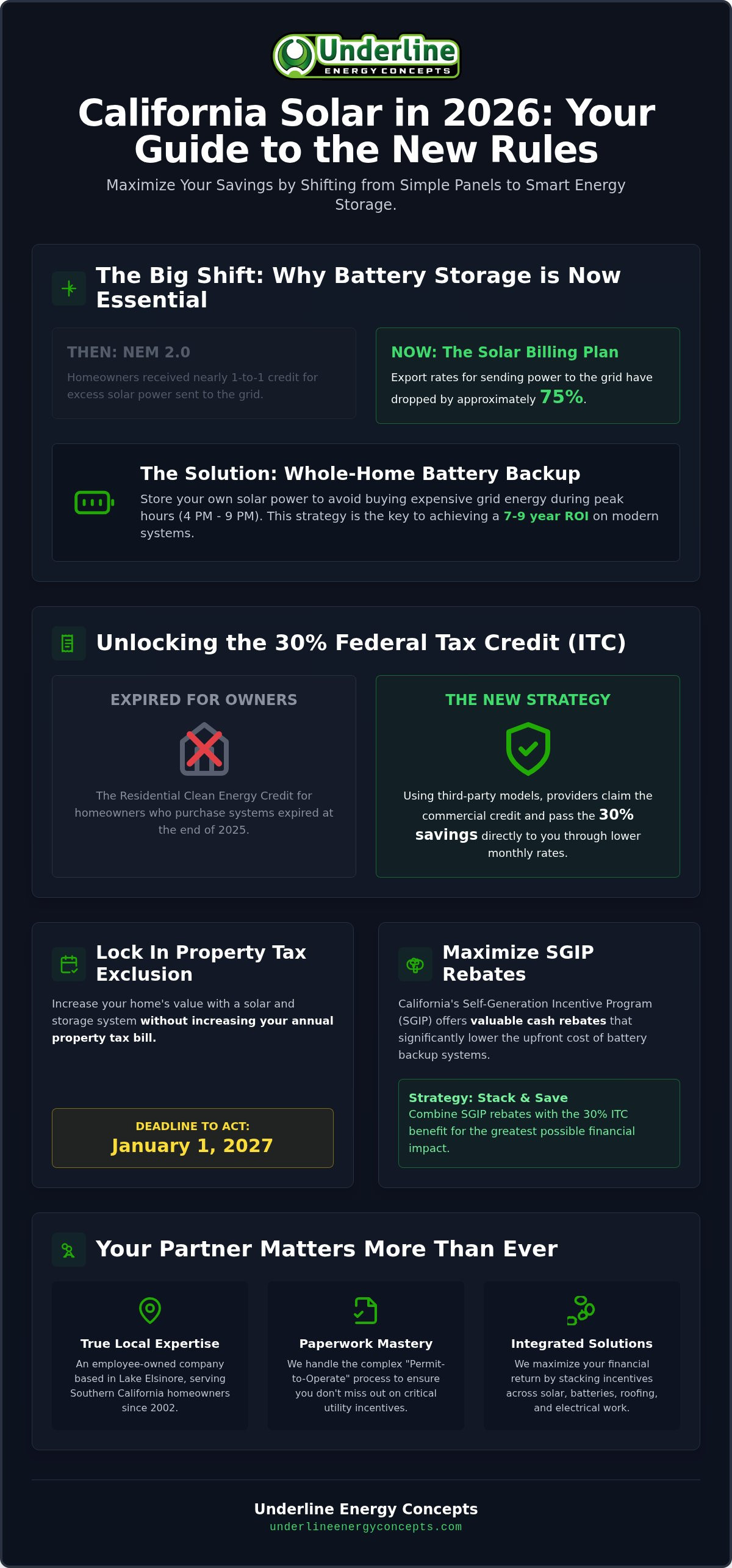
Southern California Edison (SCE) customers in Riverside and Temecula now operate under Net Billing. Under the old NEM 2.0 rules, you could send excess power to the grid and receive a nearly one-to-one credit on your bill. Today, the export rate has dropped by about 75 percent. This shift makes whole home battery backup a necessity rather than a luxury upgrade. By storing your midday solar production, you avoid buying expensive power from SCE during the 4 PM to 9 PM peak window. This "self-consumption" strategy is the primary driver for achieving a 7 to 9 year ROI on modern systems despite the lower export rates. You aren't just generating power; you're managing it to beat the utility at its own game.
The 2026 Incentive Landscape
The 2026 incentive structure focuses on "market transformation." Direct state cash rebates for panels are largely a thing of the past because the technology is now a standard home improvement. Instead, current California solar incentives emphasize grid reliability and peak-load reduction. While the direct residential federal tax credit for owners expired at the end of 2025, many homeowners now utilize third-party ownership models. These allow providers to claim the commercial ITC and pass those 30 percent savings directly to you through lower monthly rates.
Local utility programs and state-level exclusions also play a massive role in your total savings. For example, your solar and storage installation is currently excluded from property tax assessments through the end of 2026. This prevents your home's value increase from triggering higher annual taxes. When you combine these tax breaks with the long-term utility savings, the financial logic for switching to solar remains undeniable. We help you navigate these layers to ensure no money is left on the table.
The 30% Federal Investment Tax Credit (ITC)
The landscape of California solar incentives changed significantly on January 1, 2026. For homeowners who directly own their systems, the Residential Clean Energy Credit (Section 25D) officially expired at the end of 2025. While this shift feels sudden, it hasn't removed the 30% savings from the table. Instead, the focus has shifted toward third-party ownership models. Under these arrangements, solar providers utilize the commercial tax credit (Section 48E) and pass that value to you through lower monthly rates. This ensures you still benefit from a 30% reduction in system costs without needing to manage the tax liability yourself.
It's vital to work with a local partner who understands these nuances. We ensure every component of your installation, from the panels and racking to the labor and integrated storage, is documented correctly. This documentation is essential for your provider to claim the credit and secure your lower rate. If you're carrying over a credit from a 2025 installation, those funds remain available to offset your future tax liability. Since tax laws are complex, we always recommend consulting a tax professional to maximize this specific incentive for your household.
Battery Storage and the ITC
One of the most important updates in the current landscape is that standalone battery storage now qualifies for the full 30% credit through these third-party models. Adding a high-performance solution like the SolarEdge Home Battery is a smart move for maximizing your savings. These systems capture excess midday energy and protect your home during grid outages. When integrated with state programs like California’s SGIP, the combination of federal and state support significantly lowers the barrier to energy independence. Even battery charge mounts and specialized backup systems fit into these federal definitions when installed as part of your energy solution.
Bundling Electrical Upgrades
Many older homes in Riverside and San Diego counties require a 200 amp or 400 amp panel upgrade to support modern solar and storage systems. When these upgrades are necessary for the solar installation, they are often bundled into the total project cost. This allows the 30% credit to apply to the electrical work as well. Our team at Underline Energy Concepts handles the entire process, from the initial electrical assessment to the final inspection. We specialize in documenting electrical work for incentive compliance to ensure your system meets all federal requirements. If you're curious about how your home’s wiring might affect your eligibility, reach out to us for a personalized consultation. We'll help you build a system that's safe, compliant, and optimized for maximum financial benefit.
California’s SGIP: Rebates for Battery Backup
The Self-Generation Incentive Program (SGIP) has historically been a cornerstone of storage adoption. As of August 2026, the landscape for these California solar incentives has evolved into a more targeted model. Currently, the General Market and Equity Resiliency budgets are closed to new applications. The primary pathway remaining is the income-qualified Residential Solar and Storage Equity (RSSE) budget, which currently operates on a waitlist-only basis. Even with these limitations, the program remains a vital part of the state's plan to build a more resilient grid. As a local, employee-owned team based in Lake Elsinore, we stay vigilant regarding these funding shifts to ensure our neighbors are always positioned for the best possible outcome.
To qualify for SGIP support, batteries must be grid-tied and "smart," meaning they can communicate with the utility to provide support during peak demand. This program was designed to make energy storage financially accessible, particularly for those who need it most. While the state works through current budget cycles, the technical requirements for these systems remain a standard for quality installations across Southern California.
Qualifying for SGIP in Southern California
Qualification for the highest rebate tiers, such as the RSSE budget, often depends on income levels or location within disadvantaged communities. Previously, the Equity Resiliency tier offered significant support to those in High Fire Threat Districts (HFTDs) throughout Riverside County. We still encourage customers to document their eligibility, especially those on a medical baseline. This preparation is essential because your contractor must manage the entire filing process. We handle the paperwork to ensure that if funding levels change or new budgets open, your application is ready to move forward immediately.
Battery ROI with SGIP
Investing in a whole home battery backup provides a return on investment that goes far beyond a simple rebate check. The real financial gain comes from daily "load shifting" to avoid SCE’s high Time of Use (TOU) rates. By using your stored solar power during the 4 PM to 9 PM peak window, you stop buying the most expensive electricity the utility sells. When available, SGIP rebates can range from $150/kWh to as much as $1,100/kWh for the RSSE tier, which dramatically shortens your payback period.
Autonomy is the ultimate goal. Southern California families frequently deal with Public Safety Power Shutoffs (PSPS) during high-wind events. A smart battery system provides the peace of mind that your home will remain functional when the grid goes dark. We focus on building systems that offer this long-term stability, protecting your family and your budget from external pressures.
Stacking Incentives: Roofing, Windows, and Energy Efficiency
Maximize your investment by thinking beyond the roof. True energy autonomy comes from an efficient home, not just a powerful solar array. By stacking various California solar incentives with energy efficiency upgrades, you reduce your total project cost and increase your property's long-term value. One of the most significant benefits is the Active Solar Energy System Exclusion. This state policy ensures your property taxes won't rise because of your solar or storage system. However, this exclusion is set to expire after 2026. Systems completed on or after January 1, 2027, will be subject to property tax based on their added value. This makes 2026 a critical year for Southern California homeowners to lock in these permanent savings.
Think of your home as a single ecosystem. When you reduce the amount of energy your home wastes, you decrease the number of panels you need to buy. This common-sense logic turns a complex renovation into a series of practical, savvy financial decisions. We've served the Lake Elsinore community since 2002, and we've seen how this "whole-home" approach provides the fastest path to a full return on investment.
The Roofing-Solar Connection
Most homeowners realize they need a new roof right as they decide to go solar. Bundling these services is a strategic move that simplifies your project and secures your home's structural integrity. While a standard roof replacement doesn't typically qualify for federal tax credits, installing both simultaneously prevents double labor costs and ensures a seamless seal. Our dual license in roofing (C-39) and electrical (C-10) means we optimize every inch of your integrated roofing and solar system. You get a single point of accountability and a roof that's specifically engineered to support your energy production for decades.
Additional SoCal Savings
Your daily energy load is the biggest factor in your utility bill. Installing hybrid heat pump water heaters can trigger local SCE rebates while significantly lowering your electrical demand. Similarly, QuietCool whole house fans use a fraction of the energy required by traditional air conditioning to cool your home during those hot Inland Empire summers. When you combine these with improved attic insulation and energy-efficient windows, your home stays comfortable with less effort. Once your system is live, you can even join the Underline Referral Program to earn rewards while helping your neighbors achieve the same financial relief.
Don't leave money on the table by overlooking these smaller, high-impact upgrades. Contact us today to schedule a comprehensive whole-home energy inspection and see how much you can save by stacking these incentives.
How to Secure Your Incentives: The Underline Energy Process
Securing your financial benefits shouldn't feel like a second job. While the list of available California solar incentives is extensive, the application process is often where homeowners get stuck. At Underline Energy Concepts, we provide "White Glove" incentive management. This means we handle every permit, application, and filing on your behalf. We've served Lake Elsinore, Menifee, and the broader Inland Empire since 2002. Our team knows that a successful installation is only half the battle; the other half is ensuring the paperwork is perfect to trigger your savings.
The most critical milestone in this process is the "Permit-to-Operate" (PTO). This is the official green light from Southern California Edison (SCE) that allows your system to connect to the grid. Many California solar incentives and rebate programs require this specific document before funds are released. Because we're an employee-owned and operated company, our technicians and office staff have a personal stake in your success. We care about your long-term ROI because we're your neighbors, not a distant corporate entity. We prioritize quality workmanship and clear communication to ensure your system passes inspections the first time.
Our Local Expertise
Riverside County has specific building codes, and SCE has strict interconnection requirements that change frequently. A local brick-and-mortar company provides a level of support that national installers simply can't match. We understand the soil in the Inland Empire for ground mounts and the unique wind loads in our canyons for rooftop solar. Our approach centers on homeowner education. We provide the facts about your home's energy potential without using aggressive sales tactics. This transparency helps you make a practical, common-sense decision for your family's future.
Schedule Your 2026 Energy Audit
Your journey toward energy independence starts with a thorough site inspection. During an Underline site audit, we evaluate your roof's condition, your electrical panel's capacity, and your home's overall efficiency. We then provide a customized ROI report. This document shows exactly which incentives you qualify for and how they stack to lower your costs. We explain the benefits, maintenance requirements, and expected savings in plain English. It's time to stop guessing and start saving. Contact us today to start your journey toward energy independence and lock in your 2026 benefits before regulations shift again.
Take Control of Your Home’s Energy Future
Success in 2026 comes down to maximizing the synergy between solar production and smart storage. You now have the roadmap to navigate the Solar Billing Plan by prioritizing self-consumption and whole home battery backup. While the rules for California solar incentives have shifted, the opportunity to lock in property tax exclusions and leverage third-party tax savings remains a powerful financial tool. By stacking these benefits with roofing and electrical upgrades, you ensure your home is optimized for long-term stability.
Underline Energy Concepts has been a trusted local partner since 2002. As an employee-owned company with licenses in roofing, electrical, and general contracting, we provide the comprehensive expertise needed to simplify this transition. We're here to manage the paperwork and deliver a system that works for your specific Southern California home. It's time to stop letting rising utility rates dictate your family's budget.
Get Your Custom 2026 Solar Incentive Report
Your path to energy independence is clear and achievable. We look forward to helping you build a more resilient and cost-effective home today.
Common Questions About California Solar Incentives
Is the 30% solar tax credit still available in 2026?
The direct residential tax credit for homeowners who purchase their systems expired at the end of 2025. However, you can still access these savings through third-party ownership models like leases or Power Purchase Agreements. In these cases, the solar provider claims the 30 percent commercial credit and passes the value to you through lower monthly payments. It's a practical way to benefit from federal support while keeping your upfront costs low.
What is the current SGIP rebate amount for Southern California?
Rebate amounts for the Self-Generation Incentive Program vary based on your eligibility tier. While the General Market budget is closed to new applicants, the Residential Solar and Storage Equity budget offers incentives as high as $1,100 per kilowatt-hour for qualified households. This specific budget is currently fully reserved and operating on a waitlist basis. Most previous General Market participants saw rates around $150 per kilowatt-hour before those funds were exhausted.
Do I need a battery to get solar incentives in California now?
You don't strictly need a battery to qualify for all California solar incentives, but it's now the most effective way to maximize your financial return. Under the Solar Billing Plan (NEM 3.0), the value of exported energy has dropped by roughly 75 percent. Without a battery, you lose a massive portion of your potential savings. Adding storage allows you to use your own power during peak hours and qualifies you for state storage rebates.
Does California offer a property tax exemption for solar panels?
Yes, California currently offers a property tax exclusion for solar and solar-plus-storage systems, but you must act quickly. This exclusion ensures your home's assessed value doesn't increase because of your new energy system. This benefit is set to expire after December 31, 2026. Any systems completed on or after January 1, 2027, will be subject to property tax based on the added value they provide to your Southern California home.
Can I get a rebate for my electric panel upgrade?
Direct rebates specifically for panel upgrades are rare, but you can often include the cost in your total solar project for tax purposes. If you use a third-party ownership model, the provider can often fold a 200 amp or 400 amp panel upgrade into the agreement. This allows the 30 percent commercial tax credit to apply to the electrical work. We document these upgrades as necessary components of your energy independence system.
How does NEM 3.0 affect my solar savings in Riverside County?
NEM 3.0, or the Solar Billing Plan, changes how SCE credits you for excess energy sent back to the grid. In Riverside County, your export credits are now worth about 25 percent of the retail electricity rate. This makes self-consumption the key to savings. By using a battery to store your midday production, you avoid buying expensive power from SCE during the evening peak, preserving your path to a solid and reliable ROI.
Are there specific solar incentives for low-income households in SoCal?
Low-income households in Southern California can access specialized California solar incentives like the DAC-SASH program. This offers a significant incentive of $3 per watt for solar systems up to 5 kW in disadvantaged communities. Additionally, the RSSE budget of the SGIP program provides the state's highest battery rebates for income-qualified residents. These programs are designed to ensure energy independence is accessible to everyone in our Lake Elsinore and Inland Empire communities.
Can I claim the tax credit if I lease my solar panels?
You cannot personally claim the federal tax credit if you lease your solar panels. Instead, the company that owns the system claims the 30 percent commercial credit. They then pass those savings on to you through a lower monthly lease rate or power price. This is a common-sense solution for homeowners who don't have enough tax liability to use the full credit themselves but still want to lower their monthly utility bills.