
2026 SoCal Guide: Main Panel Upgrade for EV and Solar
/
Article by
Jesse Malone
Jesse Malone
CEO & Partner, Underline Energy Concepts
Jesse Malone is the CEO and Partner of Underline Energy Concepts, a Southern California energy services company that has been serving homeowners since 2002. Since joining the company and becoming a partner in approximately 2015, Jesse has helped lead its growth into one of Southern California’s most trusted providers of residential energy efficiency and home improvement solutions.
Throughout his tenure, Jesse and the Underline Energy team have completed more than 2,500 energy upgrade projects for homeowners across Southern California. These projects include solar energy systems, roofing, battery storage, EV charging stations, electrical panel upgrades, water heater replacements, attic insulation, retrofit windows, and other energy-efficient home improvements designed to lower utility costs and increase property value.
Jesse holds a Bachelor’s Degree from California Southern University and brings more than 20 years of experience in emergency services through his service with the fire department. His background in public service has shaped his leadership style, emphasizing integrity, accountability, safety, and a commitment to serving the community.
A lifelong advocate for efficiency and practical solutions, Jesse is passionate about helping homeowners make informed decisions that improve both their homes and their financial future. His interests extend beyond energy efficiency into financial literacy, budgeting, investing, and long-term wealth-building strategies. He believes that reducing unnecessary expenses and maximizing efficiency are key components of financial success.
As CEO, Jesse continues to focus on delivering exceptional customer experiences, building high-performing teams, and helping Southern California homeowners achieve greater comfort, energy independence, and long-term savings through smart home investments.
What if the biggest obstacle to your energy independence isn't the cost of solar panels, but the gray metal box hiding in your garage? For many Southern California homeowners, an outdated 100-amp service is a silent bottleneck that prevents the transition to a modern, electrified lifestyle. If you're planning for a main panel upgrade for EV charger and solar in 2026, you're likely feeling the pressure of rising SCE rates and the confusion surrounding new California electrical codes. It's frustrating to realize your home's foundation isn't ready for the technology you want to adopt.
We understand that the technical jargon of amps and circuits can feel overwhelming, especially when you're just trying to lower your monthly bills. You deserve a home that's safe, efficient, and ready for the future. This guide explains why a panel upgrade is the essential starting point for your 2026 energy goals and how to navigate the expiring federal tax credits before the June 30 deadline. We'll break down the differences between 200-amp and 400-amp requirements, explore the latest SCE rebates, and show you how to build a solar-ready infrastructure that provides long-term stability.
Key Takeaways
- Understand why your electrical panel acts as the "traffic controller" for your home and how adding solar or EV chargers requires a modern foundation to prevent system overloads.
- Discover why a 200-amp panel upgrade is the modern "sweet spot" for Southern California homes to safely support Level 2 EV charging and battery backup.
- Learn how to maximize your return on investment by coordinating a main panel upgrade for EV charger and solar to take advantage of the 30% federal tax credit and local SCE rebates.
- Identify the long-term benefits of the "Electrification Roadmap," positioning your home for total energy autonomy and protection against rising utility rates.
- Explore the advantages of the "One Contractor" approach, where bundling your electrical, roofing, and solar projects ensures seamless quality and local code compliance.
Why Solar and EV Chargers Often Require a Main Panel Upgrade
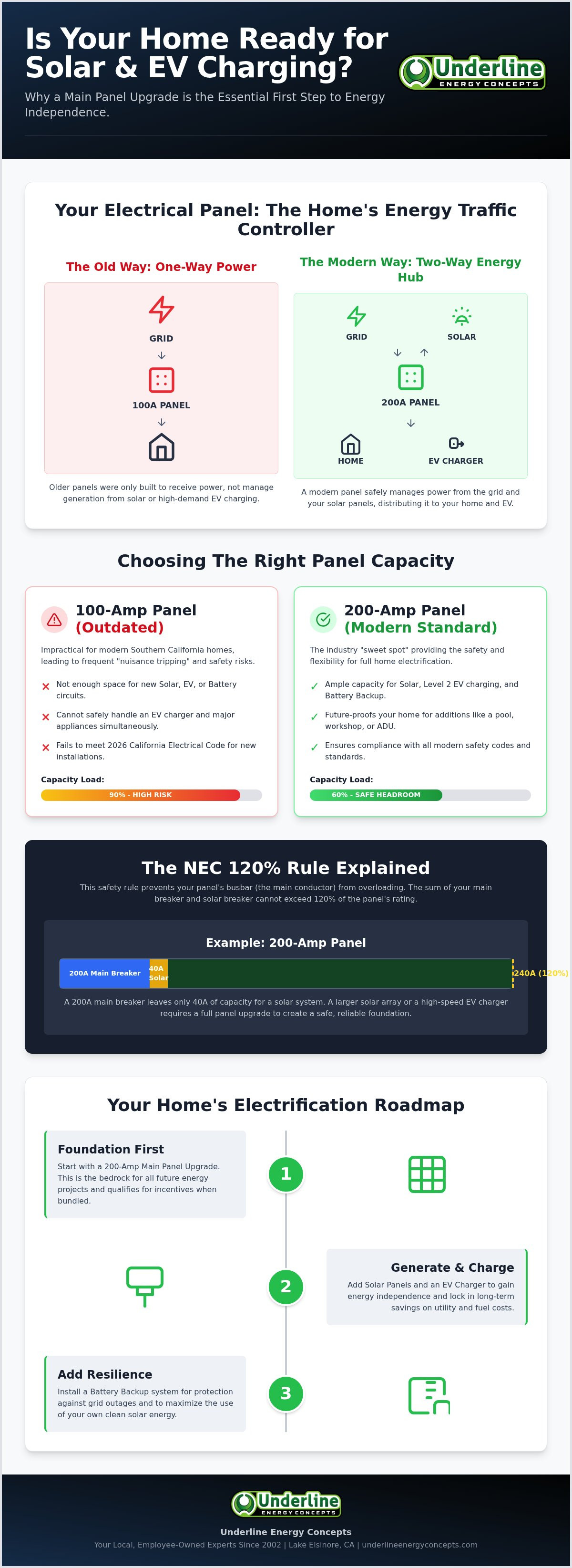
Your main electrical panel acts as the traffic controller for every kilowatt that enters your home. For decades, this was a simple one-way street: electricity arrived from Southern California Edison and flowed to your lights and appliances. Adding a solar system and a Level 2 EV charger changes that dynamic entirely. Suddenly, your home has two power sources and a massive new electrical demand. Most older panels weren't designed to handle this bidirectional flow or the sustained high amperage required for modern charging.
A main panel upgrade for EV charger and solar ensures your home can safely distribute this increased energy without overheating. If your home was built before 1990, you might have a panel from manufacturers like Zinsco or Federal Pacific Electric. These brands are notorious for circuit breakers that fail to trip during an overload, creating significant fire risks. Replacing these isn't just about solar compatibility; it's a critical safety necessity for your family.
Common Triggers for a Main Panel Upgrade (MPU)
Homeowners in Lake Elsinore and Temecula often find that their original 100-amp panels lack the physical space for new circuits. Even if you have an open slot, the physical busbar inside the panel might not have the capacity to "backfeed" solar power safely. The 2026 California Electrical Code now requires specific safety features, such as outdoor emergency disconnects and surge protective devices, for any new panel installation. These standards ensure your investment is protected against power surges and allow first responders to cut power quickly during an emergency.
The 120% Rule Explained Simply
The National Electrical Code (NEC) uses the "120% Rule" to prevent your panel's busbar from melting. Think of your busbar like a water pipe. If you push too much water through it from both ends (the utility and your solar panels), the pipe will eventually burst. The rule dictates that the combined amperage of your main breaker and your solar inverter breaker cannot exceed 120% of the busbar's rated capacity.
If your panel is rated for 200 amps, the 120% limit is 240 amps. With a standard 200-amp main breaker, you only have 40 amps of "headroom" for solar. If your solar array is large or you're adding a high-speed EV charger, you'll likely hit this limit quickly. While a professional can sometimes "derate" your main breaker to create more space, a full main panel upgrade for EV charger and solar is often the most reliable way to future-proof your home for the long term. This foundation gives you the autonomy to grow your energy system without worrying about safety or code violations.
Choosing the Right Capacity: 100 Amp vs 200 Amp vs 400 Amp Upgrades
Selecting your home's electrical capacity is about more than just meeting today's needs; it's about securing your autonomy for the next twenty years. While your current panel might keep the lights on, the transition to clean energy requires a robust foundation. A 200-amp upgrade is the most common requirement for solar-ready homes. This capacity provides the necessary headroom to handle the simultaneous demands of high-efficiency appliances, climate control, and renewable energy systems.
Is a 100-Amp Panel Enough for Solar and EV Charging?
You may find online forums suggesting that a 100-amp panel is sufficient if you manage your energy usage carefully. However, this approach is often impractical for modern Southern California living. A Level 2 EV charger typically requires a 50-amp circuit on its own. When you combine that with an air conditioner, an electric oven, or a dryer, you quickly exceed the safety limits of a 100-amp busbar. This leads to "nuisance tripping," where your breakers frequently pop during normal daily activities. Beyond the inconvenience, these older panels rarely have the physical space to house the additional breakers required for a main panel upgrade for EV charger and solar or a battery backup system.
The Long-Term Benefits of a 200-Amp Upgrade
A 200-amp panel is the industry standard for a reason. It offers the flexibility to install high-performance equipment like REC Solar Panels without compromising your home's safety. If you live in Riverside County and plan to add a pool, a workshop, or an ADU in the future, this "heavy-up" ensures you won't have to pay for a second electrical renovation later. This capacity also allows for the seamless integration of whole-home battery backups. These batteries require dedicated breakers and sophisticated management that 100-amp panels simply cannot accommodate. By choosing a 200-amp foundation, you simplify your path to energy independence.
For larger luxury estates or homes with extensive electrification goals, a 400-amp (K-Base) upgrade may be necessary. This massive capacity is ideal for properties with multiple EV chargers, dual HVAC systems, and large-scale solar arrays. Whether you need a standard 200-amp solution or a high-capacity 400-amp system, the right choice depends on your specific "Electrification Roadmap." To ensure your home is ready for the future, you should schedule a professional load calculation with our Lake Elsinore-based team. We'll help you determine the exact main panel upgrade for EV charger and solar that fits your goals and your budget.
The Financial Logic: Integrating Tax Credits and SCE Rebates in 2026
Timing your main panel upgrade for EV charger and solar correctly can save you thousands in upfront costs. While federal incentives like the 30% Investment Tax Credit (ITC) have historically provided a massive boost, the landscape in 2026 is shifting toward local utility support. By bundling your panel upgrade with a solar installation, you create a clear 'nexus' for tax purposes. This strategic approach transforms a necessary equipment change into a high-ROI asset, though you should always consult a tax professional to confirm your specific eligibility for any remaining federal credits.
Qualifying for the 30% Federal Tax Credit
The Residential Clean Energy Credit allows homeowners to claim a significant portion of their project costs if the equipment is essential to the solar or battery system. This is where professional documentation becomes your most valuable asset. As an employee-owned contractor, Underline Energy Concepts provides the detailed invoicing required to demonstrate that your new panel is a necessary foundation for your clean energy goals. This documentation is critical for offsetting the cost of electric panel upgrade for solar, helping you transition to a 200-amp or 400-amp service with greater financial confidence.
Local Rebates and SCE Grid Integration
The most immediate financial relief for Riverside County residents now comes through the SCE Charge Ready Home program. This active 2026 rebate offers substantial support for electrical panel upgrades required for Level 2 EV chargers. Depending on your household's qualifications or community designation, you could receive between $2,100 and $4,200 to cover the installation costs. This program is a game-changer for families in Lake Elsinore and Temecula who want to future-proof their homes without bearing the full financial burden alone.
Navigating the technical side of these upgrades requires a partner who understands Southern California Edison's specific regulations. SCE Rule 16 and Rule 21 govern how your home connects to the grid and how your solar system interacts with utility lines. These rules involve complex meter clearances and technical standards that must be met for a successful inspection. We handle all utility coordination and permitting for you, ensuring your main panel upgrade for EV charger and solar is compliant and safe. While we manage the heavy lifting, you can check the SCE Marketplace for additional rebates on smart home technology that can further lower your long-term energy bills.
Future-Proofing: The Panel as the Foundation for Home Electrification
Think of your electrical panel as the mission control for your home's energy future. While we often discuss a main panel upgrade for EV charger and solar as a response to a specific need, it's actually the first step in a broader "Electrification Roadmap." This roadmap shifts your home away from volatile utility costs and toward total energy autonomy. By building a strong foundation now, you ensure that future additions like hybrid water heaters or high-efficiency HVAC systems don't require expensive, repetitive electrical work down the road.
Preparing for EV Charging and Battery Backup
A standard Level 2 EV charger requires a 50-amp circuit to provide a meaningful charge overnight. In a home with an outdated 100-amp panel, this single appliance consumes half of your total available capacity. Upgrading to a 200-amp service has become the modern standard because it allows you to charge your vehicle while simultaneously running your dishwasher, air conditioning, and laundry. This capacity is also vital for integrating advanced SolarEdge inverters, which manage the flow between your panels, the grid, and your home loads. A modern panel allows these systems to switch to battery power during a grid outage instantly, providing the relief and security your family needs during California's frequent summer power strains.
Smart Panels and Modern Energy Management
The latest generation of electrical panels includes smart circuit breakers and app-based load management. These systems allow you to prioritize which appliances receive power during a blackout or during SCE's peak hours (4-9 PM) when electricity costs are highest. By automating your energy consumption, you can "shed" non-essential loads like pool pumps to maximize your solar savings. This level of control is a fundamental prerequisite for a whole home battery backup installation. Without a main panel upgrade for EV charger and solar, your battery system won't have the physical infrastructure to manage your home's circuits effectively. If you're ready to take control of your energy future, contact our Lake Elsinore team for a comprehensive load analysis.
Choosing Underline Energy Concepts for Your Solar-Ready Upgrade
Selecting a contractor for your home's electrical infrastructure shouldn't feel like a gamble. At Underline Energy Concepts, we've spent over two decades serving as a relatable local partner for homeowners in Lake Elsinore, Menifee, and Temecula. We provide a unique "One Contractor" advantage by bundling your roofing, solar, and electrical projects into a single, cohesive experience. This approach eliminates the stress of managing multiple subcontractors and ensures that every component of your whole-home energy system works in perfect harmony.
Because we're employee-owned and operated, our technicians have a personal stake in the quality of your installation. We don't just see a project; we see a neighbor who deserves long-term stability and protection from rising utility costs. Our team acts as your professional advocate, translating complex technical requirements into common-sense logic. We want you to feel empowered by your technology, not confused by it.
Our Comprehensive Inspection and Installation Process
Every project begins with a methodical inspection to assess the health of your existing infrastructure. If we determine that a main panel upgrade for EV charger and solar is necessary, we manage the entire lifecycle of the installation. This includes coordinating directly with Southern California Edison (SCE) for service disconnects and handling all local municipal permitting. We ensure your main panel upgrade for EV charger and solar meets the rigorous 2026 California Electrical Codes, including new requirements for outdoor disconnects and surge protection.
Take the Next Step Toward Energy Independence
The peace of mind that comes with a solar-ready, 200-amp home is a powerful feeling. You'll gain the autonomy to charge your vehicle, run your home, and store your own power without fear of overloaded circuits or electrical fires. Once your system is live and you're enjoying the savings, we invite you to join our Referral Program to help your friends and neighbors achieve the same energy independence.
Don't let an outdated panel stand between you and your 2026 energy goals. Our Lake Elsinore-based specialists are ready to help you build a safe, efficient foundation for your home. Contact Underline Energy Concepts for a professional consultation today and start your journey toward a more resilient future.
Secure Your Energy Autonomy for 2026 and Beyond
A resilient home starts with a modern electrical foundation. By prioritizing a main panel upgrade for EV charger and solar, you aren't just meeting code requirements; you're taking a bold step toward financial independence and safety. This upgrade unlocks the full potential of your renewable energy system and prepares your property for the evolving demands of Southern California's grid. With federal tax credits and SCE rebates available through mid-2026, there has never been a more strategic time to modernize your infrastructure.
Since 2002, Underline Energy Concepts has served as a trusted partner for families in Lake Elsinore and the surrounding region. As an employee-owned and operated business, we take immense pride in our quality workmanship and local community roots. We hold active licenses in roofing, electrical, and solar (C-39, C-10, and B), ensuring every project is handled with comprehensive expertise. You don't have to navigate these complex technical shifts alone. Our team is here to guide you through every step of the process with transparency and reliability. Schedule your solar-ready electrical inspection with Underline Energy Concepts today and embrace the peace of mind that comes with a truly future-proof home.
Frequently Asked Questions
How much does a 200-amp panel upgrade cost in Southern California in 2026?
The investment for a 200-amp panel upgrade in Riverside County depends on several factors, including the age of your home and the complexity of the utility coordination. Costs vary based on whether you need new trenching, specific permitting fees in cities like Lake Elsinore or Menifee, or additional circuit work. We recommend a professional load calculation to determine your home's unique requirements. This ensures your electrical foundation is safe and ready for your long-term energy goals.
Can I get the 30% solar tax credit for my electrical panel upgrade?
While the federal solar tax credit expired at the end of 2025, you might still qualify for the 30% Alternative Fuel Vehicle Refueling Property Credit for your EV charger infrastructure if completed by June 30, 2026. This credit often applies to the electrical panel work necessary to support the charger. You should consult a tax professional to see how these credits apply to your situation. Bundling these upgrades often simplifies the documentation process for potential savings.
How long does it take to replace a main electrical panel?
The physical replacement of your panel typically takes one full working day. However, the entire timeline involves planning, securing permits from local departments in Temecula or Corona, and coordinating with SCE for the service disconnect. This preparation phase can span several weeks. Our team manages all the logistics and utility communication for you. We prioritize efficiency so your home's transition to a modern energy system is as smooth and fast as possible.
Will my power be turned off during the panel upgrade process?
Yes, your power will be temporarily disconnected during the installation to ensure the safety of our technicians and your property. We coordinate this outage directly with SCE to minimize the impact on your schedule. Most homeowners in Wildomar or Perris experience a power loss of approximately four to eight hours on the day of the swap. We'll provide plenty of notice so you can plan ahead for this brief interruption to your service.
What happens if I install solar without upgrading an old 100-amp panel?
Installing solar on an outdated 100-amp panel often leads to safety hazards and code violations. Most older panels don't have the "headroom" required by the NEC 120% Rule, which prevents the busbar from overheating. You might face frequent circuit breaker trips or even electrical fires from an overloaded system. A main panel upgrade for EV charger and solar provides the necessary capacity to handle modern electrical loads safely and reliably for years to come.
Do I need a new panel if I am only adding a small solar array?
Not every small solar system requires a full panel replacement, but it depends entirely on your existing busbar capacity and the age of your equipment. Even a modest array might trigger an upgrade if your panel is full or made by manufacturers with known safety issues. We perform a detailed load analysis for every client in Moreno Valley and Canyon Lake. This helps us determine if a breaker derate is possible or if an upgrade is safer.
Does SCE require a specific type of electrical panel for solar homes?
SCE and local building departments require panels that meet the 2026 California Electrical Code standards. This includes specific hardware like an outdoor emergency disconnect and a surge protective device to protect your home's electronics. For residents in Winchester and Murrieta, we ensure every main panel upgrade for EV charger and solar is fully compliant with SCE Rule 16 and Rule 21. Using approved equipment ensures your system passes inspection and connects to the grid without hurdles.
Can I upgrade my panel myself to save on solar installation costs?
Upgrading your electrical panel is not a DIY project because it involves high-voltage utility lines and requires specific city permits. Attempting this yourself can lead to severe injury, voided insurance, and failed inspections that delay your solar project. As a licensed C-10 electrical contractor, we handle the dangerous work safely. Professional installation guarantees your home meets all modern safety standards while preserving your property value. It's the best way to ensure long-term reliability.