
Whole House Fan Installation in Lake Elsinore: 2026 Homeowner Buying Guide
/

Article by
Jesse Malone
Jesse Malone
CEO & Partner, Underline Energy Concepts
Jesse Malone is the CEO and Partner of Underline Energy Concepts, a Southern California energy services company that has been serving homeowners since 2002. Since joining the company and becoming a partner in approximately 2015, Jesse has helped lead its growth into one of Southern California’s most trusted providers of residential energy efficiency and home improvement solutions.
Throughout his tenure, Jesse and the Underline Energy team have completed more than 2,500 energy upgrade projects for homeowners across Southern California. These projects include solar energy systems, roofing, battery storage, EV charging stations, electrical panel upgrades, water heater replacements, attic insulation, retrofit windows, and other energy-efficient home improvements designed to lower utility costs and increase property value.
Jesse holds a Bachelor’s Degree from California Southern University and brings more than 20 years of experience in emergency services through his service with the fire department. His background in public service has shaped his leadership style, emphasizing integrity, accountability, safety, and a commitment to serving the community.
A lifelong advocate for efficiency and practical solutions, Jesse is passionate about helping homeowners make informed decisions that improve both their homes and their financial future. His interests extend beyond energy efficiency into financial literacy, budgeting, investing, and long-term wealth-building strategies. He believes that reducing unnecessary expenses and maximizing efficiency are key components of financial success.
As CEO, Jesse continues to focus on delivering exceptional customer experiences, building high-performing teams, and helping Southern California homeowners achieve greater comfort, energy independence, and long-term savings through smart home investments.
What if cranking your central air conditioner after sunset is actually the most expensive way to keep your home warm? If you live in the valley, you already know the frustration of watching your AC run nonstop during peak evening hours while trapped attic heat radiates straight down into second-story bedrooms. Recirculating stale indoor air simply cannot solve a structural heat problem. That is why investing in a professional whole house fan installation in Lake Elsinore has become the smarter path for homeowners seeking relief from relentless summer utility bills.
True indoor comfort requires rapid thermal purging, not just costly air conditioning cycles. In this 2026 homeowner guide, you'll discover how modern, whisper-quiet ventilation systems capture cool evening breezes off the lake, push stifling heat out through your attic vents, and dramatically cut your cooling power draw. We'll walk you through proper airflow sizing, updated Title 24 energy standards, and what to look for when partnering with a trusted local contractor.
Key Takeaways
- Understand how flushing attic temperatures that exceed 150 degrees resets your home's thermal envelope far faster than standard air conditioning alone.
- Learn why properly sizing a whole house fan installation Lake Elsinore project requires exact interior volume and CFM calculations to deliver rapid evening cooling.
- Discover the critical attic exhaust ventilation ratios needed to comply with California Title 24 standards and prevent positive air pressure issues.
- Find out how offsetting central AC runtime during Southern California Edison's peak 4 PM to 9 PM rate window shields your household budget from rising utility costs.
- See how partnering with an employee-owned contractor rooted in Lake Elsinore ensures seamless electrical, structural, and roofing craftsmanship.
Why Whole House Fan Installation Is Essential for Lake Elsinore Homes
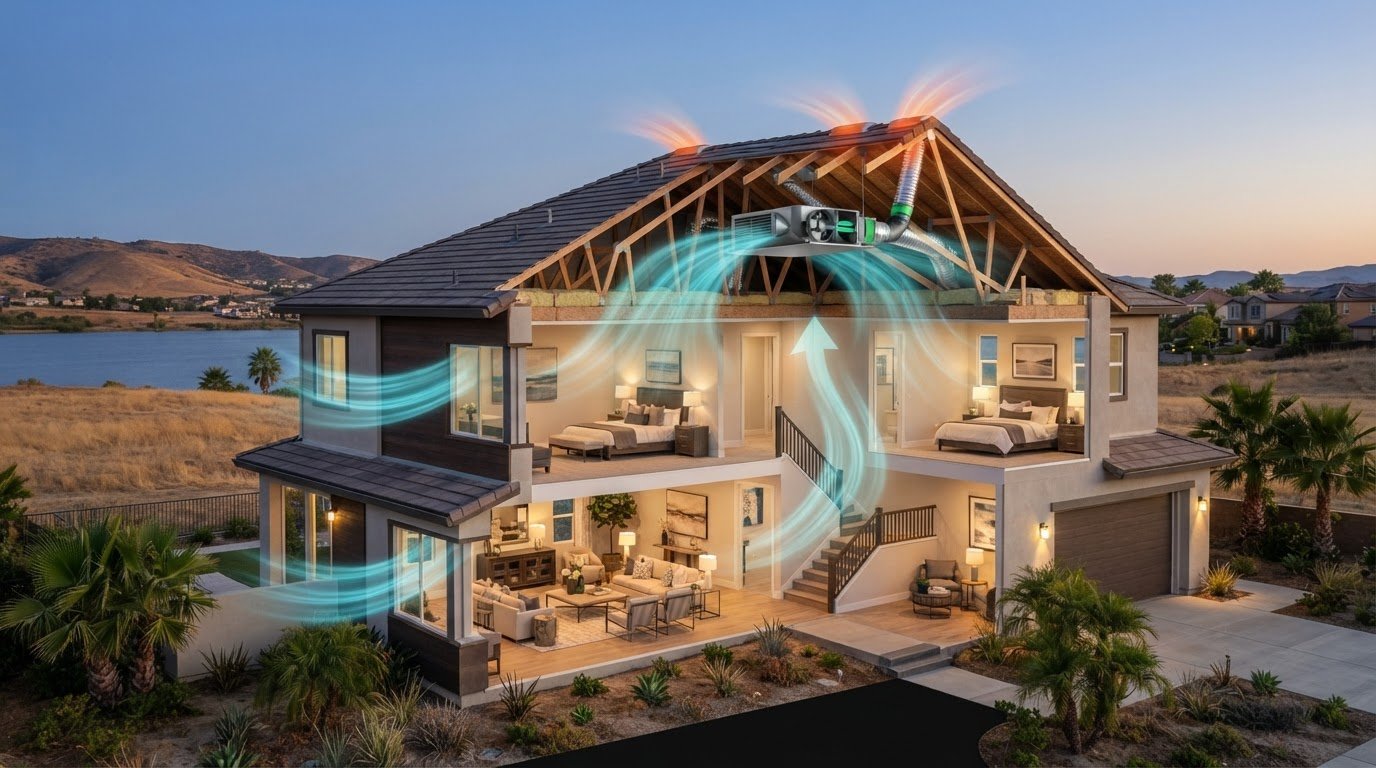
Fundamentally, whole house fan ventilation is an engineered thermal purge system designed to rapidly pull cool outdoor air through living spaces and forcefully exhaust trapped, superheated air out through attic vents. During Inland Empire summers, radiant heat builds quickly, pushing attic temperatures past 150 degrees. When you understand what a whole house fan is and how it displaces air volume, it becomes clear why relying entirely on a standard central air conditioner is both inefficient and expensive. Scheduling a professional whole house fan installation Lake Elsinore homeowners trust gives you an immediate way to purge that accumulated heat within minutes of sunset, dramatically cutting reliance on your compressor during costly peak energy hours.
Beating Lake Elsinore Valley Heat Traps and Summer Extremes
The geographic bowl formed by the Ortega Mountains and the Elsinore Basin traps intense radiant energy throughout the day. Your roof absorbs this continuous solar radiation, turning the attic into a massive thermal sponge. Even when the outside temperature cools after dark, that stored heat continues radiating down through ceiling drywall, forcing central air conditioning compressors to run continuously. Completing a whole house fan installation Lake Elsinore project allows you to capture cool lake breezes the moment outdoor temperatures drop, sweeping fresh airflow through your living spaces and flushing blistering attic air out through roof vents.
Thermal Mass Cooling vs. Air Conditioning Recirculation
Central air conditioners work by slowly cooling and recirculating the same closed loop of indoor air. While the ambient air might feel cool, the home's structural thermal mass remains blazing hot. A dedicated whole house fan installation Lake Elsinore system changes the dynamic entirely:
- Cools structural framing: High-volume airflow strips heat directly from drywall, ceiling joists, and attic rafters, preventing stored heat from bleeding back into living areas overnight.
- Refreshes indoor air: Rather than recycling stale air, the massive air exchange flushes out cooking aromas, pet dander, indoor dust, and airborne VOCs within minutes.
- Reduces mechanical wear: Giving your central AC a break during late afternoon and evening hours extends equipment life and limits expensive service calls.
How to Choose the Right Whole House Fan: Sizing and CFM Selection
Selecting the right equipment comes down to matching airflow capacity with the actual interior cubic volume of your living space. Airflow is measured in CFM (cubic feet per minute). Sizing isn't just about floor area; it requires calculating your home's total air mass. An undersized system fails to pull cool breezes through distant bedrooms, leaving pockets of trapped warmth. Conversely, an oversized setup placed in a home without sufficient roof venting creates unwanted attic backpressure. Getting the sizing dialed in ensures your whole house fan installation in Lake Elsinore performs efficiently on the hottest summer evenings.
Calculating Accurate Airflow (CFM) for Inland Empire Architecture
Standard guidelines often suggest two to three CFM per square foot of living space. However, many homes around Lake Elsinore feature two-story layouts, open foyers, or vaulted cathedral ceilings. In these properties, you need to calculate total volume rather than simple floor dimensions. Factoring in ceiling height ensures the fan moves enough air volume to complete a full air exchange across the entire home every two to three minutes.
Modern Ducted Motor Design vs. Noisy Legacy Shutter Fans
Older direct-drive fans earned a reputation for being noisy, shuddering violently against ceiling joists and clattering louvers whenever they kicked on. Modern systems use suspended motor housings connected to ceiling intake grilles through acoustic, sound-dampening flexible ductwork. Hanging the motor from the attic rafters isolates mechanical vibration completely from your living areas. Additionally, these modern assemblies incorporate insulated, gravity-closing damper doors. These tight seals prevent warm indoor air from leaking into the attic during winter months or hot attic air from settling back down into your home on calm summer afternoons.
Single-Unit Central Systems vs. Zoned Multi-Fan Configurations
Choosing the best layout depends on your home's design and how your family uses different rooms:
- Centralized Hallway System: An ideal, cost-effective setup for single-story ranch homes, pulling air evenly through open bedroom windows into a central return.
- Zoned Multi-Fan Configuration: Places smaller, dedicated units in individual bedrooms and master suites, letting you cool occupied rooms overnight without pulling air through the entire house.
- Control Options: Modern setups include multi-speed wall switches, count-down digital timers, and smart controls, allowing high-speed purging at dusk followed by whisper-quiet low-speed operation overnight.
Ensuring that your attic has the exhaust capacity required by California's building code for attic ventilation is essential before completing any fan layout. If you want help calculating the right CFM profile and damper layout for your specific ceiling architecture, reach out to a local specialist for a comprehensive home assessment.

Attic Ventilation, Electrical Prep, and Safety Codes for Installation
A high-performance whole house fan is only as effective as the attic exhaust path behind it. When powerful fans push thousands of cubic feet of air into an attic cavity, that air must escape freely to the outside. If the attic lacks sufficient exhaust openings, positive air pressure builds up rapidly. This pressure traps heat against roof rafters, strains the fan motor, and can even blow loose insulation or ceiling dust back into living spaces. Executing a code-compliant whole house fan installation in Lake Elsinore requires balancing structural roof ventilation, dedicated electrical infrastructure, and regional wildfire protection standards.
Verifying Attic Net Free Vent Area (NFVA)
Every whole house fan manufacturer requires a specific ratio of Net Free Vent Area (NFVA) to operate safely, typically requiring roughly one square foot of clear exhaust area for every 750 CFM of fan power. Before any equipment is hung, a thorough roof calculation assesses existing soffit, gable, eyebrow, and ridge vents. If total net ventilation falls short of fan output, installing additional high-efficiency, watertight roof vents is mandatory to restore balanced exhaust pathways.
Electrical Infrastructure and Dedicated Circuit Requirements
Modern fan systems utilize efficient electronically commutated motors, but they still require stable, code-compliant power delivery. Connecting high-performance equipment directly to overloaded living room or bedroom circuits creates breaker trip hazards during peak usage hours. Installing a dedicated 15-amp circuit from your breaker panel guarantees safe operation. For older Lake Elsinore properties with crowded distribution boxes, homeowners often review their overall electric panel capacity to ensure room for ventilation, solar expansion, or future battery storage.
Wildfire Zone Safety and California Title 24 Compliance
Because Lake Elsinore borders wildfire-prone chaparral along the Cleveland National Forest and Ortega corridor, safety protocols must address airborne ember risks:
- Title 24 Energy Standards: California building codes mandate that mechanical ventilation systems meet rigorous energy performance metrics and list approved damper doors that prevent conditioned indoor air leakage.
- Motorized and Gravity Dampers: Integrated insulated dampers close tight when the fan shuts down, stopping thermal backdrafts and keeping outdoor contaminants out.
- Ember-Resistant Attic Vents: Upgrading exterior attic exhaust vents with specialized micro-mesh exterior screens prevents wind-blown embers from entering the attic structure during high-wind Santa Ana fire conditions.
Working with a contractor licensed in roofing, electrical, and general construction ensures every roof penetration remains watertight, framing stays structurally sound, and all wiring meets local municipal codes.
Financial Savings: Slashing Southern California Edison Electric Bills
Southern California Edison utility rates continue climbing across Riverside County, making standard air conditioning one of the largest expenses on any household balance sheet. A typical 3-to-5-ton central AC compressor pulls anywhere from 3,500 to 5,000 watts of continuous electricity every hour it operates. In sharp contrast, an advanced whole house fan consumes between 200 and 600 watts on its highest settings. Choosing a whole house fan installation Lake Elsinore project allows you to substitute low-wattage fan power for energy-intensive air conditioning once evening temperatures fall, slashing cooling electricity consumption while keeping living spaces deeply comfortable.
Navigating Southern California Edison Peak Time-of-Use (TOU) Rates
Most local homeowners operate under Southern California Edison Time-of-Use rate schedules. Under these plans, power consumed between 4:00 PM and 9:00 PM carries a steep premium, with summer on-peak rates frequently exceeding 50 cents per kilowatt-hour. That window happens to align exactly with peak cooking, family relaxation, and evening heat buildup inside your house. Running an energy-intensive AC compressor during these hours leads directly to painful monthly utility statements. With a proper whole house fan installation Lake Elsinore layout in place, switching on the fan as twilight arrives pulls brisk evening air through the structure, shutting down the compressor right when grid power costs the most. To check current utility incentive availability before starting your project, check the SCE energy rebates portal.
Pairing Whole House Ventilation with Rooftop Solar and Battery Systems
Integrating mechanical ventilation into a home equipped with solar panels and battery storage creates a powerful efficiency multiplier:
- Extending battery runtime: Running central AC at night drains home battery storage rapidly. Operating a low-wattage fan instead keeps your family cool while preserving battery reserves for essential appliances through the night.
- Pre-cooling the structural envelope: Purging attic and interior heat down to the low 60s overnight delays the need to start your central AC until late the following afternoon, shrinking daily electrical demand.
- Protecting home comfort during grid outages: Because whole house fans require minimal wattage, you can easily run them during summer flex alerts or grid shutoffs using moderate backup battery power.
Balancing high-efficiency ventilation with home generation gives you genuine control over rising utility expenses. When you want to explore how a whole house fan installation Lake Elsinore upgrade fits your property's electrical setup, schedule a home energy consultation with our local team today.
Why Lake Elsinore Trusts Underline Energy Concepts for Whole House Fan Installation
Selecting the right equipment is only half the equation; craftsmanship determines how safely, quietly, and effectively your system operates. Executing a seamless whole house fan installation Lake Elsinore homeowners can rely on requires careful structural framing, precise drywall modifications, safe electrical hookups, and balanced roof venting. Rather than juggling separate trade contractors or dealing with out-of-town call centers, Inland Empire residents trust Underline Energy Concepts. As a local brick-and-mortar company serving our neighbors since 2002, we deliver turnkey ventilation solutions designed specifically for our local basin climate.
Decades of Local Heritage and Employee-Owned Accountability
Unlike digital directories that auction off installation leads to third-party sub-contractors, our headquarters are right here in Lake Elsinore. We experience the same extreme heat waves and utility rate spikes as our clients. Because Underline Energy Concepts is employee-owned and operated, every installer working in your attic or on your roof holds a personal stake in the company's reputation. We lead with homeowner education rather than aggressive sales tactics, taking the time to explain how airflow dynamics, insulation, and equipment placement impact your daily comfort.
Multi-Trade Expertise: Roofing, Electrical, and Attic Integrity
A whole house fan directly interacts with your home's structural framing, electrical distribution, and roofing weatherproofing. Holding licenses in general contracting, electrical, and roofing allows our crews to manage every facet of the project in-house:
- Watertight roof flashing: If your attic requires extra exhaust vents to support fan CFM, our roofing specialists install code-compliant, leak-proof vents tailored to clay tile, concrete tile, or composition shingle roofs.
- Safe electrical integration: In-house electricians run dedicated circuits from your panel, eliminating fire risks and nuisance breaker trips.
- Attic envelope inspection: During the site visit, technicians evaluate your attic insulation depth and seal draft points, ensuring your new fan doesn't pull conditioned air through unsealed recessed lighting.
Investing in reliable home cooling protects your family's living environment while providing long-term relief from utility peak charges. When you're ready to experience rapid evening cooling from a proven local partner, take the first step. Contact our team today to schedule your whole house fan installation consultation.
Take Control of Your Home Comfort and Energy Costs
Living comfortably in our valley basin shouldn't mean surrendering your household budget to nonstop compressor cycles and punishing peak utility rates. By expelling superheated attic air and flooding living spaces with crisp evening breezes, an expertly sized whole house fan installation Lake Elsinore homeowners invest in restores control over the entire structural thermal envelope.
Since 2002, Underline Energy Concepts has helped Inland Empire residents achieve lasting energy efficiency and reliable indoor cooling. As a 100% employee-owned company holding active general, electrical, and roofing licenses, our team ensures your ventilation system is structurally sound, code-compliant, and engineered for whisper-quiet performance. Ready to transform your indoor climate and keep high electric bills at bay? Schedule your Lake Elsinore whole house fan consultation with Underline Energy Concepts today and start enjoying cooler evenings with complete peace of mind.
Frequently Asked Questions
How does a whole house fan differ from an attic exhaust fan in Lake Elsinore?
An attic exhaust fan only removes hot air from your attic space, whereas a whole house fan pulls fresh outdoor air through your entire living area and forces it out through the attic. Attic fans pull make-up air through exterior vents without cooling interior rooms. When completing a whole house fan installation in Lake Elsinore, the system creates an active indoor breeze that cools both your living areas and attic simultaneously.
Can a whole house fan completely replace my central air conditioning system?
No, a whole house fan works as an energy-saving partner to your central air conditioner rather than a total replacement. When Lake Elsinore summer afternoons reach triple digits, your AC system is essential for active refrigeration. Once outdoor temperatures drop in the evening, switching to a whole house fan flushes stored thermal mass and keeps the home cool overnight, dramatically reducing expensive compressor runtimes.
How many windows need to be open when operating a whole house fan?
You typically need to open two to four windows roughly three to six inches, depending on your fan's total airflow capacity. Proper window opening area prevents unwanted negative air pressure, which could otherwise pull dust or combustion gases down chimney flues. Opening windows specifically in occupied bedrooms directs cool evening air right where you need it, creating a refreshing lake breeze throughout your sleeping spaces.
Will installing a whole house fan void my roof or drywall warranties?
Professional installation by a licensed contractor will not void your structural or roofing warranties. Skilled technicians suspend the fan motor from attic rafters without compromising structural trusses, and ceiling grilles fit cleanly between standard drywall joists. Partnering with a contractor holding active roofing and general building licenses ensures any additional attic roof vents are flashed watertight to preserve your roofing manufacturer warranty.
How long does a professional whole house fan installation take to complete?
A standard whole house fan installation Lake Elsinore homes require typically takes between four and six hours to complete. That timeframe includes precision ceiling drywall cuts, hanging the acoustic duct and fan motor in the attic, installing dedicated electrical circuits, and adding intake grilles with insulated dampers. If your attic requires supplementary roof venting to meet code standards, technicians usually finish the entire project in a single working day.
Is my Lake Elsinore home attic large enough for a whole house fan installation?
Most Inland Empire residential attics easily accommodate modern ducted whole house fans because the motor hangs horizontally within the roof pitch. Unlike bulky vintage shutter fans that needed immense vertical clearance directly above the ceiling cutout, flexible acoustic ducting allows technicians to position the motor away from tight clearances or low roof rafters. During an initial site assessment, technicians inspect truss spacing, joist depth, and attic exhaust area to confirm proper fit.
What maintenance is required to keep a whole house fan running smoothly?
Modern whole house fan systems require very minimal ongoing maintenance compared to complex central air conditioning units. Homeowners simply need to wipe down the ceiling intake grille once or twice a year to remove surface dust. Because advanced motors utilize sealed bearings, there are no belts to adjust or motors to oil. During routine roof or attic checkups, a technician can quickly verify that damper seals and vent screens remain clear of debris.