
Generator vs. Battery Backup in Southern California: The 2026 Resilience Guide
/
Article by
Jesse Malone
Jesse Malone
CEO & Partner, Underline Energy Concepts
Jesse Malone is the CEO and Partner of Underline Energy Concepts, a Southern California energy services company that has been serving homeowners since 2002. Since joining the company and becoming a partner in approximately 2015, Jesse has helped lead its growth into one of Southern California’s most trusted providers of residential energy efficiency and home improvement solutions.
Throughout his tenure, Jesse and the Underline Energy team have completed more than 2,500 energy upgrade projects for homeowners across Southern California. These projects include solar energy systems, roofing, battery storage, EV charging stations, electrical panel upgrades, water heater replacements, attic insulation, retrofit windows, and other energy-efficient home improvements designed to lower utility costs and increase property value.
Jesse holds a Bachelor’s Degree from California Southern University and brings more than 20 years of experience in emergency services through his service with the fire department. His background in public service has shaped his leadership style, emphasizing integrity, accountability, safety, and a commitment to serving the community.
A lifelong advocate for efficiency and practical solutions, Jesse is passionate about helping homeowners make informed decisions that improve both their homes and their financial future. His interests extend beyond energy efficiency into financial literacy, budgeting, investing, and long-term wealth-building strategies. He believes that reducing unnecessary expenses and maximizing efficiency are key components of financial success.
As CEO, Jesse continues to focus on delivering exceptional customer experiences, building high-performing teams, and helping Southern California homeowners achieve greater comfort, energy independence, and long-term savings through smart home investments.
You might think choosing between a standby generator and a whole-home battery is a simple matter of fuel versus sun, but in 2026, the "obvious" choice could be costing you thousands in missed savings. As a Lake Elsinore neighbor who has helped homeowners since 2002, we understand the stress of frequent PSPS events during high-wind seasons. It's frustrating to watch your electricity costs climb past 50 cents per kWh during peak hours while fearing food spoilage or AC failure during the next heatwave. You deserve a home that stays powered and a budget that stays protected. That starts with understanding the real-world trade-offs of a generator vs battery backup Southern California residents face today.
This 2026 resilience guide compares the pros, cons, and 10-year costs of these two powerful solutions. Now that the federal tax credit for residential solar has expired, the financial math for energy independence has changed significantly. We'll show you how to maximize state rebates like SGIP and manage the new fixed utility charges that hit bills this year. You'll learn exactly how to maintain uninterrupted power for medical equipment and your cooling system while actually increasing your property value. We're here to help you navigate these changes with confidence and local expertise.
Key Takeaways
- Learn why localized grid strain and Public Safety Power Shutoffs (PSPS) make a dedicated backup plan essential for homes in Canyon Lake and across the region.
- Compare the long-term costs and performance of a generator vs battery backup Southern California to determine which system best fits your energy profile and budget.
- Navigate the specific permitting and safety clearance requirements in Riverside County to ensure your backup installation is legal, safe, and fully compliant.
- Discover how to leverage current 2026 incentives like the SGIP rebate to lower your initial investment while maximizing your home's long-term resale value.
- Explore the benefits of a "Triple Threat" hybrid strategy that combines solar, batteries, and generators for the highest level of energy autonomy.
Why Southern California Homeowners Need Backup Power in 2026
The Southern California energy landscape has reached a tipping point in 2026. With SCE peak rates now exceeding 50 cents per kWh during the 4 to 9 PM window, electricity is no longer a simple utility; it is a major household expense that requires active management. For homeowners in Lake Elsinore and surrounding areas, the debate over generator vs battery backup Southern California solutions is driven by more than just high bills. It's about maintaining control when the grid fails. Reliance on an aging infrastructure that struggles under the weight of record-breaking heatwaves and mandatory shutoffs is a risk most families can't afford to take.
The Reality of PSPS Events in Riverside County
Utilities frequently initiate Public Safety Power Shutoffs (PSPS) during Santa Ana wind events to prevent wildfires in high-risk zones like Canyon Lake and the hills of Temecula. These aren't just brief flickers. In rural parts of Riverside County, a shutoff can last for days while crews manually inspect lines for damage. We define grid instability as the system's inability to maintain a reliable power flow during these environmental stresses or high-demand periods. While suburban neighborhoods in Murrieta might see faster restoration, the unpredictability makes a personal backup system a necessity for home office productivity and home security.
The financial impact of these outages goes beyond the utility bill. A single long-term outage can result in hundreds of dollars in spoiled groceries and the loss of a day's wages for remote workers. In 2026, energy autonomy has transitioned from a luxury to a practical financial strategy for protecting your household budget.
Protecting Critical Loads: AC and Medical Needs
For many of our neighbors, power is a literal lifeline. Homeowners with medical baseline requirements for oxygen concentrators or refrigerated medications can't wait for the utility to resolve a local transformer failure. This challenge is amplified during summer heatwaves when temperatures in Winchester and Lake Elsinore regularly climb into the triple digits. Running a high-draw HVAC system requires significant surge capacity, something traditional portable units often fail to provide.
Modern home energy storage systems and standby generators offer the heavy-duty support needed to keep the air conditioning running when the neighborhood goes dark. These solutions ensure that grid edge communities stay cool and safe regardless of external conditions. As an employee-owned company serving this region since 2002, we've seen how these systems transform a house from a vulnerable asset into a self-sufficient sanctuary.
Generator vs. Battery Backup: A 2026 Side-by-Side Comparison
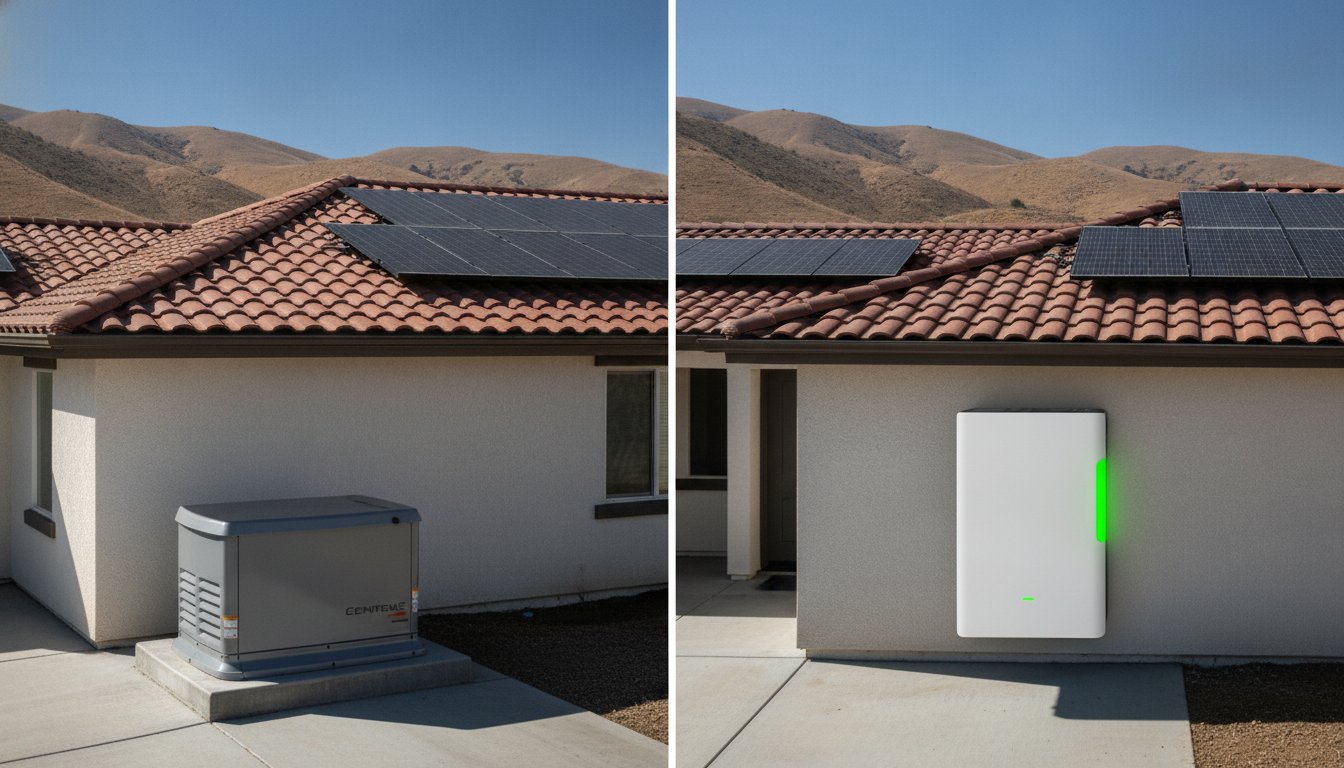
Deciding on a generator vs battery backup Southern California homeowners can trust involves balancing immediate needs with long-term financial goals. While both systems provide a safety net when the grid fails, they operate on entirely different principles. One relies on mechanical combustion and a steady fuel supply; the other uses advanced chemistry to store energy for later use. Understanding these technical differences is the first step toward taking control of your home energy future.
The Standby Generator: Reliable Power on Demand
Permanent standby units are the heavy lifters of home resilience. These systems connect directly to your home's electrical panel and a fuel source, typically natural gas or liquid propane. When the grid goes down, an automatic transfer switch detects the loss and starts the engine within seconds. This provides a seamless transition that keeps your lights, security systems, and high-draw appliances running without interruption.
The primary advantage of a generator is its runtime. As long as you have a fuel supply, the generator will continue to produce power. This makes it a preferred choice for residents in rural areas where outages might last several days. However, you must account for the mechanical realities of these systems. They are subject to local air quality regulations and require routine maintenance similar to a vehicle. In communities like Corona, noise levels and emissions are important factors to consider during the planning phase.
Whole-Home Battery Backup: Silent, Smart, and Sustainable
Batteries represent a shift toward a more integrated, intelligent home. Instead of creating power, they store it. When paired with high-efficiency REC Solar Panels, a battery system creates a closed loop of energy independence. They operate in complete silence, making them ideal for high-density residential neighborhoods where a loud engine might be a nuisance. Because they have no moving parts, the maintenance requirements are virtually nonexistent compared to a generator.
Beyond emergency backup, batteries provide daily financial benefits. In 2026, the value of a battery lies in "load shifting." You can use stored energy during the expensive 4 to 9 PM peak hours to avoid SCE's highest rates. To help offset the initial investment, the state offers the Self-Generation Incentive Program (SGIP), which provides significant rebates for qualifying installations. This program makes batteries a savvy financial tool for maximizing the ROI of your solar investment. If you want to see how these incentives apply to your specific zip code, speak with one of our local energy experts for a personalized assessment.
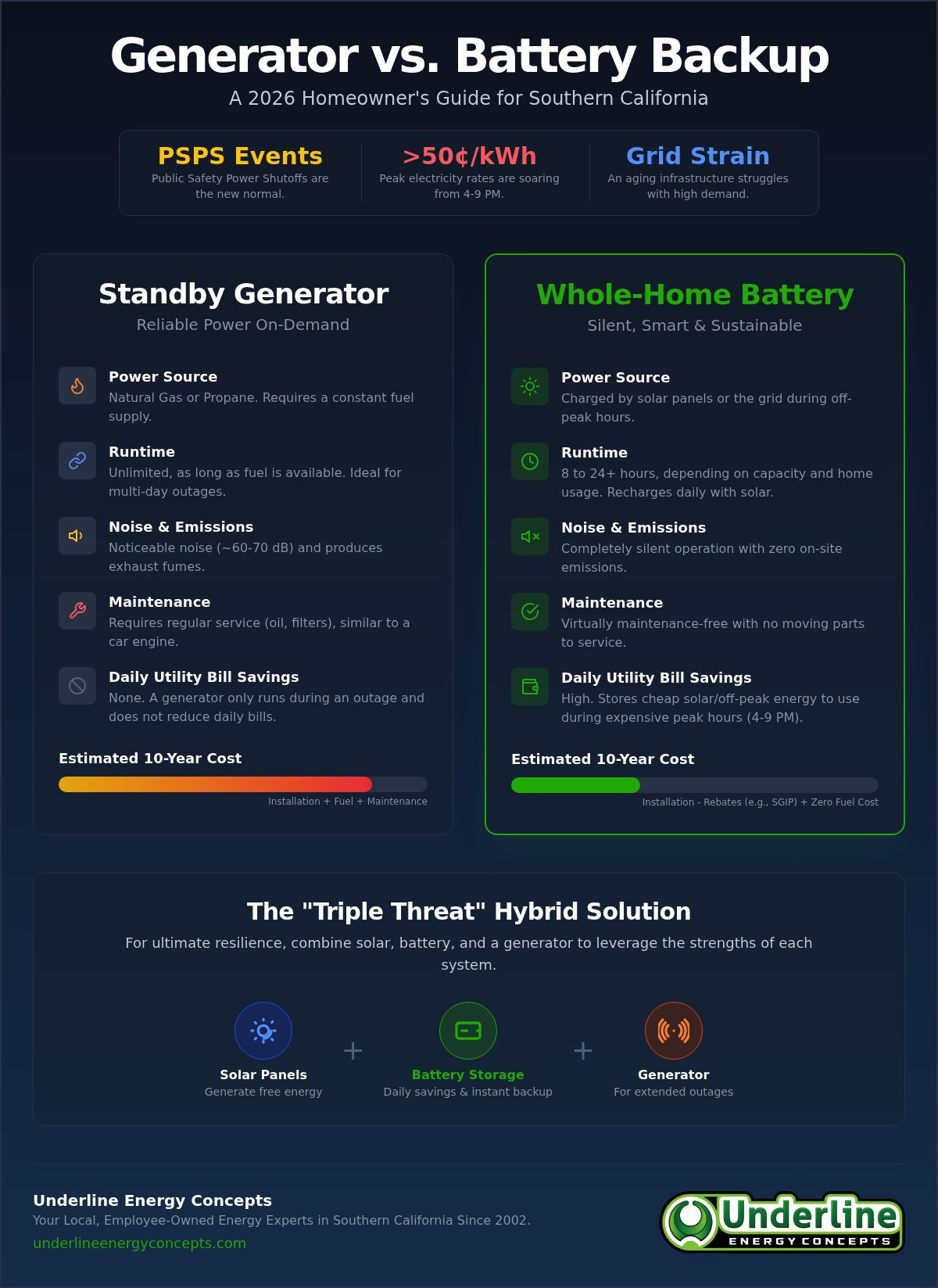
The choice ultimately depends on your specific priorities. Generators offer indefinite runtime for multi-day emergencies, while batteries provide silent operation and daily utility savings. The maintenance profiles also differ. A generator needs oil changes and spark plugs; a battery experiences slow chemical degradation over a decade or more. Both paths lead to a more resilient home, but the right fit depends on your property layout and energy goals.
Navigating SoCal Installation: Permitting, Fuel, and Compliance
Choosing between a generator vs battery backup Southern California homeowners often find that the technical logistics are what dictate the final design. It's not just about buying a unit; it's about meeting strict local codes and utility standards. From air quality standards to fire safety setbacks, every detail must be documented to ensure your home remains safe and legal. These requirements vary significantly between cities, making local expertise a vital part of your project's success.
The Permitting Lifecycle in Riverside County
Securing a permit is a multi-step process that starts with a professional site plan and ends with a final inspection from your local building department. In high-risk fire zones like Wildomar, fire safety setbacks are strictly enforced to prevent equipment from becoming a hazard during extreme weather. These regulations exist because of the Public Safety Power Shutoff (PSPS) program, which highlights the need for reliable, compliant backup power. As an employee-owned and operated local brick-and-mortar based in Lake Elsinore, we manage this entire lifecycle for you. We handle the paperwork, coordinate with inspectors, and ensure your system meets all Riverside County requirements without the typical headaches.
Your home's existing electrical infrastructure must be able to handle the new load. We often find that a 200-amp panel upgrade is necessary to safely integrate a whole-home backup system. This upgrade provides the capacity needed for high-draw appliances like your AC unit to start up when the grid is down. Without proper panel capacity, your backup system may trip breakers or fail to support your critical needs during a heatwave. We assess your current panel during the site visit to determine if an upgrade is required for long-term stability.
Fuel Coordination: Natural Gas vs. Liquid Propane
For those choosing a standby engine, fuel supply is the most critical variable. Most suburban homes will utilize natural gas, requiring coordination with SoCalGas to verify that your meter can handle the specific BTU load of the engine. In more rural areas like Perris or Menifee, where natural gas lines might not reach, liquid propane (LP) tanks offer a reliable alternative for indefinite runtime. You must ensure the gas line plumbing is sized correctly for the distance between the fuel source and the generator. Gas line sizing is the #1 cause of generator failure because an undersized pipe starves the engine of the pressure it needs to maintain a load. We verify these calculations during our initial site assessment to guarantee your system performs when you need it most.
Calculating the Real ROI: Incentives, Rebates, and Savings
Analyzing the return on investment for a generator vs battery backup Southern California homeowners choose involves looking past the initial sticker price. True ROI includes utility bill offsets, property value increases, and the mitigation of expensive outage-related losses. In 2026, the financial landscape for energy independence has shifted. While some traditional incentives have changed, new state-level programs and utility structures make the case for backup power stronger than ever. Protecting your home is a savvy financial decision that secures your comfort and your capital.
Battery Incentives: SGIP and the New Incentive Landscape
The most significant financial driver for battery storage in 2026 is the state's Self-Generation Incentive Program (SGIP). This program is designed to support residents in high-fire-threat areas or those who have experienced frequent power shutoffs. Depending on your eligibility, the Equity Resiliency Tier can provide rebates of $1,000 per kWh of storage, which significantly offsets the cost of high-performance systems. It's important to understand that the 30% federal tax credit for residential solar systems has expired as of 2026. This makes state-level rebates and the long-term savings from "load shifting" the primary engines of your battery's ROI.
By using stored energy during SCE peak hours, when rates can exceed 50 cents per kWh, you effectively bypass the most expensive electricity of the day. You can browse current local offers through the SCE Marketplace to find additional incentives that may apply to your specific equipment. If you are considering a full system upgrade, read our Solar Panel Installation Southern California Guide to see how modern storage integrates with the latest panel technology for maximum efficiency.
The Financial Case for Standby Generators
Standby generators offer a different but equally compelling financial narrative. Unlike portable units that require expensive, last-minute fuel runs and manual setup, a permanent system operates on natural gas or liquid propane. This prevents the "hidden costs" of outages, such as hundreds of dollars in spoiled food or the loss of income from home office downtime. Over a 10-year period, the total cost of ownership for a generator includes fuel and routine mechanical service, but it lacks the chemical degradation concerns of older battery chemistries.
A permanent backup system also serves as a permanent improvement to your real estate. Homes in regions like Temecula and Menifee often see a boost in property resale value when they feature professional-grade resilience. Some insurance providers may even offer premium reductions for homes equipped with permanent fire-safety systems and reliable backup power. To get a detailed breakdown of the 10-year costs for your specific property, schedule a professional consultation with our employee-owned team today. We'll help you run the numbers so you can choose the path that offers the best long-term stability for your family.
The Hybrid Solution: Why a Diversified Strategy Wins
The debate surrounding generator vs battery backup Southern California homeowners face often presents a false choice. You don't have to pick between silent efficiency and indefinite runtime. At Underline Energy Concepts, we recommend a "Triple Threat" system that combines solar panels, battery storage, and a standby generator. This diversified portfolio ensures your home remains a sanctuary during every type of grid failure. While a battery handles daily peak-shaving and short outages, the generator stands ready for those rare multi-day catastrophes where the sun alone might not be enough to power heavy AC loads.
Managing these multiple energy sources requires a sophisticated "brain" for your home. We utilize SolarEdge technology to coordinate the flow between your panels, the grid, your battery, and your generator. This integration allows your home to automatically prioritize the most cost-effective power source at any given moment. It's about achieving total autonomy. You get the silence and utility savings of a battery for 95% of the year, backed by the raw mechanical power of a generator for the remaining 5% of extreme emergencies.
Building Your Energy Portfolio
A smart energy strategy treats your home like a microgrid. Your batteries work hard every afternoon to discharge during the expensive 4 to 9 PM window, effectively shielding you from SCE's highest rates. To maximize this efficiency, we integrate specialized components like Quietcool battery charge mounts. These tools ensure your storage system stays topped off and ready to perform when the Santa Ana winds begin to kick up. This level of coordination is what separates a standard backup system from a true energy fortress.
Integrating these complex systems requires a contractor who understands the nuances of Southern California's electrical codes and climate. As an employee-owned company based in Lake Elsinore, we take a long-term view of every installation. Our team doesn't just install hardware; we design custom solutions that increase your property's value and stability. You can see these principles in action by reviewing our Integrated Roofing and Solar Case Study, which highlights how a unified approach solves multiple home energy challenges at once.
Start Your Resilience Journey Today
True peace of mind comes from knowing your family is protected regardless of what happens with the local utility. We invite you to visit our Lake Elsinore office for a no-obligation site assessment. Our experts will analyze your historical energy use and property layout to determine the perfect balance for your hybrid system. If you're already a client, don't forget to ask about our Referral Program, which rewards you for helping your SoCal neighbors achieve their own energy independence.
Don't wait for the next heatwave or PSPS event to test your home's limits. Take control of your energy future with a partner who has served this community since 2002. Schedule Your Professional Generator Consultation with Underline Energy Concepts today and discover how a diversified strategy can provide the ultimate protection for your home.
Secure Your Home's Energy Future Today
Navigating the complex choice between a generator vs battery backup Southern California homeowners face doesn't have to be overwhelming. You've learned that while batteries provide silent operation and daily utility savings through peak-shaving, standby generators offer the raw power needed for extended emergencies. In 2026, the smartest move is often a hybrid strategy that balances these strengths to protect your family and your financial interests. This diversified approach ensures you aren't left in the dark when the grid fails or when utility rates spike during peak hours.
As a local, employee-owned brick-and-mortar company based in Lake Elsinore, Underline Energy Concepts has served the region since 2002. We are a licensed roofing, electrical, and general contractor, which means we handle every technical detail from gas line plumbing to panel upgrades. We focus on quality workmanship and customer education to ensure your investment delivers long-term stability and increased property value. Take the first step toward true energy autonomy and enjoy the relief of a home that stays powered through any heatwave or wind event.
Schedule Your Professional Generator Consultation with Underline Energy Concepts and start building your custom resilience plan today.
Frequently Asked Questions
How much does a whole-home standby generator installation cost in Southern California?
Total installation costs depend on several variables. You have to consider the generator's power capacity, the distance to your gas meter, and any necessary electrical upgrades. Since we are a licensed general, electrical, and roofing contractor, we look at the whole picture. We recommend a professional site assessment to get a precise estimate tailored to your home's specific footprint and energy demands in the Inland Empire.
Do I need a permit to install a standby generator in Riverside County?
Yes, you absolutely need a permit for a permanent installation. Riverside County and local city building departments require permits to ensure the system meets fire safety and air quality standards. This process includes a site plan review and a final inspection. We manage this entire lifecycle for our clients, ensuring your generator vs battery backup Southern California project remains fully compliant with all local regulations.
Is a solar battery backup better than a generator for PSPS events?
It depends on your priorities for energy independence. Batteries excel at silent operation and reducing daily peak-hour costs. However, generators win for multi-day outages because they aren't limited by storage capacity. For many residents in high-fire-risk zones like Canyon Lake, the hybrid solution is the most effective. This combines the daily savings of storage with the indefinite runtime provided by a standby engine during long-term emergencies.
Can a standby generator run my central air conditioning during a heatwave?
Yes, a properly sized standby generator can easily power your central air conditioning. These units are designed to handle the high startup surge required by HVAC compressors. Keeping your home cool during triple-digit heatwaves in Wildomar or Menifee is a primary reason many neighbors invest in these systems. We'll evaluate your cooling load during our consultation to ensure your backup unit has the capacity to keep you comfortable.
How long can a standby generator run on natural gas?
A standby generator connected to a natural gas line can run indefinitely. Because it draws fuel from a continuous utility supply, you don't have to worry about manual refueling or running out of energy. This is a major advantage over portable models during extended Public Safety Power Shutoffs. It provides peace of mind for families in rural areas who might experience longer restoration times after a wind event or grid failure.
Will a standby generator or battery backup increase my home’s property value?
Yes, these systems are significant assets that improve property resale value. Resilience is a major selling point in Southern California where grid instability is a growing concern. A permanent backup system tells potential buyers that the home is protected from food spoilage, AC failure, and medical equipment downtime. This technological edge makes your property stand out in competitive markets like Temecula and Murrieta while providing long-term financial stability.
Does a backup generator require annual maintenance?
Yes, your generator needs annual service to ensure it performs when you need it most. This includes checking the battery, changing the oil, and replacing filters. Think of it like a vehicle that stays parked until an emergency happens. Routine maintenance prevents engine failure and extends the life of your investment. Our employee-owned team provides expert maintenance to keep your home energy system reliable for the long haul.
Can I integrate a generator into my existing solar panel system?
Yes, we can integrate a generator into your existing solar and battery setup. Using intelligent management systems like SolarEdge, we coordinate these power sources to work together seamlessly. This creates a Triple Threat energy portfolio where solar handles the day, batteries manage the evening peaks, and the generator provides a final safety net for catastrophes. It's the ultimate way to achieve autonomy and protection for your Southern California home.