
QuietCool vs Traditional AC: The Ultimate Southern California Cooling Comparison
/
Article by
Jesse Malone
Jesse Malone
CEO & Partner, Underline Energy Concepts
Jesse Malone is the CEO and Partner of Underline Energy Concepts, a Southern California energy services company that has been serving homeowners since 2002. Since joining the company and becoming a partner in approximately 2015, Jesse has helped lead its growth into one of Southern California’s most trusted providers of residential energy efficiency and home improvement solutions.
Throughout his tenure, Jesse and the Underline Energy team have completed more than 2,500 energy upgrade projects for homeowners across Southern California. These projects include solar energy systems, roofing, battery storage, EV charging stations, electrical panel upgrades, water heater replacements, attic insulation, retrofit windows, and other energy-efficient home improvements designed to lower utility costs and increase property value.
Jesse holds a Bachelor’s Degree from California Southern University and brings more than 20 years of experience in emergency services through his service with the fire department. His background in public service has shaped his leadership style, emphasizing integrity, accountability, safety, and a commitment to serving the community.
A lifelong advocate for efficiency and practical solutions, Jesse is passionate about helping homeowners make informed decisions that improve both their homes and their financial future. His interests extend beyond energy efficiency into financial literacy, budgeting, investing, and long-term wealth-building strategies. He believes that reducing unnecessary expenses and maximizing efficiency are key components of financial success.
As CEO, Jesse continues to focus on delivering exceptional customer experiences, building high-performing teams, and helping Southern California homeowners achieve greater comfort, energy independence, and long-term savings through smart home investments.
What if the secret to surviving a Southern California summer isn't a more powerful air conditioner, but a way to liberate your home from the AC altogether? With SCE and SDG&E tiered rates hitting $0.40 per kWh as of June 2026, watching your meter spin while a noisy compressor rattles all night is enough to make any homeowner feel trapped. You deserve a cool house, but you shouldn't have to choose between personal comfort and your financial stability.
When you evaluate QuietCool vs traditional AC, you quickly see that you don't have to rely solely on expensive, recycled air to stay comfortable. By shifting to a thermal mass cooling strategy, you can slash your cooling-related electricity costs by 50-90% while flushing out stale indoor allergens. This guide explains how to leverage these systems to lower your monthly utility bills, protect your home from rising energy prices, and breathe easier with 15 to 20 complete air changes every hour.
Key Takeaways
- Understand the fundamental mechanical differences in QuietCool vs traditional AC and why ventilation is often more effective than refrigeration for Southern California homes.
- Learn how to achieve a complete home air exchange every few minutes to remove dust, pet dander, and VOCs that standard AC units simply recirculate.
- Master the "70-Degree Rule" and morning pre-cooling strategies to keep your home’s thermal mass cool and delay the need for heavy AC usage.
- Discover how to integrate high-efficiency cooling with your solar and battery backup systems to gain total autonomy over your monthly utility bills.
- Identify the safety and performance requirements for attic ventilation that ensure your system meets local fire codes and operates at peak efficiency.
The Mechanics of Cooling: How QuietCool and Traditional AC Differ
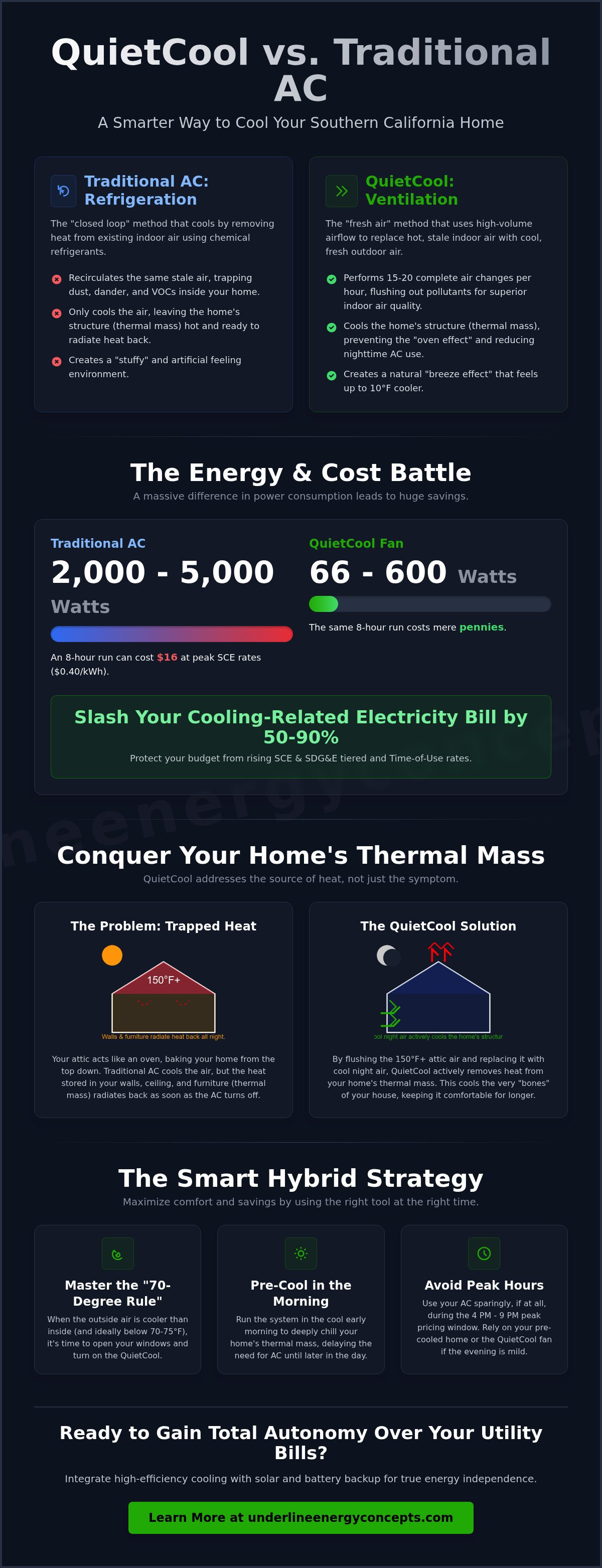
To understand the debate of QuietCool vs traditional AC, you must first understand that these systems solve the problem of heat in fundamentally different ways. Most Southern California homeowners are used to the "closed loop" of traditional air conditioning. This process relies on chemical refrigerants and a heavy compressor to strip heat from the air inside your home. It then recirculates that same air over and over. While this makes the air feel cold, it often leaves the house feeling stuffy and artificial. It is a brute-force approach to comfort that treats your home like a sealed refrigerator.
Refrigeration vs. Ventilation: A Physics Primer
QuietCool operates on a completely different physical principle. Instead of cooling the same stagnant air, it uses high-volume ventilation to create a constant stream of fresh, outdoor air. If you've ever wondered what is a whole-house fan?, it's essentially a high-powered vacuum for your home's atmosphere. By moving massive amounts of Cubic Feet per Minute (CFM), the system creates a "breeze effect" that makes the indoor temperature feel up to 10 degrees cooler than it actually is. It's the difference between standing in a walk-in freezer and sitting on a porch with a perfect coastal wind. One is a chemical process; the other is a natural one.
The Battle Against Thermal Mass
The real victory in the QuietCool vs traditional AC comparison happens where you can't see it: inside your walls. Your home acts as a giant battery for heat, a concept known as thermal mass. During a hot day in Moreno Valley, your attic can reach temperatures exceeding 150 degrees. This heat radiates downward into your ceiling and walls long after the sun sets. Traditional AC only cools the air. As soon as the unit turns off, the heat trapped in your home’s "bones" radiates back out, warming the air right back up. This is why your AC often kicks on at 10:00 PM even when it's cool outside.
QuietCool solves this by flushing the hot air out of your living space and your attic simultaneously. It replaces that 150-degree attic air with cool evening air. This process actually cools the structure of your home. By removing the heat from your furniture, drywall, and framing, you prevent the "oven effect" that usually forces your AC to run all night long. You gain control over your home's environment by addressing the source of the heat, not just the symptoms. It's a smarter, more efficient way to maintain a stable, comfortable temperature without the massive energy draw of a compressor.
Efficiency and Operational Costs: AC vs. QuietCool
Financial autonomy begins with understanding where your money goes every summer. In Southern California, the gap between QuietCool vs traditional AC operational costs isn't just a few dollars; it's a fundamental shift in your monthly budget. A standard 5-ton central AC unit pulls between 2,000 and 5,000 watts to keep your home comfortable. In contrast, a high-efficiency whole house fan operates on a fraction of that power, typically drawing between 66 and 600 watts depending on the speed setting. This makes it a powerful energy-efficient alternative to air conditioning that protects your wallet from escalating utility rates.
Watts vs. Kilowatts: The Math of Savings
Think about your energy use in terms of everyday items. Running a QuietCool fan on its lowest setting uses about the same amount of electricity as a single LED lightbulb. If you run a 5-ton AC for eight hours, you could be consuming 40 kWh of electricity. At SCE’s Tier 2 rate of $0.40 per kWh, that single day costs you $16. Switching to a whole house fan for those same eight hours brings that cost down to pennies. Based on current SCE rate data, homeowners who prioritize ventilation over refrigeration can realistically slash their cooling-related electricity bills by up to 90%.
Local Utility Impacts: SCE and SDG&E Peak Pricing
The timing of your cooling matters as much as the technology you use. Southern California Edison and SDG&E utilize Time-of-Use (TOU) rates that penalize you for using energy between 4 PM and 9 PM. This is exactly when your home's thermal mass is at its hottest. Instead of fighting the grid during peak pricing, you can use QuietCool to "pre-cool" your home earlier in the day or later in the evening when rates are lower. This strategy reduces your peak load and keeps your home's structure cool enough to skip the AC entirely during the most expensive hours of the day.
Maintenance and longevity also favor the simpler system. Traditional AC units require expensive refrigerant recharges, coil cleanings, and frequent filter replacements to stay efficient. A whole house fan relies on a durable, long-lasting motor with minimal moving parts, ensuring a much higher return on investment. For homeowners in Riverside County, the system often pays for itself in just a few seasons through direct utility savings. If you want to see how this fits into your specific energy profile, you can explore a professional whole house fan installation to start saving immediately.
Indoor Air Quality and Health: The Hidden Advantage
While the financial relief of lower utility bills is immediate, the long-term impact on your family's health is the most profound difference between QuietCool vs traditional AC. Traditional air conditioning operates as a closed loop. It takes the air already inside your home, cools it, and pushes it back through your vents. This means you are constantly breathing recirculated dust, pet dander, and microscopic skin cells. In a region like Southern California where we spend significant time indoors during the summer, this lack of fresh air can lead to "sick building syndrome" and stagnant living spaces.
QuietCool transforms your home into a breathing organism. Instead of recycling old air, it provides a complete air exchange every three to four minutes. According to the research, indoor air can be two to five times more polluted than outdoor air. By achieving 15 to 20 complete air changes per hour, you ensure that pollutants don't have the chance to settle. This active ventilation also expels "attic soup," the mixture of trapped heat and moisture that accumulates in your roof space. Removing this moisture protects your home's structure from mold and mildew growth that often goes unnoticed in traditional closed-system homes.
Flushing Out VOCs and Indoor Pollutants
Modern homes are built to be airtight for energy efficiency, but this design choice traps Volatile Organic Compounds (VOCs) from cleaning chemicals, paints, and off-gassing furniture. QuietCool requires you to open a few windows to operate, which naturally boosts indoor oxygen levels and flushes these toxins out of your living space. This process aligns with the U.S. Department of Energy guide on whole-house fans, which highlights how moving air through the entire home is a superior way to maintain a healthy environment. You gain total control over the freshness of your air, rather than relying on a filter that hasn't been changed in months.
Allergies and the SoCal Environment
Homeowners in the Inland Empire often worry that opening windows will invite dust and pollen inside. However, using QuietCool vs traditional AC actually helps manage these irritants more effectively. When you run a whole house fan with high-quality window screens, the high-volume airflow creates a pressurized environment that can help expel lighter particulates while bringing in filtered, cooler evening air. This influx of fresh air is particularly beneficial for sleep quality. During those cool Menifee nights, the drop in indoor temperature and the rise in oxygen levels support deeper REM sleep. You'll wake up feeling refreshed because you spent the night breathing crisp, natural air rather than the dry, artificial atmosphere created by a compressor.
The Hybrid Strategy: When to Use AC and When to Use QuietCool
Stop viewing QuietCool vs traditional AC as a competition. In the challenging climate of Murrieta or Menifee, the most effective approach is a hybrid strategy that uses each system for its specific strength. Your air conditioner is a specialist at removing humidity and lowering temperatures when it's blistering outside. Your whole house fan is a specialist at mass-cooling your home's structure and flushing the attic. By coordinating these two, you maximize comfort while minimizing that $0.40 per kWh SCE bill.
The 70-Degree Rule is your guide for this transition. The math is simple. Once the outside temperature drops below 70 degrees, or at least becomes lower than your indoor temperature, it's time to turn off the AC and open the windows. This usually happens around sunset in Southern California. Flipping the switch at this precise moment prevents the AC from fighting the "oven effect" of your attic, which can stay at 150 degrees long after dark. You're essentially letting nature do the heavy lifting for pennies on the dollar.
The Daily Cooling Cycle
- Evening: Open windows in the rooms you're currently using and blast the fan on high. This immediately dumps the day's trapped heat and provides an instant breeze.
- Night: Shift the fan to a lower, whisper-quiet setting. This "deep cools" the thermal mass of your home, chilling the walls, floors, and furniture throughout the night.
- Morning: Turn the fan off before the sun gets high, typically around 7:00 AM or 8:00 AM. Close your windows, blinds, and high-quality windows to trap that reservoir of cold air inside for the rest of the day.
The "AC Assist" Method
Even on 100-degree days, your fan is a vital teammate. If you've been away and your home has climbed to 85 degrees, don't just crank the AC. Run the whole house fan for 10 minutes first to flush out the hottest air and reset the attic temperature. This "AC Assist" can drop the initial indoor temperature by several degrees instantly. This means your AC only has to maintain the cool rather than fight an uphill battle against a heat-soaked structure. This simple move can save up to two hours of compressor runtime. While the AC is better for those rare humid "monsoon" days, the fan remains your primary defense against dry desert heat. To start building your custom cooling plan, explore our whole house fan options today.
The Underline Advantage: Expert Installation and Energy Integration
Choosing between QuietCool vs traditional AC is only the first step toward achieving true energy independence. The real value comes from how these systems are integrated into your home's specific ecosystem. At Underline Energy Concepts, we take a holistic approach to your home's efficiency. We serve neighbors in Canyon Lake, Temecula, and the surrounding Inland Empire with local expertise that national retailers simply cannot match. We don't just install a fan; we perform a comprehensive energy audit to ensure every component of your home works in harmony to lower your monthly bills.
This level of system integration and technical oversight isn't just for residences; for business owners looking to secure and streamline their commercial operations, you can check out Terapixels Systems for expert cabling and cybersecurity management.
Attic Ventilation and Fire Code Upgrades
Proper installation requires more than just a hole in the ceiling. To maximize the benefits of a whole house fan, your attic must have adequate exhaust venting to handle the massive volume of air being moved. Without this balance, you risk backdrafting or reduced efficiency. We specialize in updating vents to meet modern California fire codes, which is critical for homes in high-risk wildfire zones. Our team ensures that your roofing warranty remains fully intact by using industry-approved methods and materials. This professional oversight protects your investment and ensures your home remains safe and compliant.
Solar, Batteries, and the QuietCool Connection
The synergy between a whole house fan and a whole home Battery backup is a game changer for Southern California homeowners. During a grid outage or a Flex Alert, running a traditional AC unit can drain a home battery in just a few hours. Because QuietCool uses up to 90% less energy, it allows your battery backup to last significantly longer. This ensures you stay cool even when the grid fails. It's about maintaining control over your comfort during the times you need it most.
Additionally, cooling your attic mass actually improves the performance of your Solar Panel Install. High heat can reduce solar panel efficiency; by lowering the ambient temperature under the roof, you help your system produce more power. True energy autonomy is about making smart, data-driven decisions for your property. By combining high-efficiency cooling with attic insulation and solar power, you create a home that is resilient against rising utility rates. We are here to guide you through every step of this transition, from the initial evaluation to the final installation. Take the first step toward a more comfortable and cost-effective home today. Schedule a professional cooling audit with Underline Energy Concepts to see how much you can save.
Take Control of Your Home's Climate and Costs
Reclaiming your financial autonomy starts with shifting how you think about home comfort. By choosing a cooling strategy that addresses thermal mass and stagnant air, you move beyond the expensive limitations of a closed-loop system. Comparing QuietCool vs traditional AC reveals that you don't have to settle for soaring utility bills or poor indoor air quality. You can enjoy a home that breathes naturally while keeping your hard-earned money in your pocket.
Underline Energy Concepts is your local partner in this transition. As a licensed Southern California General Contractor with deep expertise in solar and cooling integration, we specialize in creating resilient, energy-independent homes. Whether you live in Murrieta, Temecula, or Menifee, we are ready to help you optimize your energy profile for long-term stability. Start saving on your energy bills with a QuietCool installation from Underline Energy Concepts. You have the power to transform your living space into a high-performance environment that serves your family and your budget for years to come.
Frequently Asked Questions
Does QuietCool actually replace my traditional air conditioner?
QuietCool acts as a powerful partner to your existing air conditioner rather than a complete replacement. While it handles the majority of the cooling work during the evening and night, you'll still want your traditional AC for those rare days with high humidity or extreme triple-digit heat. This hybrid approach ensures you stay comfortable all summer while using the most cost-effective tool for the job.
QuietCool acts as a powerful partner to your existing air conditioner rather than a complete replacement. While it handles the majority of the cooling work during the evening and night, you'll still want your traditional AC for those rare days with high humidity or extreme triple-digit heat. To ensure your primary system is ready for these demands, Ultra Air Heating and Cooling offers expert climate solutions that maximize efficiency and reliability. This hybrid approach ensures you stay comfortable all summer while using the most cost-effective tool for the job.
How many windows do I need to open to run my whole house fan safely?
You typically need to open between one and three windows to provide enough airflow for the system. A good rule of thumb is to provide roughly one square foot of window opening for every 750 CFM of fan capacity. Opening windows in the specific rooms you want to cool allows you to direct the fresh breeze exactly where it is needed most while preventing backdrafting.
Is the QuietCool fan loud enough to disturb my sleep?
These systems are engineered with specialized acoustical ducting that dampens motor vibration and noise. On lower speeds, the sound is a soft, rhythmic hum that many homeowners find comparable to a white noise machine. You can run the unit throughout the night without the loud clanking or jarring starts and stops associated with a traditional AC compressor cycle.
Can I run my whole house fan during a Southern California heatwave?
You should run your fan during a heatwave specifically when the outside temperature drops below your indoor temperature. Even during a blistering Inland Empire afternoon, the air often cools down significantly after sunset. Using the fan during these cooler windows flushes out the day's trapped heat and deep-cools your home's structure to prepare it for the following day's sun.
Does a whole house fan work in humid weather?
Whole house fans are most effective in dry, arid climates where the evening temperature drop is significant. While the fan can still move air and provide a cooling breeze in humid conditions, it won't be as efficient at lowering the temperature of your home's thermal mass. During those rare humid "monsoon" stretches in Southern California, your traditional AC remains the better tool for removing moisture.
How much can I realistically save on my monthly SCE bill with QuietCool?
When evaluating QuietCool vs traditional AC, the savings stem from the massive difference in power draw between a fan and a compressor. Because a fan uses a fraction of the wattage, you can stay within your baseline electricity allocation more easily. By avoiding the expensive upper-tier surcharges triggered by heavy AC use, you gain much better control over your monthly utility expenses.
Do I need to clean or maintain my QuietCool fan every year?
Maintenance requirements are very low because the system has fewer complex moving parts than a central air unit. You should periodically check your attic vents for any obstructions and wipe down the ceiling intake grille to prevent dust buildup. You don't have to worry about refrigerant levels, seasonal coil cleanings, or expensive mechanical tune-ups to keep the system running at peak performance.
What happens to the air in the attic when the fan is running?
The fan pulls fresh air from your open windows and pushes it directly into the attic space. This creates positive pressure that forces the stagnant, superheated attic air out through your existing roof and gable vents. This constant cycle effectively "washes" your attic with cool air, which stops heat from radiating back down into your living space through the ceiling.