
The Real Cost of EV Charger Installation in Southern California: 2026 Homeowner’s Guide
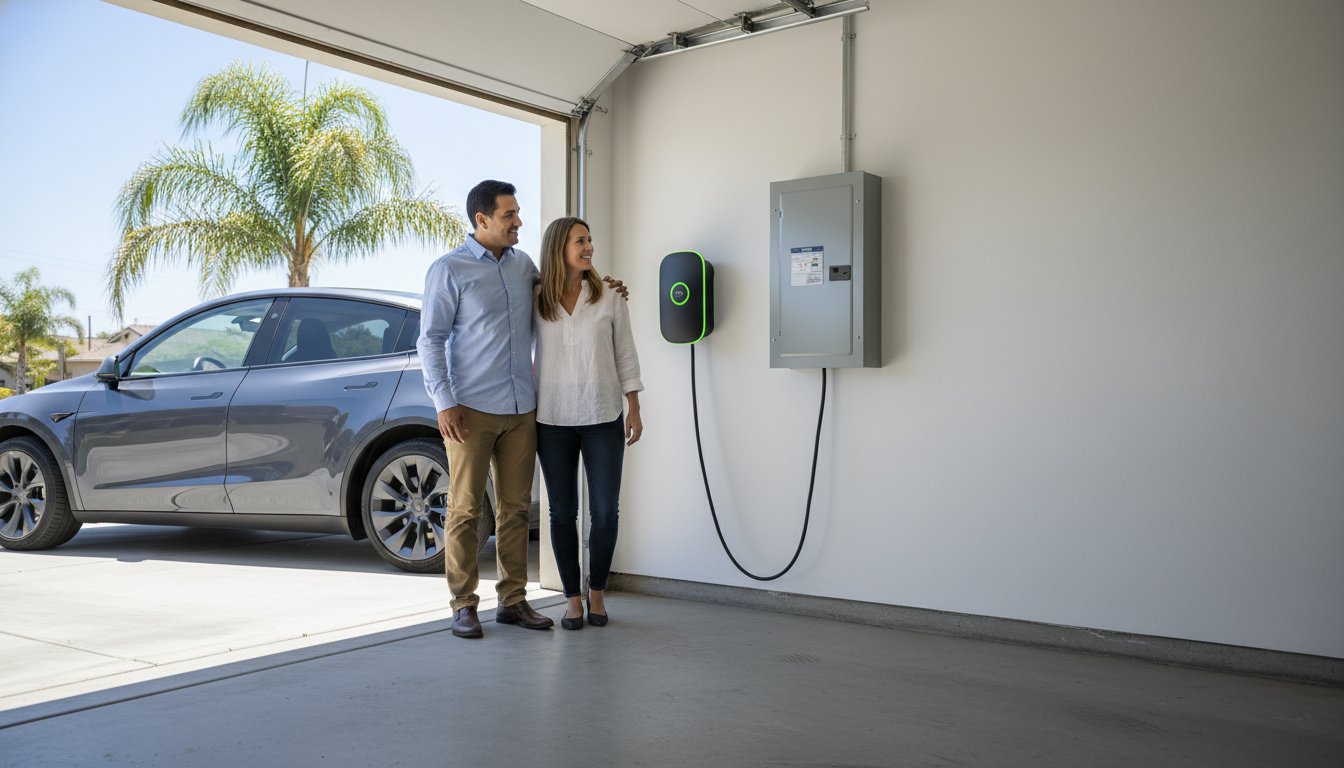
/
Article by
Jesse Malone
Jesse Malone
CEO & Partner, Underline Energy Concepts
Jesse Malone is the CEO and Partner of Underline Energy Concepts, a Southern California energy services company that has been serving homeowners since 2002. Since joining the company and becoming a partner in approximately 2015, Jesse has helped lead its growth into one of Southern California’s most trusted providers of residential energy efficiency and home improvement solutions.
Throughout his tenure, Jesse and the Underline Energy team have completed more than 2,500 energy upgrade projects for homeowners across Southern California. These projects include solar energy systems, roofing, battery storage, EV charging stations, electrical panel upgrades, water heater replacements, attic insulation, retrofit windows, and other energy-efficient home improvements designed to lower utility costs and increase property value.
Jesse holds a Bachelor’s Degree from California Southern University and brings more than 20 years of experience in emergency services through his service with the fire department. His background in public service has shaped his leadership style, emphasizing integrity, accountability, safety, and a commitment to serving the community.
A lifelong advocate for efficiency and practical solutions, Jesse is passionate about helping homeowners make informed decisions that improve both their homes and their financial future. His interests extend beyond energy efficiency into financial literacy, budgeting, investing, and long-term wealth-building strategies. He believes that reducing unnecessary expenses and maximizing efficiency are key components of financial success.
As CEO, Jesse continues to focus on delivering exceptional customer experiences, building high-performing teams, and helping Southern California homeowners achieve greater comfort, energy independence, and long-term savings through smart home investments.
In Southern California, you aren't just paying for a charger; you're paying for the electrical infrastructure that supports it. Understanding the total cost of EV charger installation Southern California homeowners face in 2026 means looking beyond the hardware price tag. It's frustrating when one neighbor gets a quick install for a low fee while your quote in Menifee or Temecula includes a mandatory panel upgrade. You deserve to know exactly why these prices fluctuate and which local rebates will actually lower your bottom line.
We're here to provide that clarity. This guide breaks down the real-world expenses of labor and materials while highlighting the specific 2026 incentives that put money back in your pocket. You'll learn about the new AB 1820 permit fee caps, discover if your current electrical panel can handle the load, and get a roadmap to maximize SCE and federal tax credits before the June 30 deadline. By the end, you'll have the confidence to upgrade your home with total financial control.
Key Takeaways
- Understand the three pillars of cost, hardware, labor, and infrastructure, that define the total cost of EV charger installation Southern California homeowners see on their quotes.
- Evaluate the technical differences between hardwired units and NEMA outlets to ensure your 40-amp or 50-amp circuit meets 2026 safety standards.
- Use professional load calculations to determine if an electric panel upgrade is a necessary step for your home's capacity before starting the project.
- Secure your financial return by stacking the 30% federal tax credit with Southern California Edison’s Charge Ready Home incentives before they expire.
- Align your charging needs with your existing electrical system to prevent expensive infrastructure mistakes and maximize your long-term energy stability.
Breaking Down the Cost Factors of SoCal EV Home Charging
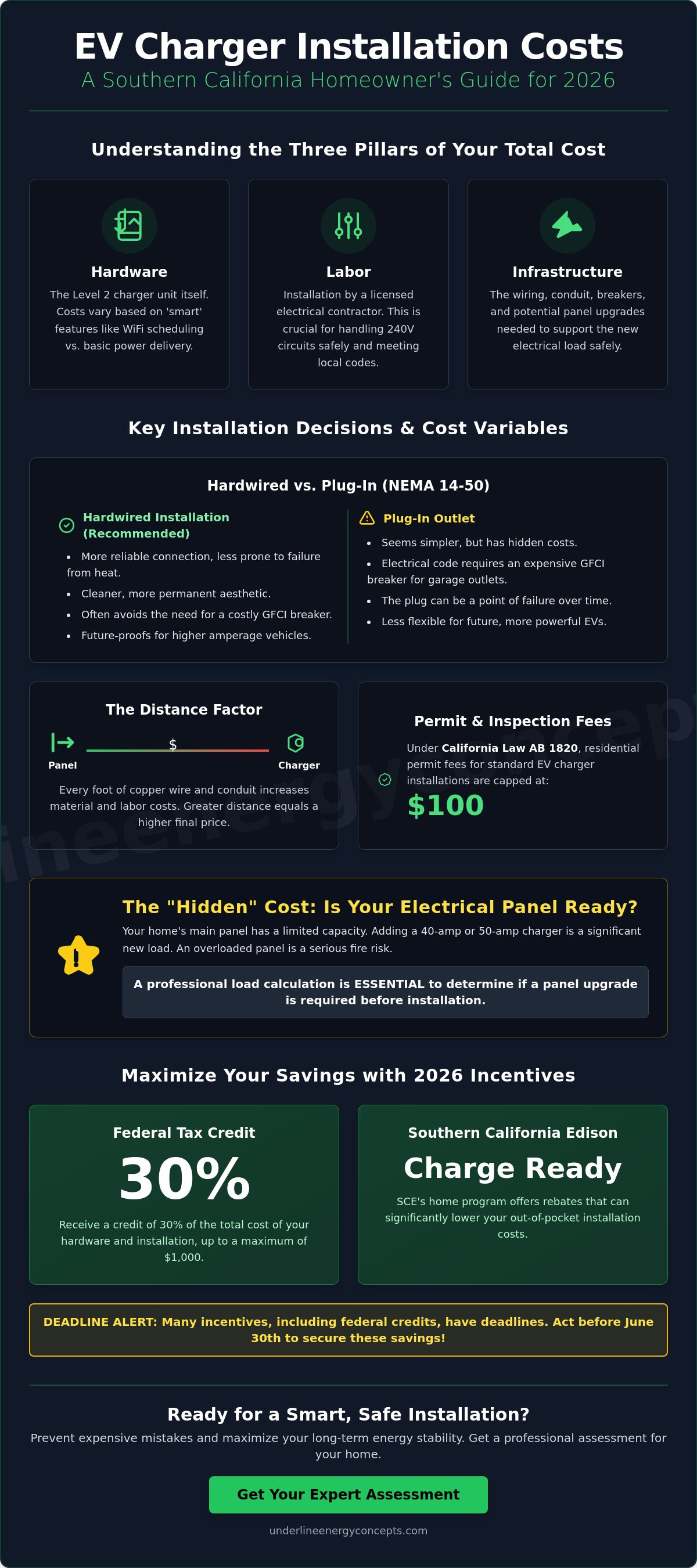
The total cost of EV charger installation Southern California residents encounter in 2026 depends on three specific pillars: hardware, labor, and infrastructure. While a basic Level 2 setup might seem straightforward, your final investment is shaped by the unique electrical demands of your home and the strict safety standards of the Golden State. It's common to see a wide range of quotes online, but these often shift after a physical site walk. A specialist needs to see your panel's current load and the distance to your garage to provide an accurate figure. Southern California’s high demand for skilled trades also means labor rates reflect the specialized knowledge required to meet Title 24 energy codes.
Hardware vs. Installation Labor
Choosing your electric vehicle supply equipment (EVSE) is the first major decision. Smart chargers offer WiFi connectivity and off-peak scheduling to save on SCE rates, while basic units simply deliver power. While you can buy hardware yourself, many homeowners prefer contractor-sourced materials. This approach often secures better warranty protection and ensures the unit is compatible with your home's existing capacity. Don't be tempted to hire a general handyman for this task. High-voltage 240V circuits require a licensed electrical contractor to prevent fire risks and ensure the system operates at peak efficiency for years.
Local Permit and Inspection Fees
Permitting is a non-negotiable step for any Southern California installation. In cities like Corona, Murrieta, and Temecula, local building departments require a permit to verify that your home can safely support the new electrical draw. Under California law AB 1820, residential permit fees for EV charging stations are now capped at $100 for standard installations. This regulation protects you from excessive municipal costs while ensuring safety. Skipping this step is a major risk. Unpermitted electrical work can jeopardize your home insurance coverage and may lead to complications if you decide to sell your property later. The inspector’s role is to confirm that the load calculations are accurate, protecting your investment and your family’s safety.
Level 2 Charging: Hardware Options and Wiring Requirements
Select the right connection method to avoid unexpected expenses during your project. While many homeowners assume a NEMA 14-50 outlet is the most cost-effective route, recent code changes have shifted the financial math. The technical requirements for your circuit depend on your vehicle's charging speed. A 40-amp circuit is standard for many, but a 50-amp circuit allows for faster charging. These setups require specific materials, including heavy-gauge copper wire, durable conduit, and industrial-grade breakers that can handle continuous electrical loads for hours at a time. Using high-quality materials ensures your system operates safely without overheating or tripping breakers during the night.
Hardwired vs. Plug-In Installations
Choose hardwiring to maximize the reliability of your home charging station. Hardwired installations are often the superior choice for the Southern California climate because they eliminate the plug-and-socket connection, which can be a point of failure in high heat. There is also a hidden cost associated with plug-in chargers. The National Electrical Code now requires GFCI breakers for all garage outlets. These specialized breakers are much more expensive than the standard breakers used for hardwired units. By hardwiring your charger, you often bypass the need for a GFCI breaker while creating a cleaner, more permanent look. This approach also future-proofs your home, as hardwired connections can typically support higher amperage for future electric vehicles.
The Distance and Placement Variable
Distance is the most significant variable in the total cost of EV charger installation Southern California homeowners experience. Every foot of heavy-duty copper wire and protective conduit adds to the material and labor totals. If your main electrical panel is located on the opposite side of the home from your garage, the installation becomes more complex. Detached garages or outdoor pedestals may require trenching through dirt or concrete, which involves more intensive labor. Consider the placement of your vehicle’s charging port before finalizing the location. Efficient placement reduces the linear footage of wire needed and keeps your invoice manageable. Ensure your home's infrastructure can support this new technology by considering an electric panel upgrade to handle the increased demand safely and effectively.
Environmentally conscious homeowners in the Inland Empire should also consider how equipment ratings impact longevity. High-voltage components must be rated for their specific environment. If you install a charger outdoors, it requires a higher NEMA rating to withstand dust and occasional moisture. Investing in the right hardware and placement today prevents the need for costly repairs or relocations tomorrow.
The "Hidden" Cost: Electrical Panel Upgrades and Capacity
"Why do I need a new panel for just one charger?" This is the most common question we hear from homeowners in older Riverside County neighborhoods. It feels like an unnecessary hurdle, but it's actually about protecting your home from a massive new electrical demand. A Level 2 charger isn't like a toaster or a vacuum; it pulls a high, continuous load for hours. Under California electrical code, we must perform a load calculation to ensure your existing system won't overheat. For those interested in the technical details of this process, Sanford Electric, LLC offers a detailed look at how to calculate circuit loads and avoid overloading. If your panel is already nearing its limit with your air conditioning and electric dryer running, adding an EV could trigger a safety hazard. The total cost of EV charger installation Southern California residents pay often includes this vital infrastructure work to ensure long-term stability.
Identifying an unsafe panel is the first step toward a safer home. If your garage features a panel from Zinsco or Federal Pacific, you're likely sitting on a fire risk that many insurance companies won't cover in 2026. These older units are notorious for failing to trip during an overload. Replacing these with a modern system isn't just about the car; it's about securing your entire property. Transitioning to a 200-amp service provides the autonomy to add more technology later, such as solar panel installation or a whole-home battery backup, without ever worrying about your power capacity again.
Is Your 100-Amp Panel Enough?
Load capacity is the maximum amount of electricity your home can safely draw at one time. A standard Level 2 charger can consume 30% to 40% of a 100-amp panel’s total capacity on its own. For many 1970s-era homes in the Inland Empire, this creates a significant bottleneck. If an upgrade isn't feasible, you might explore smart energy management systems that "shed" the EV load when your AC kicks on. However, these are often temporary fixes. Overloading an original 100-amp panel leads to flickering lights, tripped breakers, and premature wear on your appliances. Securing a professional electric panel upgrade is usually the most logical path to reliable power.
The ROI of a 200-Amp Main Panel Upgrade
Investing in a 200-amp upgrade offers a tangible return on investment beyond just charging your car. Homes with modernized electrical systems command higher resale values in the Southern California market because they're ready for the future. You can often integrate this upgrade with a solar project to streamline your financing and maximize federal tax credits. The process involves coordination with Southern California Edison (SCE) to disconnect and reconnect your service, a timeline we manage to minimize your downtime. By the time the work is done, you'll have a foundation that supports your EV, your home’s value, and your environmental goals for decades to come.
Maximizing Savings: 2026 Rebates and Tax Credits
Don't let the sticker price of a new system deter you from the benefits of home charging. While the initial investment matters, the actual cost of EV charger installation Southern California homeowners pay is significantly reduced when you leverage current incentives. Stacking federal credits with local utility rebates can turn a major infrastructure project into a manageable home improvement. The key is acting before specific deadlines, particularly the federal tax credit expiring on June 30, 2026. By taking control of these financial tools, you transform a necessary expense into a savvy long-term investment in your home’s autonomy.
SCE Programs and Time-of-Use Rates
Southern California Edison (SCE) offers more than just electricity; they provide a pathway to lower operating costs through the Charge Ready Home program. If you need a panel upgrade to support your new charger, income-qualified customers can receive rebates of up to $4,200 to cover those costs. Even if you don't qualify for the full rebate, switching to a Time-of-Use rate like TOU-D-PRIME can drastically lower your monthly bills. This rate is designed specifically for EV owners, allowing you to charge your vehicle when demand on the grid is lowest. To ensure you qualify for these programs, it's vital to work with a contractor who understands the specific documentation requirements of Riverside County utility providers.
Federal and State Tax Incentives
The Federal Alternative Fuel Vehicle Refueling Property Tax Credit remains the most powerful tool in your financial arsenal. This credit covers 30% of your total hardware and installation costs, capped at $1,000 for residential properties. You’ll use IRS Form 8911 to claim this when filing your taxes. For residents in the Inland Empire, the South Coast Air Quality Management District (SCAQMD) also offers a hardware rebate of up to $250 for Level 2 chargers, with higher amounts available for low-income households. Combining these incentives ensures that 2026 is the most affordable year yet to modernize your home’s energy capabilities. To get started on your project and lock in these savings, reach out to Underline Energy Concepts for a professional consultation today.
Keep your paperwork organized to ensure a smooth claim process. You will need the following documentation for most rebate and tax credit applications:
- The final paid invoice from your licensed electrical contractor.
- A copy of the finalized building permit from your city, such as Corona or Murrieta.
- The specific model and serial number of your Level 2 charger.
- Your most recent utility bill showing your SCE account number.
- Photos of the completed installation and your new electrical panel if an upgrade was performed.
The Underline Advantage: Expert Installation in the Inland Empire
Choosing the right partner determines whether your project is a simple upgrade or a long-term headache. In communities like Canyon Lake and Menifee, local building codes require a specific level of expertise that outside contractors often miss. We understand that the cost of EV charger installation Southern California residents manage is about more than just a wire. It is about integrating a high-power device into your existing energy ecosystem. We specialize in complex electrical upgrades that ensure your home remains safe and efficient. By choosing a local specialist, you gain a partner who understands the specific grid requirements of Riverside County and the nuances of SCE incentive programs.
Most installers simply pull a wire from the panel to the garage. We take a different path. Our team evaluates your entire property to identify opportunities for optimization. If you are considering a solar panel install or need roofing repairs, it makes sense to address the electrical panel at the same time. This synergy saves you money and prevents redundant labor costs. We handle the "White Glove" details that others ignore, from performing precise load calculations to filing permits with your city and providing the documentation you need for rebate support. This level of service ensures you don't leave money on the table while securing your home’s long-term stability.
A Holistic Approach to Home Energy
We look at your home as a complete system. From the main breaker to the attic insulation, every component affects your energy stability. As a licensed general contractor, we provide a higher standard of care than a basic electrician. We ensure all electrical work is fire-code compliant and integrated with your current or future solar panel installation. This comprehensive view gives you the autonomy to grow your home’s energy capabilities without fear of overloading the system. We prioritize safety and efficiency, ensuring that your new charger works in harmony with your hybrid water heater, HVAC system, and other high-demand appliances.
Ready to Charge? Get Your Local Quote Today
Secure your home’s energy future with a partner who understands the Inland Empire. We maintain a strong local presence in Temecula, Murrieta, and Lake Elsinore; this allows us to respond quickly to your needs and provide expert guidance tailored to our region. Don’t guess at your project requirements or rely on generic online estimates. Schedule a professional site assessment to receive an accurate, transparent breakdown of your specific installation needs. Get your expert EV charger installation quote and take the first step toward a more sustainable, self-sufficient home today.
Take Control of Your Home’s Energy Future
Transitioning to an electric vehicle is a bold step toward financial and environmental autonomy. You now understand that the true cost of EV charger installation Southern California homeowners experience involves balancing hardware choices with critical infrastructure like electric panel upgrades. By acting before the June 2026 federal tax credit deadline and utilizing SCE rebates, you can significantly lower your net investment while increasing your home’s resale value. These incentives provide a rare window to modernize your property for a fraction of the standard price.
Don't leave your home’s safety to chance with unverified contractors. As a local, SoCal family-owned and operated business, Underline Energy Concepts brings the expertise of a licensed electrical and general contractor to every project. We specialize in navigating the specific panel upgrade needs of older Inland Empire homes to ensure your new charging station runs flawlessly for years to come. Take the first step toward a more reliable and cost-effective home energy system by partnering with a guide you can trust. Schedule Your Professional EV Charger Site Assessment and secure your energy independence today.
Frequently Asked Questions
How much does it cost to install a Level 2 EV charger in Southern California?
The total cost of EV charger installation Southern California homeowners pay is determined by your home's existing electrical capacity and the distance between your panel and the charging station. While hardware is a fixed expense, labor and infrastructure work vary based on complexity. Standard installations are the most affordable, while projects requiring trenching for detached garages or main panel upgrades represent a larger investment in your home’s long-term infrastructure.
Do I really need a permit for an EV charger in Riverside County?
Yes, you must obtain a permit for any Level 2 charger installation in Riverside County to ensure safety and code compliance. Under California law AB 1820, residential permit fees are capped at $100 for standard installations. Securing this permit protects your home insurance coverage and verifies that the new electrical load won't compromise your property’s safety. It's a vital step for maintaining the legal standing and safety of your home.
Can I install an EV charger if I only have a 100-amp panel?
You can technically install a charger on a 100-amp panel, but it often requires load management technology or a full electric panel upgrade to prevent overloading. A Level 2 charger consumes a significant portion of a 100-amp system's total capacity. Upgrading to a 200-amp panel provides the autonomy to run your AC, appliances, and charger simultaneously without the risk of tripping breakers or overheating your electrical system.
How long does a professional EV charger installation take?
A standard professional installation typically takes between four to eight hours to complete. If your project requires complex wiring, trenching for a detached garage, or a main panel swap, the timeline may extend to a full day of work. We manage the entire process, including coordination with Southern California Edison for panel reconnections, to ensure your transition to home charging is as efficient and seamless as possible.
Does SCE offer rebates for home EV charging stations in 2026?
Yes, Southern California Edison provides significant rebates through the Charge Ready Home program in 2026. Income-qualified customers may receive up to $4,200 to cover the expenses of necessary electrical panel upgrades. Stacking these utility incentives with the 30% federal tax credit ensures you maximize your savings while modernizing your home’s energy capabilities. These programs help make the cost of EV charger installation Southern California more accessible for every resident.
Is a hardwired charger better than a NEMA 14-50 plug?
Hardwired chargers are generally the superior choice for Southern California’s climate because they offer a more durable connection that withstands high heat better than a standard plug. Hardwiring also avoids the added expense of a GFCI breaker, which is now required by code for all garage outlets. This setup provides a cleaner look and supports higher charging speeds, making it the more logical choice for future-proofing your home.
Will installing an EV charger increase my property value in SoCal?
Installing a Level 2 charging station boosts your property value as EV adoption continues to rise across the region. Homebuyers in 2026 prioritize "EV-ready" homes that don't require immediate electrical renovations or infrastructure work. Modernizing your electrical system today positions your property as a high-tech, sustainable asset in the competitive Southern California real estate market, offering a clear return on your investment.
Can I use my solar panels to charge my EV directly?
You can use your solar panel install to charge your EV by routing the generated power through your home’s electrical panel. While the panels power your home first, any excess energy can go directly to your vehicle during peak sunlight hours. This creates a self-sustaining energy loop that reduces your reliance on the grid and maximizes the financial benefits of your solar investment.