
Powering EV Charger with Solar Panels: The 2026 SoCal Homeowner’s Guide
/

Article by
Jesse Malone
Jesse Malone
CEO & Partner, Underline Energy Concepts
Jesse Malone is the CEO and Partner of Underline Energy Concepts, a Southern California energy services company that has been serving homeowners since 2002. Since joining the company and becoming a partner in approximately 2015, Jesse has helped lead its growth into one of Southern California’s most trusted providers of residential energy efficiency and home improvement solutions.
Throughout his tenure, Jesse and the Underline Energy team have completed more than 2,500 energy upgrade projects for homeowners across Southern California. These projects include solar energy systems, roofing, battery storage, EV charging stations, electrical panel upgrades, water heater replacements, attic insulation, retrofit windows, and other energy-efficient home improvements designed to lower utility costs and increase property value.
Jesse holds a Bachelor’s Degree from California Southern University and brings more than 20 years of experience in emergency services through his service with the fire department. His background in public service has shaped his leadership style, emphasizing integrity, accountability, safety, and a commitment to serving the community.
A lifelong advocate for efficiency and practical solutions, Jesse is passionate about helping homeowners make informed decisions that improve both their homes and their financial future. His interests extend beyond energy efficiency into financial literacy, budgeting, investing, and long-term wealth-building strategies. He believes that reducing unnecessary expenses and maximizing efficiency are key components of financial success.
As CEO, Jesse continues to focus on delivering exceptional customer experiences, building high-performing teams, and helping Southern California homeowners achieve greater comfort, energy independence, and long-term savings through smart home investments.
What if your daily commute cost you nothing but a few hours of Southern California sunshine? With Southern California Edison rates hitting as high as 74 cents per kWh during summer peaks, driving an electric vehicle can feel like you've just swapped one expensive fuel for another. You aren't alone in feeling frustrated by utility bills that seem to climb every month in Riverside and Temecula. Many homeowners are finding that powering ev charger with solar panels is no longer just a "green" luxury; it's a financial necessity for anyone looking to escape the volatility of the grid.
Underline Energy Concepts has helped local families navigate these shifts since 2002. We understand the confusion surrounding how many panels your specific car needs and whether your current electrical service can handle the extra load. This 2026 guide will show you how to maximize your ROI under the current NEM 3.0 rules, where export rates have dropped to just $0.05 to $0.08 per kWh. You'll learn how to bypass those low export credits by using your solar energy exactly where it's worth the most: right in your own driveway. We'll cover everything from panel counts to electrical upgrades so you can achieve total energy independence.
Key Takeaways
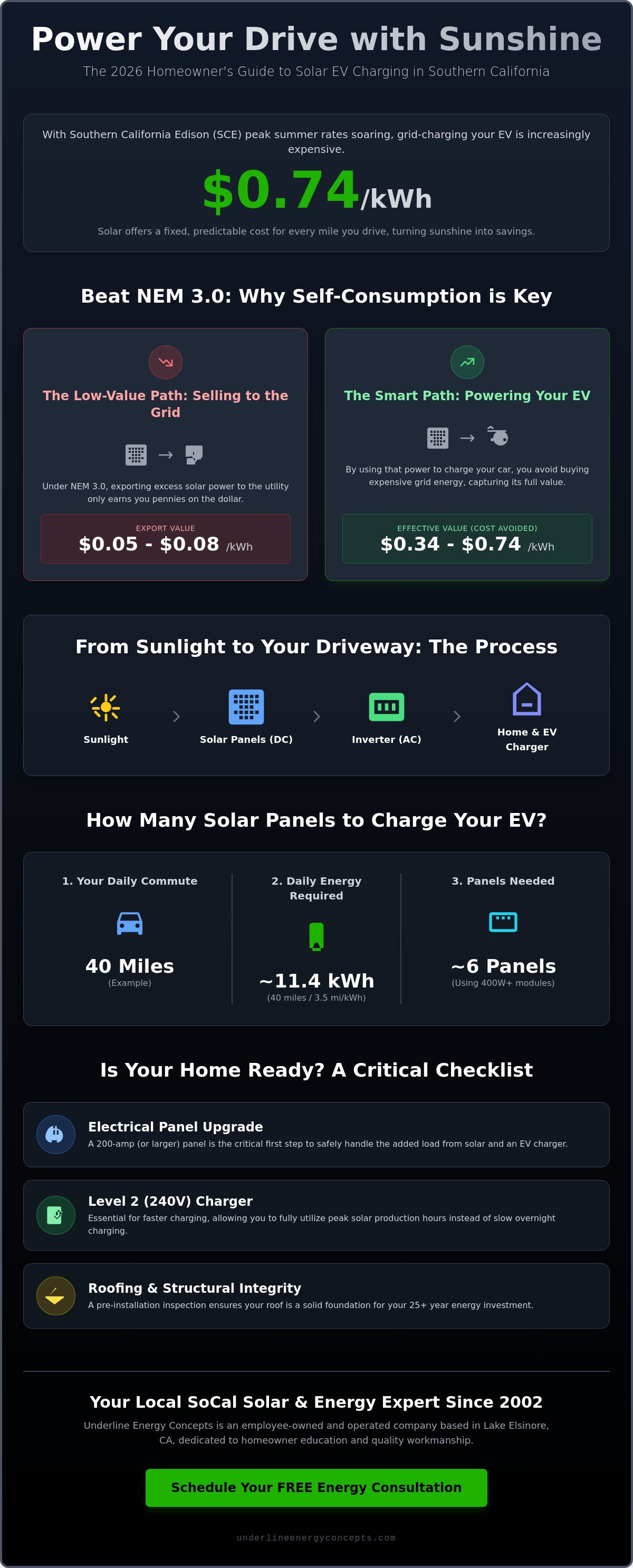
- Learn how to beat NEM 3.0 export rates by consuming your own solar energy to fuel your car instead of selling it back to the utility company for pennies.
- Discover the specific calculations for powering ev charger with solar panels based on your daily commute and the output of modern 400W+ high-efficiency modules.
- Identify why a 200-amp or 400-amp electric panel upgrade is often the critical first step to ensuring your home's infrastructure can safely handle the increased load.
- Understand the technical necessity of Level 2 charging stations for solar-integrated homes to ensure efficient energy conversion and faster recovery times.
- Find out how pairing your solar array with smart solutions like Whole House Fans can reduce home energy demand, leaving more power available for your vehicle.
The Financial Case for Solar-Powered EV Charging in Southern California
Southern California isn't just the sunniest place to live; it's also one of the most expensive regions to drive if you rely solely on the grid. While our abundant sunshine provides the perfect fuel, the extreme heat in areas like Lake Elsinore and Riverside creates a unique challenge for homeowners. High temperatures can actually reduce the efficiency of solar panels and stress EV batteries during charging. Understanding how photovoltaic systems work in these conditions is the first step toward building a resilient home energy setup. By choosing high-efficiency modules designed for heat tolerance, you ensure that powering ev charger with solar panels remains a viable financial strategy even when the mercury hits triple digits.
The math for 2026 is clear. As of June, average SCE residential rates have climbed to approximately 34.4 cents per kWh. During summer peak hours, those rates can skyrocket to 74 cents per kWh. Comparing these costs to solar is eye-opening. While gasoline remains volatile and grid electricity continues its upward trend, solar provides a fixed, predictable cost for every mile you drive. In Riverside County, this energy independence does more than just lower your monthly bills. It significantly boosts home resale value. Local buyers are increasingly looking for "future-proofed" homes that come equipped with both solar and high-speed EV charging infrastructure.
Beating the Utility Monopoly
Energy autonomy is the ultimate relief from the "utility monopoly." Under the current NEM 3.0 regulations, the strategy for financial success has shifted from selling power back to the grid to maximizing self-consumption. Since the utility only pays you about $0.05 to $0.08 per kWh for the energy you export, every kilowatt you use to charge your car is worth much more than a kilowatt you sell. This makes 2026 the definitive tipping point for solar EV ROI. You're essentially "storing" your solar harvest in your car's battery, bypassing the low export rates and avoiding high peak-hour pricing entirely.
Local Incentives and Rebates
You don't have to fund this transition alone. While the federal solar tax credit for homeowner-owned systems expired at the end of 2025, other incentives remain active through mid-2026. The federal EV charger tax credit provides a 30% credit for hardware and installation, capped at $1,000 for residential setups. Additionally, you should explore the SCE Rebates available through their marketplace. These programs often provide financial assistance for smart chargers that help you manage your load more effectively. Our team at Underline Energy Concepts stays updated on these local programs to help you capture every available dollar of savings.
How Solar EV Charging Systems Work: From Sunlight to Battery
The process of powering ev charger with solar panels is a sophisticated transformation of energy that happens in seconds. When sunlight hits your roof, your solar panels generate Direct Current (DC) electricity. However, your home and your car's charger require Alternating Current (AC). This is where the solar inverter steps in. It acts as the "brain" of the system, converting that raw solar energy into a usable form. For Southern California homeowners, choosing the right inverter technology is vital. While string inverters are a traditional choice, many modern setups utilize microinverters or power optimizers. These allow each panel to operate independently, ensuring that a little afternoon shade on one corner of your roof doesn't throttle the power flowing into your vehicle's battery.
Smart energy management systems now take this a step further by prioritizing your EV charging during peak sunlight hours. Instead of letting your solar harvest drift back to the grid for a minimal credit, these systems "divert" the excess power straight to your garage. Using a Home EV Charger Calculator can help you visualize how this timing impacts your charging speed. By aligning your car's thirst for power with the sun's highest output, you maximize your self-consumption and protect yourself from the utility company's high time-of-use rates.
The Hardware Ecosystem
Reliability starts with the right equipment. We often recommend SolarEdge because of their specialized EV-integrated inverters. These units combine solar conversion and car charging into one piece of hardware, reducing installation complexity and potential points of failure. When paired with high-efficiency modules like REC Solar panels, you ensure you're getting the most juice possible out of every square inch of roof space. This integrated ecosystem allows the charger to communicate directly with your solar array. If a cloud passes over, the system can automatically adjust the charging speed to ensure you aren't accidentally pulling expensive power from the grid.
Level 1 vs. Level 2 Solar Charging
Many new EV owners start with Level 1 charging, which uses a standard 120V wall outlet. In the world of solar, this is essentially "solar waste." Level 1 is too slow to capture the concentrated window of peak solar production we enjoy in Lake Elsinore and Temecula. It can take over 20 hours to fill a battery, meaning you'll inevitably end up charging at night when the sun isn't shining. A Level 2, 50-amp charger is the only viable option for true energy independence. It works much faster, allowing you to "soak up" your entire solar harvest during the 5 or 6 hours of peak sun. If you're unsure if your current setup is ready for this upgrade, you can talk with a local expert to evaluate your home's capacity.
Sizing Your System: How Many Panels Do You Need for an EV?
Determining the right size for your solar array is the most critical step in the planning process. If you undersize your system, you'll still be at the mercy of Southern California Edison's high-tier rates, which currently average about 34.4 cents per kWh. Most modern electric vehicles require roughly 30 to 40 kWh of energy to travel 100 miles. For a typical 40-mile daily commute, you'll need about 12 to 14 kWh of daily production dedicated solely to your vehicle. When powering ev charger with solar panels, we typically utilize 400W+ high-efficiency modules. In our sunny region, one of these panels produces approximately 1.8 to 2.2 kWh per day depending on the season and your roof's orientation.
Don't forget to account for the "SoCal Heat Tax." In inland cities like Corona or Moreno Valley, summer temperatures frequently stay above 90 degrees for weeks at a time. Your air conditioning system will work overtime during these months, consuming energy you might have intended for your car. We advise our clients to oversize their systems by at least 20%. This buffer accounts for extreme weather events and future-proofs your home for a second EV or other electric upgrades. The U.S. Department of Energy provides excellent technical resources on Charging Electric Vehicles at Home, but a local expert can help you tailor these numbers to your specific household needs.
The Battery Storage Necessity
The shift to NEM 3.0 has changed the rules of the game. Because the utility now pays very little for the energy you send back to the grid, usually between $0.05 and $0.08 per kWh, the goal is to keep every kilowatt-hour within your own home. If you plan on charging your car at night, a Whole Home Battery Backup is the missing piece of the puzzle. This allows you to store your daytime solar harvest and use it when the sun goes down, rather than buying power back from the grid at peak prices. We also use Quietcool battery charge mounts to help manage the temperature of your storage system, ensuring it operates at peak efficiency even during our hottest summer days.
System Sizing Table
Consulting a professional is the best way to verify your specific roof orientation and shading. Every home in Lake Elsinore and the surrounding communities has a unique solar profile. A south-facing roof will always outperform a north-facing one, and even small amounts of shade from a chimney or nearby tree can impact your total harvest. Use the estimates below as a starting point for your planning:
| Daily Commute | Daily kWh Needed | Estimated Panels (400W+) |
|---|---|---|
| 20 Miles | ~6-7 kWh | 3 - 4 Panels |
| 40 Miles | ~12-14 kWh | 6 - 7 Panels |
| 60 Miles | ~18-21 kWh | 9 - 10 Panels |
If your roof space is limited, we can explore solar ground mounts to ensure you have the capacity you need. If you're ready to see a custom design for your property, you can schedule a consultation with our Lake Elsinore team to get started.
Preparing Your Home: Electrical Panel Upgrades and Roofing Integrity
Before you commit to a specific solar array or charger, you must evaluate the foundation of your home's energy system. Many older properties in Lake Elsinore and Temecula were built with 100-amp electrical panels. While this was sufficient for basic appliances decades ago, it has become the number one bottleneck for homeowners powering ev charger with solar panels. An EV charger is a continuous load, meaning it draws a high amount of electricity for several hours straight. If your panel is already at capacity from your air conditioner and kitchen appliances, adding a 50-amp charger can lead to dangerous overheating or frequent system failures.
Underline Energy Concepts takes a "Roof-to-EV" approach to every project. We don't just bolt panels to your shingles and walk away. Our team evaluates your entire electrical infrastructure to ensure your home's envelope is ready for the transition. Upgrading to a 200-amp or 400-amp electric panel upgrade provides the necessary "headroom" for your charger while simplifying any future energy additions, such as a heat pump or electric water heater. This proactive step protects your investment and guarantees that your home meets modern safety codes.
The Main Panel Upgrade
Your electrical panel is the gatekeeper of your home's safety. Look for warning signs that your current system is struggling, such as breakers that feel warm to the touch, flickering lights when the AC kicks on, or breakers that trip without a clear cause. Modern circuit breakers are designed to handle the rigorous demands of EV charging, but they require a panel with the physical space and busbar capacity to support them. A professional upgrade eliminates these risks and provides a stable platform for your solar inverter and vehicle charger to communicate without interference.
Roofing and Solar Integration
Installing solar panels is a 25-year commitment. If your roof has less than ten years of life remaining, you should never install an array on top of it. Removing and reinstalling solar panels later to fix a leak is an expensive and avoidable headache. We specialize in matching your roof’s lifespan to your solar equipment. As a local, employee-owned company, we handle seamless roof repairs or full replacements before the first mounting bracket is ever installed. You can review our Solar Panel Installation Guide to see the specific prep steps we take to protect your home's integrity.
Don't risk your home's safety by cutting corners on your electrical or roofing needs. Our Lake Elsinore experts are ready to provide a comprehensive evaluation of your property. Schedule your professional home energy inspection today to ensure your infrastructure is ready for a sun-powered future.
Maximizing Your Investment with Smart Home Integration
Every watt you save inside your house is a watt you can put into your vehicle's battery. This is the secret to truly powering ev charger with solar panels effectively. Installing a Whole House Fan is one of the smartest ways to achieve this energy surplus. By pulling cool evening air through your home and exhausting trapped heat out of the attic, you drastically reduce the need for air conditioning. Since the AC is often the largest energy consumer in a Southern California home, cutting its runtime leaves significantly more solar energy available for your car's next commute.
There is also incredible synergy between your solar array and other modern appliances. Hybrid water heaters work by using heat pump technology to move heat rather than generate it, consuming far less electricity than traditional units. When you combine these high-efficiency systems, you create a surplus of energy that allows you to drive on 100% sunshine. You can track this performance in real-time through integrated monitoring apps. These tools allow you to see exactly how many sun-powered miles you've generated each day, giving you total transparency over your savings. If you're impressed with the results, you can even offset your initial costs through the Underline Referral Program by helping your neighbors in Riverside County make the switch to clean energy.
Optimizing for the SoCal Climate
Our region's unique climate requires a specialized approach to efficiency. High-quality attic insulation acts as a thermal barrier, keeping desert heat out and your cool air in. This further lowers your home's energy baseline. We also utilize Quietcool technology in our battery charge mounts to ensure your storage system stays at an optimal temperature. Excessive heat can degrade battery life and slow down charging speeds, so keeping components cool is vital for longevity. Additionally, don't overlook seasonal maintenance. The Inland Empire is known for dust and Santa Ana winds. A quick, professional cleaning of your panels twice a year can improve production significantly, ensuring your car always has a full tank of solar "gas."
Getting Started with Underline
Choosing a local partner makes a significant difference in long-term reliability. Underline Energy Concepts is a brick-and-mortar company based right here in Lake Elsinore. We are employee-owned and operated, which means every member of our team is personally invested in the quality of your installation. We don't believe in one-size-fits-all solutions. Your journey begins with a professional energy audit and inspection where we analyze your roof, your electrical panel, and your typical driving habits. This ensures your system is perfectly calibrated for your specific lifestyle and financial goals.
The importance of choosing a qualified installer cannot be overstated. Even outside of Southern California, professional firms like MarGav Solar set the standard for consultancy and installation, ensuring homeowners receive a system tailored to their exact needs.
Take the first step toward energy independence and stop letting rising utility rates dictate your budget. Our Lake Elsinore team is ready to help you build a home that powers your life and your vehicle. Schedule your 2026 Solar & EV Consultation with our expert team today to see how much you can save.
Take Control of Your Energy Future Today
Transitioning to a sun-powered lifestyle is more than a trend; it's a strategic move to protect your household from unpredictable utility hikes. By powering ev charger with solar panels, you turn your home into an independent fueling station while maximizing the value of every kilowatt produced on your roof. You now understand how the right panel sizing and a modern electrical foundation prevent bottlenecks and ensure long-term reliability. These steps create a home that is both efficient and prepared for the future of transportation.
Since 2002, Underline Energy Concepts has served as a licensed roofing, electrical, and solar contractor for families across Lake Elsinore and the broader Southern California region. As an employee-owned and operated partner, we take pride in our specialized expertise in 200-amp and 400-amp panel upgrades. We ensure your home's infrastructure is safe and ready for the 2026 energy landscape. Don't let rising rates slow you down. Schedule Your Free Solar EV Energy Audit with Underline Energy Concepts and start driving on your own terms. We're here to help you achieve the relief and autonomy you deserve.
Frequently Asked Questions
Can I charge my EV with solar panels during a power outage?
You can only charge your vehicle during an outage if your system includes a whole home battery backup. Standard solar installations are designed to shut down when the grid goes dark to protect utility workers. By adding a battery, your home creates a private microgrid that keeps your 50 amp EV charger active even when the rest of the neighborhood is in the dark.
How many solar panels does it take to charge a Tesla?
The number of panels depends on your daily driving habits and the efficiency of the modules. For a standard 40 mile commute, most Tesla owners in Southern California require between 6 and 7 high-efficiency panels. This estimate assumes you are using 400W+ modules that take full advantage of our local sunshine in Riverside and Lake Elsinore.
Do I need a special EV charger to work with solar panels?
While any Level 2 station will work, smart chargers offer the best results for powering ev charger with solar panels. These advanced units communicate directly with your solar inverter to ensure your car only draws power when your panels are producing a surplus. This prevents you from accidentally pulling expensive electricity from the grid during peak utility hours.
Is it better to charge my car during the day or at night with a battery?
Charging during the day is technically more efficient because the energy goes directly from your roof into your car. This avoids the minor energy loss that occurs when storing power in a battery. If you aren't home during the day, using a battery backup to store that sunlight for a nighttime charge is still far cheaper than paying SCE peak rates.
How much does it cost to add solar for an EV charger in Southern California?
Total project costs depend on several local factors, including your roof's condition and your current electrical capacity. If your home requires a 200 amp electric panel upgrade to handle the new load, that will be factored into your custom quote. We recommend a professional energy audit to get an accurate picture of the infrastructure needed for your specific property and vehicle.
Will solar panels charge my car on a cloudy day in Riverside?
Solar panels still generate electricity in cloudy weather, though their output is lower than on a perfectly clear day. Modern high-efficiency panels are designed to capture diffuse sunlight, which is common during our "May Gray" or "June Gloom" periods. Your car will still charge, but it may take slightly longer to reach a full battery without a clear sky.
Does charging an EV with solar panels void the car’s battery warranty?
Charging your vehicle with solar energy will not void your manufacturer's warranty. The electricity produced by a high-quality solar inverter is clean and stable, making it perfectly safe for your car's sensitive battery management system. In many cases, the consistent delivery of solar power is actually gentler on your vehicle's electronics than fluctuating grid power.
Can I add more solar panels later if I buy a second electric vehicle?
You can certainly expand your system later if you have the available roof or ground space. We often suggest that homeowners install a 400 amp electric panel upgrade during their initial solar project to make this future expansion seamless. Planning for a second vehicle now saves you from needing additional major electrical work down the road as your family's needs grow.