
Generator vs. Battery Backup for Home in California: 2026 Comparison
/
Article by
Jesse Malone
Jesse Malone
CEO & Partner, Underline Energy Concepts
Jesse Malone is the CEO and Partner of Underline Energy Concepts, a Southern California energy services company that has been serving homeowners since 2002. Since joining the company and becoming a partner in approximately 2015, Jesse has helped lead its growth into one of Southern California’s most trusted providers of residential energy efficiency and home improvement solutions.
Throughout his tenure, Jesse and the Underline Energy team have completed more than 2,500 energy upgrade projects for homeowners across Southern California. These projects include solar energy systems, roofing, battery storage, EV charging stations, electrical panel upgrades, water heater replacements, attic insulation, retrofit windows, and other energy-efficient home improvements designed to lower utility costs and increase property value.
Jesse holds a Bachelor’s Degree from California Southern University and brings more than 20 years of experience in emergency services through his service with the fire department. His background in public service has shaped his leadership style, emphasizing integrity, accountability, safety, and a commitment to serving the community.
A lifelong advocate for efficiency and practical solutions, Jesse is passionate about helping homeowners make informed decisions that improve both their homes and their financial future. His interests extend beyond energy efficiency into financial literacy, budgeting, investing, and long-term wealth-building strategies. He believes that reducing unnecessary expenses and maximizing efficiency are key components of financial success.
As CEO, Jesse continues to focus on delivering exceptional customer experiences, building high-performing teams, and helping Southern California homeowners achieve greater comfort, energy independence, and long-term savings through smart home investments.
In 2026, a standby generator is a one-trick pony, but a home battery is a financial powerhouse that works for you every single day. You're likely exhausted by Southern California Edison rates hovering around 33 cents per kWh and the constant threat of a multi-day PSPS event during a heatwave. It's a stressful cycle of paying more for a grid that feels increasingly unreliable. You want protection, but you also want a solution that makes sense for your wallet.
We understand that choosing between a generator vs battery backup for home California installations is no longer just about keeping the lights on. It's about taking control of your home's autonomy. This comparison reveals the most cost-effective way to shield your family from rising utility costs and the new 24.15 dollar monthly fixed charges. You'll discover how to secure seamless power for medical devices and home offices while maximizing your ROI under current NEM 3.0 rules.
We'll break down the real-world performance of these systems, including noise levels, maintenance, and the fire zone restrictions that often sideline generators during Red Flag warnings. This guide provides the logic you need to move from grid dependence to long-term stability and energy independence.
Key Takeaways
- Contrast the daily financial benefits of solar-paired batteries against the emergency-only, sunk-cost nature of traditional standby generators.
- Evaluate the generator vs battery backup for home California choice based on specific Riverside County HOA restrictions and Red Flag fire hazard safety regulations.
- Understand why a 200 amp or 400 amp electric panel upgrade is the critical first step to ensuring your backup system can handle modern household loads.
- Learn how to use battery storage as a shield against 2026 SCE rate hikes and the new monthly fixed charges appearing on Southern California utility bills.
- Discover the advantages of a "whole home" strategy that integrates roofing, solar, and backup power under a single licensed local contractor.
The Backup Power Crisis in Southern California: Why You Need a Strategy
Southern California homeowners face a dual threat: a grid that fails during high winds and a bill that climbs even when the power stays on. Traditional grid reliance has shifted from a convenience to a financial liability. When you evaluate a generator vs battery backup for home California systems, you must look beyond the occasional outage. You need a strategy that addresses both emergency resilience and daily cost management. An emergency-only backup plan might keep your lights on, but it won't stop the financial drain of rising utility rates.
Wildfire Risks and Public Safety Power Shutoffs
In Riverside and San Diego counties, high-wind events are no longer just a weather pattern; they're triggers for Public Safety Power Shutoffs (PSPS). Utilities like Southern California Edison (SCE) de-energize lines to prevent wildfire ignitions. For residents in Temecula, Murrieta, and Lake Elsinore, this often means days without electricity during the hottest months of the year. These multi-day events threaten home food supplies and the operation of critical medical devices. You deserve a solution that provides immediate autonomy when the grid goes dark. Relying on a fragile infrastructure is a risk your family shouldn't have to take.
The Financial Toll of Rising Utility Rates
The cost of staying connected has never been higher. By August 2026, average residential rates for SCE have reached approximately 33 cents per kWh. When you add the new monthly fixed charge of 24.15 dollars, your baseline expenses are substantial before you even flip a light switch. The shift to Time-of-Use (TOU) billing means you pay a premium during the hours you need energy most. This pricing structure punishes standard consumption patterns, making energy independence a financial priority.
Under NEM 3.0, the value of sending solar energy back to the grid has plummeted. This makes battery storage a necessity rather than an optional add-on for new solar owners. While a generator sits idle until a crisis occurs, a battery system works every afternoon to shield you from peak-hour pricing. It allows you to store your own solar energy and use it when rates are highest. This transition to active energy management is the only way to stabilize your monthly overhead. Choosing between a generator vs battery backup for home California setup requires understanding that one is a sunk cost, while the other is a tool for daily financial preservation.
Generator vs. Battery Backup: Technical Comparison
Choosing between a generator vs battery backup for home California setup requires a look at how these systems actually handle a crisis. One is a mechanical engine that burns fuel to create electricity; the other is a silent chemical reservoir that stores it. This fundamental difference affects everything from how fast your lights come back on to how much noise your neighbors have to endure. Understanding these mechanics helps you move toward true home autonomy.
How Home Backup Generators Work
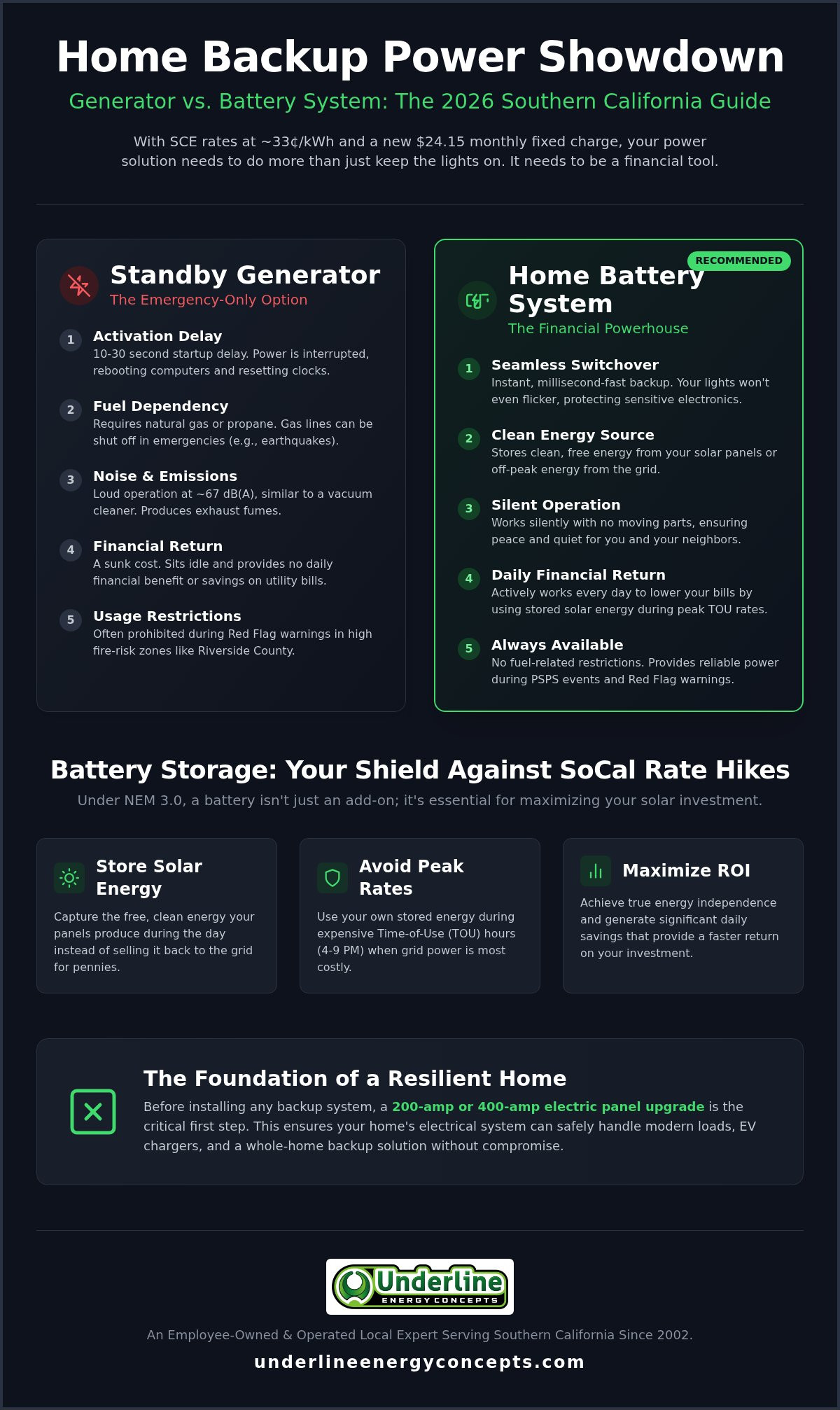
Standby generators rely on an Automatic Transfer Switch (ATS) to monitor the grid. When the sensors detect a power loss, the ATS signals the generator to start its internal combustion engine. This process isn't instant. There's typically a 10 to 30-second delay while the engine reaches the necessary speed to carry your home's electrical load. During this gap, your computers will likely reboot and your clocks will reset.
Fuel is the biggest logistical hurdle. While natural gas lines offer convenience, they can be shut off during seismic events for safety. Propane systems require large on-site tanks and regular deliveries. You also have to consider the environment. A 26 kW standby generator produces about 67 dB(A) of noise at 23 feet. That's roughly the volume of a vacuum cleaner running in your yard for the duration of the outage.
How Whole Home Battery Systems Work
Battery backups operate with sophisticated electronics rather than moving parts. These systems utilize SolarEdge inverters to manage the flow of energy between your solar panels, the battery, and your home. When the grid fails, the system switches to backup power in milliseconds. It's so fast that most electronics don't even flicker, maintaining the high-level infrastructure reliability that Uptime Co. has championed for over 30 years. Islanding is the process of a battery safely disconnecting your home from a failing grid. This ensures your home remains a self-contained power hub while protecting utility workers on the lines.
Batteries excel at daily energy management. They integrate seamlessly with efficiency upgrades like whole house fans to keep your home cool without draining the grid. Because they don't burn fuel, they're nearly silent, typically operating below 50 dB(A). If your current system is older, you might need a 200 amp or 400 amp electric panel upgrade to support a modern generator vs battery backup for home California installation. To see which setup fits your specific layout, you can consult with our local team for a technical assessment.
The Financial Showdown: Upfront Cost vs. 10-Year ROI
When you evaluate a generator vs battery backup for home California installation in 2026, you're choosing between a recurring expense and a strategic investment. A generator is essentially a form of insurance; you pay for the hardware and maintenance, hoping you never actually have to use it. A battery system, conversely, is a financial tool that works every afternoon to lower your monthly overhead. Both options typically require a 200 amp or 400 amp electric panel upgrade to safely manage whole-home loads. This foundational work ensures your infrastructure can handle the demands of modern backup technology without bottlenecking your power supply.
Calculating the Real Cost of a Generator
Standby generators carry significant "hidden" costs that extend far beyond the initial purchase. You must account for the "idle cost" of a machine that sits dormant for most of the year. Combustion engines require annual servicing, including oil changes, filter replacements, and professional load testing to ensure they remain functional. Fuel price volatility also complicates the math for Southern California residents. As of spring 2026, residential natural gas prices have reached approximately 18.17 dollars per thousand cubic feet. You're effectively paying a premium for a system that only provides value during a crisis, while its mechanical components slowly depreciate toward a major repair interval.
The ROI of Solar-Plus-Storage
Batteries offer a tangible return on investment through Time-of-Use (TOU) arbitrage. By charging your system with high-efficiency REC Solar Panels during the day, you can discharge that stored energy during peak SCE windows. This allows you to avoid utility rates that average 33 cents per kWh during the most expensive hours. This "peak-shaving" strategy turns your battery into a daily revenue generator that chips away at your initial costs.
While the 30% federal tax credit that defined previous years expired on December 31, 2025, homeowners can still find financial relief through specific SCE marketplace rebates. Beyond monthly bill savings, energy-independent homes command a higher premium in the Riverside County real estate market. A home that can maintain its own power during a PSPS event is a resilient asset. You aren't just buying backup power; you're securing long-term stability against a grid that continues to grow more expensive and less reliable every year.
Practical Considerations: Maintenance, Noise, and Local Codes
Your choice in the generator vs battery backup for home California debate will impact your daily life and your relationship with your neighbors. While technical specs matter, the physical reality of housing these systems is what you'll deal with every morning. In communities like Canyon Lake or Corona, Homeowners Associations (HOAs) often have strict bylaws regarding noise and aesthetics. A standby generator is a permanent outdoor fixture that requires a dedicated concrete pad and a fuel line. Some HOAs may restrict these due to noise levels or the perceived risk of storing large quantities of propane on-site. Batteries, however, are compact and usually wall-mounted inside a garage, making them a more neighborhood-friendly option.
Living with Your Backup System
The most immediate difference between these systems is the sound. A standard 26 kW generator produces about 67 dB(A) of noise, which is comparable to a loud vacuum cleaner or a lawnmower running in your side yard. This noise persists for the entire duration of an outage, which can be days during a PSPS event. In contrast, a Tesla Powerwall 3 operates below 50 dB(A), providing a nearly silent experience. You won't have to worry about waking the neighbors or violating local noise ordinances during a midnight power failure.
Maintenance is another area where batteries hold a clear advantage. Generators are combustion engines with moving parts that require regular oil changes, filter swaps, and spark plug replacements. If you don't test the engine monthly, it might not start when you actually need it. Batteries are solid-state devices with zero moving parts, offering a "set it and forget it" reliability. At Underline Energy Concepts, we utilize Quietcool battery charge mounts to ensure your storage system stays at optimal operating temperatures even during intense Inland Empire heatwaves. This proactive cooling prevents thermal throttling and extends the lifespan of your investment.
Local Compliance and Safety
Safety regulations in Riverside County are specific and rigorous. Generators carry inherent risks of carbon monoxide poisoning and fire if they aren't vented and placed correctly. Battery installations must also meet strict fire codes, particularly regarding where they are mounted and how they are ventilated. We often recommend attic ventilation fire code upgrades to ensure your home's thermal management supports your new energy infrastructure.
A 200 amp panel upgrade is often the foundation of a safe backup installation because it provides the necessary capacity to route power through a smart gateway without overloading your home's circuits. This upgrade ensures your system can handle the simultaneous load of your HVAC, kitchen appliances, and medical devices. To ensure your home meets all 2026 California safety standards, you should schedule a local site evaluation with our licensed electrical team.
Choosing Your Path: Why Underline Energy Concepts is the SoCal Expert
Deciding between a generator vs battery backup for home California system requires more than just picking a product off a shelf. It requires a partner who understands the unique intersection of Riverside County's grid challenges and California's evolving energy regulations. Underline Energy Concepts has served as a local guide for Southern California homeowners since 2002. As a licensed roofing, electrical, and general contractor, we bring a comprehensive perspective that most single-trade installers lack. We don't just install hardware; we build resilient home ecosystems that stand the test of time.
Our "whole home" approach means we evaluate every factor affecting your energy efficiency. We look at your roof's condition, your attic insulation, and the capacity of your main electrical panel before recommending a backup solution. This integrated strategy prevents the common pitfalls of mismatched equipment or undersized infrastructure. When you work with us, you benefit from over 20 years of specialized experience in solar, battery storage, and 200/400 amp panel upgrades. We ensure your home is prepared for the demands of 2026 and beyond.
The Underline Difference: Beyond the Hardware
We prioritize professional advocacy and homeowner education over high-pressure sales tactics. We want you to feel empowered by your choice, knowing it's based on sound logic and financial savvy. Because we're employee-owned and operated, every team member you meet is personally invested in the success of your project. This dedication to quality workmanship is why so many of your neighbors have already made the switch. You can join the community of energy-independent neighbors through our referral program and help others take control of their utility costs.
Our expertise also extends to the complex permitting processes and fire code requirements specific to Southern California. We handle the coordination with local jurisdictions and utility companies, ensuring your installation is fully compliant and safe. This level of local specialization is critical when navigating the strict safety standards for high-capacity battery arrays and standby generators in fire-prone regions.
Take Control of Your Home’s Energy Future
The evidence for 2026 clearly shows that battery storage offers the best combination of daily savings and emergency resilience for California residents. While a generator is a reactive tool for crises, a battery is a proactive asset that shields you from SCE rate hikes and new monthly fixed charges. You deserve the relief that comes with energy autonomy. The first step is a professional consultation to audit your current usage and identify the most cost-effective path forward. Schedule your expert backup power consultation with Underline Energy Concepts today and start your journey toward a more stable, independent home.
Build Your Energy Independence Today
The choice between a generator vs battery backup for home California installation is fundamentally about your long term financial security. While a generator provides a temporary safety net during a crisis, a battery system works every day to shield you from Southern California Edison's rising rates and fixed charges. You don't have to remain vulnerable to grid instability or unpredictable utility bills. By choosing a solution that offers both silent resilience and daily ROI, you're investing in a more stable future for your family.
Underline Energy Concepts brings over 20 years of local expertise to every project. As a licensed roofing, electrical, and general contractor, we've served Southern California since 2002 with a commitment to quality that only an employee owned company can provide. We understand the specific permitting and fire code requirements of Riverside and San Diego counties. Let us help you transition from a reactive backup plan to a proactive energy strategy. Secure your home's power and lower your bills; contact Underline Energy Concepts for a custom backup quote. You have the power to take control of your energy future, and we're here to guide you every step of the way.
Frequently Asked Questions
Is a battery backup cheaper than a generator in California?
While initial hardware costs are often comparable, the 10-year ROI of a battery is significantly higher. A generator is an emergency-only expense that requires ongoing fuel costs and professional maintenance. In contrast, choosing a generator vs battery backup for home California setup usually favors batteries because they generate daily savings by avoiding peak Time-of-Use rates, effectively paying for themselves over time. To see how these principles are applied by experts in other regions, you can learn more about Zonnepanelen Brabant B.V. and their specialized guides for solar battery integration.
Can a solar battery run my air conditioner during an outage?
Modern high-capacity battery systems can power central air conditioning units if they are sized correctly and paired with a soft-starter. Most standard residential AC units require a significant surge of power to start. We often recommend a 200 amp or 400 amp electric panel upgrade to ensure your backup infrastructure can handle these heavy loads without tripping breakers during a heatwave.
How long will a home battery backup last during a PSPS event?
A home battery can last indefinitely during a Public Safety Power Shutoff if it is paired with a solar array that recharges it daily. Without solar, a single battery typically provides 8 to 12 hours of power for essential loads like lights, refrigeration, and medical devices. Your specific duration depends on your actual consumption and the total storage capacity of your battery bank.
Do I need to upgrade my electrical panel to install a backup system?
Most Southern California homes require a 200 amp or 400 amp electric panel upgrade to safely integrate a whole-home backup system. Older 100 amp panels often lack the physical space and electrical capacity to route power through a smart gateway or automatic transfer switch. Upgrading your panel ensures your home meets 2026 safety standards and can support modern energy technology without risk of failure.
What are the maintenance requirements for a home generator?
Standby generators require significant hands-on maintenance, including annual oil and filter changes, spark plug replacements, and battery testing. You must also run the engine for 20 to 30 minutes every month to ensure the mechanical parts remain lubricated and functional. Neglecting these tasks can lead to engine failure when you need power most, making them a labor-intensive option compared to solid-state batteries.
Are there still rebates for installing battery storage in Riverside County in 2026?
As of August 2026, the California Self-Generation Incentive Program (SGIP) budget for residential battery rebates is currently waitlisted and not funded for new applicants. Additionally, the 30 percent federal tax credit for residential battery systems expired at the end of 2025. However, local utility programs through Southern California Edison may still offer specific marketplace incentives for energy-efficient upgrades that improve your home's grid resilience.
Can I use a generator and solar panels together?
You can use a generator alongside solar panels, but they typically do not operate simultaneously during an outage. Most standard solar inverters are designed to shut down when the grid fails for safety. To use both, you need a specialized system that can manage the generator vs battery backup for home California integration, ensuring the generator doesn't damage your solar equipment while the sun is shining.
Is a battery backup quiet enough for my HOA?
Home batteries are exceptionally quiet and almost always comply with strict HOA noise ordinances in communities like Canyon Lake or Corona. A typical battery system operates at less than 50 decibels, which is quieter than a normal conversation. This is a major advantage over standby generators, which produce roughly 67 decibels of noise and can lead to neighbor complaints or HOA violations during extended outages.