
Whole House Fan vs Air Conditioning: The 2026 SoCal Homeowner’s Guide
/

Article by
Jesse Malone
Jesse Malone
CEO & Partner, Underline Energy Concepts
Jesse Malone is the CEO and Partner of Underline Energy Concepts, a Southern California energy services company that has been serving homeowners since 2002. Since joining the company and becoming a partner in approximately 2015, Jesse has helped lead its growth into one of Southern California’s most trusted providers of residential energy efficiency and home improvement solutions.
Throughout his tenure, Jesse and the Underline Energy team have completed more than 2,500 energy upgrade projects for homeowners across Southern California. These projects include solar energy systems, roofing, battery storage, EV charging stations, electrical panel upgrades, water heater replacements, attic insulation, retrofit windows, and other energy-efficient home improvements designed to lower utility costs and increase property value.
Jesse holds a Bachelor’s Degree from California Southern University and brings more than 20 years of experience in emergency services through his service with the fire department. His background in public service has shaped his leadership style, emphasizing integrity, accountability, safety, and a commitment to serving the community.
A lifelong advocate for efficiency and practical solutions, Jesse is passionate about helping homeowners make informed decisions that improve both their homes and their financial future. His interests extend beyond energy efficiency into financial literacy, budgeting, investing, and long-term wealth-building strategies. He believes that reducing unnecessary expenses and maximizing efficiency are key components of financial success.
As CEO, Jesse continues to focus on delivering exceptional customer experiences, building high-performing teams, and helping Southern California homeowners achieve greater comfort, energy independence, and long-term savings through smart home investments.
Why are you paying Southern California Edison nearly 74 cents per kilowatt-hour just to keep your living room from feeling like a sauna? Most homeowners in the Inland Empire feel trapped by sky-high utility bills and AC units that groan under the weight of a 100-degree afternoon. It's a common struggle, but you don't have to choose between financial stability and a comfortable home.
Discover how to slash your monthly energy bills by up to 90% by mastering the balance of a whole house fan vs air conditioning. At Underline Energy Concepts, we've served as a trusted local partner since 2002, helping our neighbors take control of their energy autonomy. This guide provides a clear look at 2026 utility trends and explains how to use QuietCool technology to flush out stale, trapped air. You'll learn how to give your expensive HVAC system a much-needed break while keeping your living space refreshing and cool.
Key Takeaways
- Learn the fundamental differences between an open-loop ventilation system and a closed-loop HVAC system to determine the best fit for your home's airflow.
- Evaluate the energy consumption of a whole house fan vs air conditioning to see how switching to a low-wattage solution can slash your cooling costs by up to 90%.
- Discover why the unique "diurnal swing" in Southern California communities like Lake Elsinore and Corona makes your property the perfect candidate for night-time cooling.
- Master the "AC Optimizer" hybrid strategy that utilizes your air conditioner during peak afternoon heat and shifts to a fan once the evening breeze arrives.
- Explore why QuietCool remains the gold standard for silent, high-efficiency cooling that won't disrupt your sleep or your budget.
Understanding the Mechanism: How Whole House Fans Differ from AC
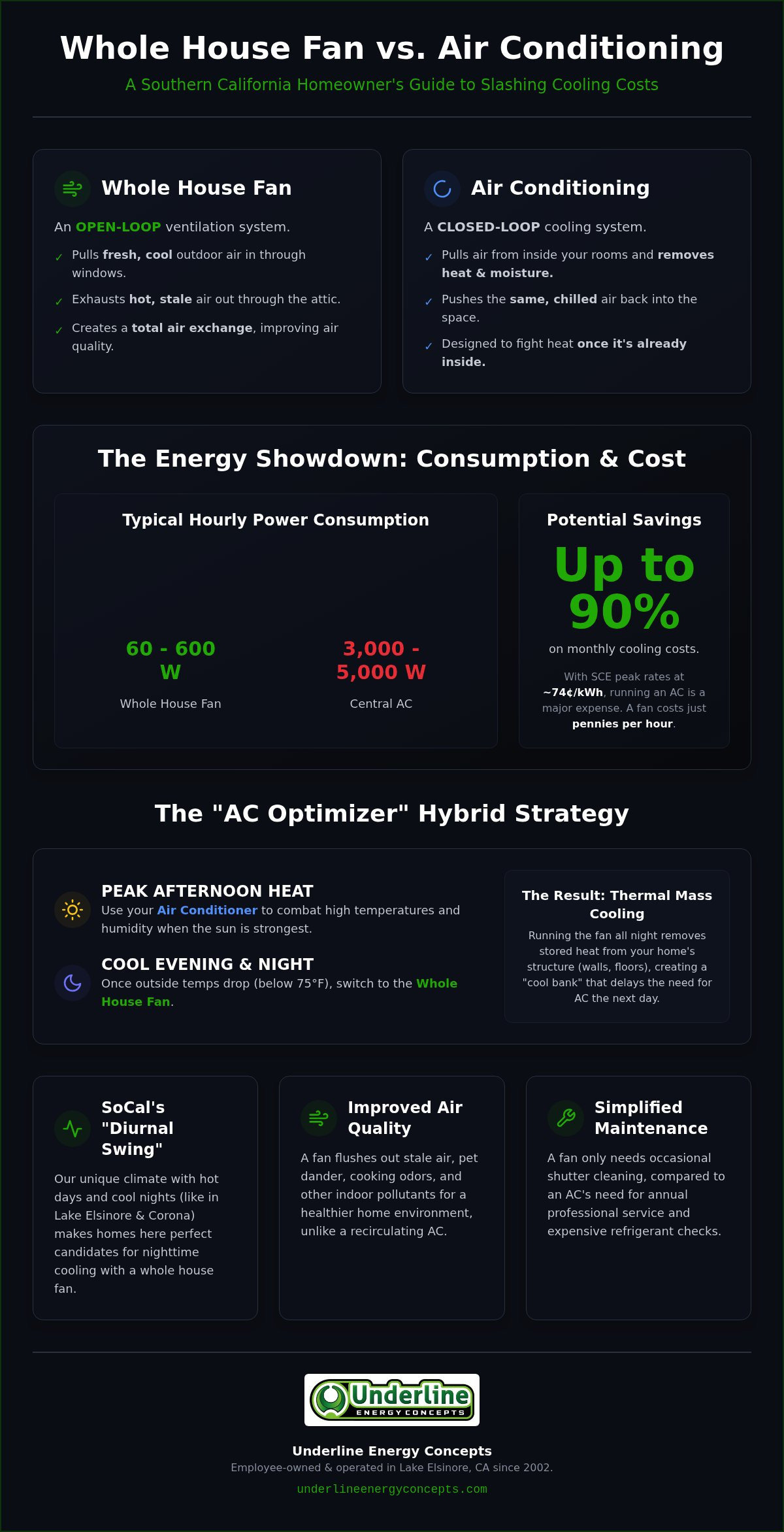
To master your home's climate, you first need to recognize that your air conditioner and a whole house fan perform two completely different jobs. An air conditioner operates as a closed-loop system. It pulls air from inside your rooms, removes the moisture, cools it down, and pushes it back into the same space. It's designed to fight heat once it's already inside. In contrast, a whole house fan works as an open-loop system. It pulls massive volumes of cool, fresh air through open windows and exhausts the hot, stale air out through your attic vents.
Understanding how a whole-house fan works reveals why it's far more than just a glorified attic fan. While an attic fan only targets the air trapped above your ceiling, a whole house fan creates a total air exchange for your entire living area. This process introduces the concept of Thermal Mass. Most homeowners focus only on the temperature of the air, but your walls, floors, and furniture actually store heat like a battery. Thermal Mass Cooling is the process of removing heat stored in the home structure. By running a fan, you aren't just cooling the air; you're pulling the heat out of the very bones of your house.
The Science of Air Exchange Rates
Efficiency isn't just about power; it's about movement. To effectively cool a Southern California home, you need a system capable of 15 to 22 air changes per hour (ACH). This high rate of exchange creates a gentle wind chill effect across your skin, making the indoor environment feel up to 10 degrees cooler than the actual thermometer reading. Strategic window placement is key. By cracking windows in the bedrooms you're using and keeping others closed, you can direct the airflow exactly where you need it. This powerful exhaust also pressurizes your attic, pushing out the 150-degree air that often bakes your roof and degrades your insulation over time.
Closed Loop vs. Open Loop: When Each Wins
Deciding on a whole house fan vs air conditioning isn't about choosing one over the other. It's about knowing when each system holds the advantage. Your AC is the undisputed king during high-humidity days or when the mid-day sun pushes temperatures into the triple digits. However, the whole house fan dominates the moment the outdoor temperature drops below 75°F. In our local climate, this usually happens shortly after sunset. Switching to the fan at this point allows you to flush the day's heat for pennies an hour, saving your HVAC system from unnecessary wear and tear while improving your indoor air quality. For readers in the Mid-Atlantic seeking similar HVAC expertise, you can visit B&B Air Conditioning & Heating Service.
Performance Breakdown: Cooling Power, Energy Use, and Monthly Savings
When you compare a whole house fan vs air conditioning, the most striking difference is found on your electric meter. A typical 3-ton central AC unit consumes between 3,000 and 5,000 watts of power every hour it runs. A high-efficiency QuietCool fan operates on a fraction of that, pulling only 60 to 600 watts depending on the speed setting. This efficiency allows you to run your fan all night for less than the cost of running your AC for fifteen minutes.
Smart homeowners use the "Pre-Cooling" strategy to maximize these savings. By running the fan throughout the cool night hours, you drop the temperature of your home's structural mass. This creates a "cool bank" that delays the need to start your AC until much later the following afternoon. Maintenance is also significantly simpler. While AC systems require refrigerant checks and annual professional service, a whole house fan only needs a quick occasional cleaning of the ceiling shutters to stay in top shape. In the Inland Empire, where summer heat is relentless, these systems often pay for themselves through energy savings in just a few seasons.
Energy Consumption Comparison
With Southern California Edison (SCE) residential rates averaging 34.4¢/kWh in 2026, every watt counts. Running a 3-ton AC during the 4 PM to 9 PM peak window can be incredibly expensive, as summer peak rates can climb as high as 74¢/kWh on certain TOU plans. A 4,000 CFM whole house fan costs pennies per hour by comparison. Using a fan helps you stay within lower SCE pricing tiers, preventing your household from being pushed into the most expensive high-usage brackets. If you're curious about how these savings apply to your specific floor plan, you can reach out for a personal consultation with our Lake Elsinore-based team.
Indoor Air Quality and Health
Beyond the financial benefits, the health advantages are profound. Air conditioning systems recirculate the same air, which can trap allergens, cooking odors, and volatile organic compounds (VOCs). A whole house fan provides a complete air exchange every few minutes, flushing out pet dander and stale air. Keep an eye on local conditions, though. During wildfire season or high-pollen days, you should keep your "open loop" system closed to prevent outdoor irritants from entering your home. For every other day of the year, it's the most effective way to keep your indoor environment fresh and oxygenated.
The Southern California Advantage: Why Our Climate Favors Whole House Fans
Southern California's climate provides the perfect environment for high-efficiency ventilation. Unlike humid regions where night-time temperatures stay high, our Inland Empire communities enjoy a significant "diurnal swing." This is the dramatic drop in temperature that occurs once the sun dips behind the Santa Ana Mountains. For homeowners in Lake Elsinore and Corona, this means you have access to a massive reservoir of free, cool air for nearly twelve hours a day. Using a whole house fan allows you to harvest that air, making the whole house fan vs air conditioning choice a simple matter of common-sense logic.
The biggest obstacle to a cool home in Riverside County is the "Attic Heat Trap." Even when the outside air feels perfect, your attic continues to bake at temperatures exceeding 150 degrees. This trapped heat radiates through your ceiling, keeping your bedrooms uncomfortably warm long after sunset. A QuietCool system breaks this cycle by creating a high-volume air exchange that flushes the attic and replaces it with the evening breeze. This not only cools your living space but also protects your roof and insulation from the degrading effects of extreme heat. We also ensure every installation meets local fire codes for attic ventilation, providing peace of mind for families living in high-risk fire zones.
Micro-Climates of the Inland Empire
Every neighborhood has its own rhythm. Residents in Temecula and Murrieta can leverage the "Rainbow Gap" evening breeze, which pulls coastal air through the mountains to provide natural cooling. In Menifee and Winchester, where daytime heat is intense, the rapid evening cooling makes a whole house fan an essential tool for relief. When weighing the benefits of a whole house fan vs air conditioning, consider that the fan is an investment in your home's long-term health and your own financial autonomy. Combining these ventilation strategies with other home improvements can lead to total energy independence and long-term stability for your household.
Utility Rebates and Financial Incentives
Your transition to smarter cooling is supported by several financial programs. You should check the current SCE rebates for energy-efficient cooling in 2026 to see how much you can save on your initial investment. These upgrades do more than just lower your monthly bills; they significantly increase your property value in an increasingly energy-conscious California market. As a local, employee-owned company, we take pride in helping our neighbors optimize their homes. You can even participate in our referral program to help friends and family achieve the same financial relief while earning rewards for your advocacy.
The Hybrid Strategy: Can You Use Both Systems Together?
Many homeowners mistakenly view the choice of a whole house fan vs air conditioning as an "either/or" ultimatum. In the Inland Empire, the most effective approach is a hybrid strategy where both systems work in tandem to maximize comfort and minimize costs. Think of your fan as an "AC Optimizer" that handles the heavy lifting once the sun goes down, allowing your air conditioner to focus solely on the peak afternoon heat. This dual-system logic gives you total control over your home's climate and your utility bills.
Implementing this strategy requires a simple four-step daily routine. First, run your AC during the peak heat hours, typically from 12 PM to 6 PM, while keeping all windows and doors closed. Second, monitor the outdoor temperature; as soon as it hits 75°F, switch off the AC and crack your windows. Third, fire up your whole house fan to flush out the 120°F attic air and the 80°F indoor air that accumulated during the day. Finally, run the fan on a low setting overnight to "super-cool" your home's thermal mass. This ensures you start the next day with a "cool bank" that can delay AC usage for several hours.
The "AC Optimizer" Approach
Using this method significantly reduces the load on your AC compressor. By letting the fan take over the evening and nighttime cooling, you can extend the lifespan of your expensive HVAC system by 5 to 10 years. It's also the fastest way to drop indoor temperatures after a brutal Southern California heatwave. For a seamless experience, many modern systems now integrate with smart home automation. This allows your fan and AC to operate under a single thermostat logic, ensuring you never waste energy by running both systems at the same time.
Common Mistakes to Avoid
Precision matters when operating an open-loop system. Never run your fan without enough open windows. Doing so creates a vacuum that can lead to back-drafting risks from gas appliances like water heaters. You should also avoid running the fan while the AC is on; you'll simply blow your expensive, cooled air straight into the attic. Finally, ensure your home meets the required attic net-free venting area. Without enough exhaust space, the hot air remains trapped, rendering the fan ineffective. If you're ready to optimize your home's performance, schedule an energy efficiency consultation with our Lake Elsinore experts today.
Why QuietCool is the Gold Standard for Southern California
If you've ever heard an old-fashioned belt-driven attic fan, you likely remember the rattling and roaring that made sleeping almost impossible. This noise is the primary reason many homeowners hesitate when weighing the choice of a whole house fan vs air conditioning. QuietCool has completely redefined the technology by moving the motor away from the ceiling intake and utilizing patented acoustical ducting. This specialized design absorbs vibrations and sound, allowing the system to provide massive airflow at a whisper-quiet level that won't disrupt your evening rest.
Efficiency is the other half of the equation. These units feature ultra-high efficiency ECM motors designed to move thousands of cubic feet of air while consuming less power than a few LED light bulbs. They cost mere pennies per hour to operate, providing a level of financial relief that traditional HVAC systems simply can't match. To protect your home's envelope, QuietCool systems include built-in dampers. These dampers act as an airtight seal when the fan isn't in use, preventing your expensive AC air from escaping into the attic during a 100-degree afternoon or keeping your heater's warmth inside during a chilly winter night.
The Underline Energy Concepts Installation Advantage
Precision is vital for a successful installation. Many contractors follow a "bigger is better" philosophy, but an oversized fan can actually create excessive pressure that leads to poor performance. At Underline Energy Concepts, we draw on our 20+ years of experience as a local, employee-owned contractor to provide professional sizing. We calculate the exact CFM your specific floor plan needs in Lake Elsinore or Menifee to ensure optimal thermal mass cooling. We also specialize in integrating these fans with Whole Home Battery Backup systems. This combination allows you to keep your home cool and fresh even during SCE grid outages or Public Safety Power Shutoffs.
Next Steps for Energy Independence
Taking control of your home's energy future requires a holistic strategy. By combining solar panels, battery storage, and high-efficiency ventilation, you can achieve a "Net Zero" cooling strategy that virtually eliminates your reliance on the grid. Whether you live in Temecula or Murrieta, our team is ready to help you navigate these technologies with a focus on long-term stability rather than high-pressure sales. Every home is unique, and our goal is to empower you with the data you need to make a smart, common-sense decision for your family's comfort.
Ready to stop overpaying for a hot home? Contact Underline Energy Concepts for a custom cooling evaluation and discover how the right balance of a whole house fan vs air conditioning can transform your monthly budget and your quality of life.
Take Control of Your Home Energy Future
Navigating the choice between a whole house fan vs air conditioning doesn't have to be a source of stress. By implementing a hybrid strategy, you can leverage our unique Southern California climate to slash your cooling costs while extending the life of your HVAC system. You've seen how modern QuietCool technology flushes out stale air and structural heat for just pennies an hour. It's a practical, common-sense move toward energy autonomy and long-term financial relief.
As local Lake Elsinore experts since 2002, we're proud to be an employee-owned and operated company dedicated to our community's well-being. We are an Authorized QuietCool Platinum Installer, ensuring that every system we place meets the highest standards of quality and performance. Don't let another heatwave drive your utility bills into the red. Our team is ready to help you optimize your home with a solution that fits your specific needs and budget.
Schedule Your Free Whole House Fan Consultation in Riverside County today and start breathing easier.
Frequently Asked Questions
Do I need a whole house fan if I already have a powerful AC?
You absolutely benefit from a fan even with a powerful AC because it reduces the workload on your expensive HVAC system. While the AC is essential for peak 100-degree afternoons, the fan takes over in the evening to flush out the heat trapped in your attic and walls. This "AC Optimizer" approach helps you avoid high SCE peak rates and can extend your unit's life by several years.
How many windows need to be open to run a whole house fan safely?
You typically need to open two to four windows to provide enough intake air for the system to operate safely. A good rule of thumb is to provide one square foot of open window space for every 750 to 1,000 CFM of fan capacity. Opening windows in the rooms you are currently using allows you to direct the cooling breeze exactly where it's needed most while preventing back-drafting.
Will a whole house fan make my allergies worse by pulling in pollen?
A whole house fan does pull in outdoor air, so you should keep the system off during high-pollen days or active wildfire events. However, for most of the year, it actually improves health by providing a complete air exchange that removes indoor pollutants, pet dander, and cooking odors. Unlike air conditioning, which recirculates the same air, the fan ensures your home is filled with fresh, oxygenated air every few minutes.
Can I install a whole house fan myself or do I need a licensed electrician?
We strongly recommend professional installation by a licensed contractor to ensure your electrical panel can handle the load and that the unit is properly supported. Proper sizing is also critical; an incorrectly installed fan can lead to noise issues or insufficient airflow. As a local Lake Elsinore expert since 2002, we ensure your installation meets all California Title 24 energy standards and local fire codes for your safety.
How much can I actually save on my SCE bill with a whole house fan?
Homeowners can reduce their cooling-related energy consumption by up to 90% when comparing a whole house fan vs air conditioning usage. Since a QuietCool system uses a fraction of the wattage required by a central AC unit, you can run it all night for pennies. These savings are especially impactful during the 4 PM to 9 PM peak pricing windows when SCE electricity rates are at their highest.
Are whole house fans noisy enough to disturb sleep?
Modern QuietCool systems are designed to be whisper-quiet and typically won't disturb your sleep. Unlike old-fashioned fans that were bolted directly to the ceiling joists, these units use acoustical ducting to isolate the motor and dampen sound. Most users find the gentle hum of the fan on a low setting to be a soothing form of white noise that actually helps them rest better.
What is the difference between a whole house fan and an attic fan?
A whole house fan pulls air from your living space and exhausts it through the attic, while a standard attic fan only circulates air within the attic itself. The whole house fan is a much more powerful solution because it provides a total air exchange for your entire home. By cooling the living area and the attic simultaneously, it addresses the structural thermal mass that keeps your home hot after sunset.
Does a whole house fan work in high humidity areas like the SoCal coast?
Whole house fans are most effective in the Inland Empire where humidity is lower and the evening temperature drop is more significant. While they still provide fresh air in coastal areas, they don't provide the same wind chill cooling effect when the outdoor air is very damp. For residents in Lake Elsinore, Menifee, and Corona, the dry evening air makes this technology the ideal choice for cost-effective cooling.