
Generac vs. Solar Battery Backup: Choosing the Best Energy Shield for Your SoCal Home
/

Article by
Jesse Malone
Jesse Malone
CEO & Partner, Underline Energy Concepts
Jesse Malone is the CEO and Partner of Underline Energy Concepts, a Southern California energy services company that has been serving homeowners since 2002. Since joining the company and becoming a partner in approximately 2015, Jesse has helped lead its growth into one of Southern California’s most trusted providers of residential energy efficiency and home improvement solutions.
Throughout his tenure, Jesse and the Underline Energy team have completed more than 2,500 energy upgrade projects for homeowners across Southern California. These projects include solar energy systems, roofing, battery storage, EV charging stations, electrical panel upgrades, water heater replacements, attic insulation, retrofit windows, and other energy-efficient home improvements designed to lower utility costs and increase property value.
Jesse holds a Bachelor’s Degree from California Southern University and brings more than 20 years of experience in emergency services through his service with the fire department. His background in public service has shaped his leadership style, emphasizing integrity, accountability, safety, and a commitment to serving the community.
A lifelong advocate for efficiency and practical solutions, Jesse is passionate about helping homeowners make informed decisions that improve both their homes and their financial future. His interests extend beyond energy efficiency into financial literacy, budgeting, investing, and long-term wealth-building strategies. He believes that reducing unnecessary expenses and maximizing efficiency are key components of financial success.
As CEO, Jesse continues to focus on delivering exceptional customer experiences, building high-performing teams, and helping Southern California homeowners achieve greater comfort, energy independence, and long-term savings through smart home investments.
The cheapest way to keep your lights on during a blackout might actually be the most expensive mistake for your long-term budget. If you're a Southern California homeowner, you're likely tired of Southern California Edison (SCE) hiking rates while Public Safety Power Shutoffs (PSPS) leave your family in the dark. It's frustrating to feel like you've lost control over your home's safety and monthly expenses. When deciding between a Generac vs solar battery backup, the right choice depends on whether you want a temporary fix or a permanent shield against rising utility costs.
At Underline Energy Concepts, we've helped our Lake Elsinore neighbors navigate home energy since 2002. As an employee-owned local partner, we understand the confusion surrounding NEM 3.0 and the 2025 expiration of the federal tax credit. This guide compares standby generators against modern battery systems to help you achieve true energy independence. You'll learn how each technology handles high-wind shutoffs, supports medical devices, and impacts your monthly bill. We'll break down the reliability and daily benefits so you can choose the backup solution that secures your family's comfort and your financial future.
Key Takeaways
- Understand the fundamental difference between fuel-powered mechanical generators and sun-powered storage to determine which energy source fits your property's layout.
- Learn how the Generac vs solar battery backup debate has changed under NEM 3.0, where batteries provide daily ROI by shaving expensive peak utility rates.
- Discover why local HOA regulations in communities like Murrieta and Canyon Lake often favor the silent, emission-free operation of solar batteries.
- Evaluate which system offers the most reliable uptime for medical devices and HVAC systems during unpredictable Santa Ana wind events and grid shutoffs.
- Explore the benefits of a hybrid energy strategy that combines multiple backup sources to achieve total energy independence and long-term financial stability.
Defining the Contenders: Generac Standby vs. Solar Battery Backup
Deciding between a Generac vs solar battery backup isn't just about picking a brand; it's about choosing the technology that will safeguard your home for the next twenty years. Southern California homeowners face a unique set of challenges. We deal with some of the highest utility rates in the nation and frequent Public Safety Power Shutoffs during wildfire season. Because of this, a backup system has transitioned from a luxury to a necessity. To find the right fit, you must first understand how these two systems generate and manage power during a crisis.
The core difference lies in the source of energy and how you use it. A generator relies on a continuous supply of external fuel to create electricity on demand. A battery stores energy you've already produced or bought at a lower rate. While both provide a shield against blackouts, they offer very different daily experiences for your wallet and your neighborhood.
The Standby Generator: Mechanical Muscle
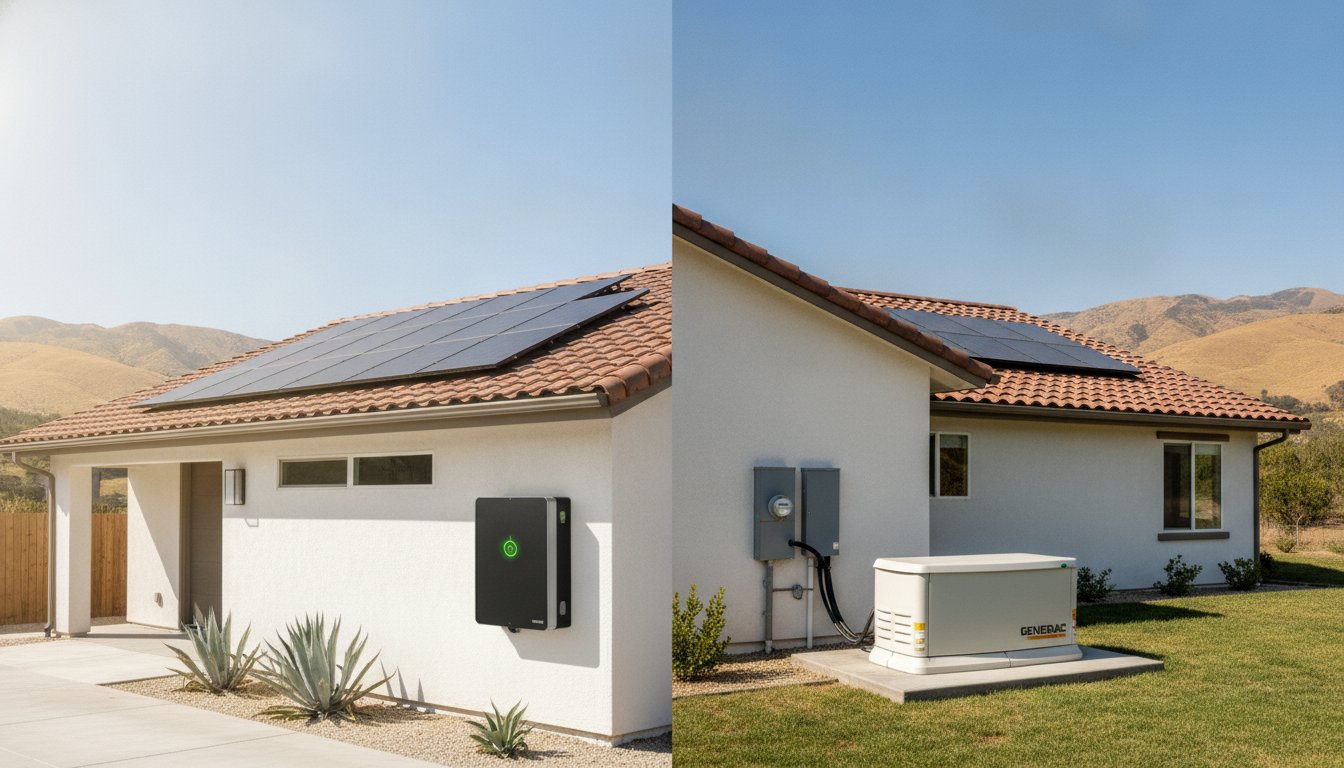
A standby generator is a permanently installed system that provides mechanical muscle when the grid goes dark. These units typically run on natural gas or liquid propane. When the power cuts out, an automatic transfer switch detects the loss and signals the engine to start. Within seconds, your home has a dedicated power plant capable of running heavy loads. This "infinite backup" concept is the primary draw for many. As long as the fuel lines remain open or your propane tank is full, your power stays on.
This mechanical approach is particularly effective for handling high-demand appliances. If you live through Menifee heatwaves, you know that keeping a central AC running is non-negotiable. Generators excel at starting and maintaining these large motors without breaking a sweat. However, they do require regular maintenance, much like a car engine, to ensure they remain reliable for years to come.
The Solar Battery: Silent Intelligence
Modern systems, like those from SolarEdge, represent a shift toward silent intelligence. Instead of burning fuel, these units use electrochemical storage to capture excess energy from your solar panels. When the grid fails, the transition is so seamless you might not even notice the lights flicker. There are no engines to start and no exhaust fumes to manage. A solar battery is a dual-purpose asset that manages both backup and daily cost-shifting.
Beyond emergency use, batteries work for you every single day. They help you avoid the most expensive "Peak" hours from Southern California Edison by discharging stored energy when rates are highest. This daily cycle capability is something a generator simply cannot match. You aren't just buying protection; you're investing in a tool that lowers your monthly overhead while keeping your home quiet and carbon-free.
- Generators: Best for indefinite backup during multi-day outages.
- Batteries: Best for daily savings and seamless, silent protection.
- Maintenance: Generators need oil changes; batteries are virtually maintenance-free.
Fuel vs. Photons: Comparing Reliability and Maintenance
When you evaluate a Generac vs solar battery backup, you have to look beyond the initial installation. Reliability in Southern California means more than just turning on; it means surviving 100-degree heatwaves and thick dust from Santa Ana winds. A backup system that fails when you need it most isn't a shield; it's a liability. At Underline Energy Concepts, we prioritize systems that offer long-term stability without becoming a secondary job for the homeowner. We've seen how local conditions affect equipment since 2002, and the maintenance reality is often the deciding factor for our clients.
The Maintenance Reality Check
A standby generator is essentially a car engine that sits in your yard. To stay reliable, it needs to "exercise" by running weekly. It requires regular oil changes, spark plug replacements, and battery checks. If it sits idle for six months without proper care, you risk mechanical failure or stale fuel issues right when a Public Safety Power Shutoff (PSPS) event hits. For many Lake Elsinore residents, keeping up with a mechanical service schedule is an added burden they didn't expect when they first sought out a backup solution.
In contrast, a solar battery uses solid-state technology. There are no moving parts to seize up and no oil to leak. The system stays ready through intelligent software monitoring. It doesn't matter if the grid stays stable for a year; the battery is always active, cycling daily to save you money on your SCE bill. This constant use actually proves its readiness. You don't have to wonder if it will work during an emergency because it worked this morning to power your home during peak hours.
Environmental and Neighborhood Constraints
Your choice also impacts your relationship with your neighbors. In tightly knit communities like Canyon Lake or Murrieta, noise is a major factor. A standby generator typically produces between 65 and 75 decibels. That is roughly the volume of a vacuum cleaner running constantly outside your window. Many HOAs have strict regulations regarding noise and permanent structures on the property. Choosing between a Generac vs solar battery backup often comes down to these specific neighborhood constraints and local permits.
Solar batteries are silent. They produce zero emissions, meaning you won't need Riverside County air quality permits or worry about exhaust fumes drifting into your neighbor's yard. The physical footprint is also much smaller. While a generator requires a dedicated concrete pad and specific clearances from windows and doors, a battery can often be wall-mounted in a garage. If you want to explore which setup fits your property's specific layout, you can talk to our local experts for a personalized site assessment.

The SoCal Economic Reality: ROI, Rebates, and NEM 3.0
The financial math for a Generac vs solar battery backup has shifted dramatically. In the past, many homeowners viewed these systems purely as emergency insurance. Today, they are active financial tools. While a standby generator typically requires a lower upfront investment at the time of purchase, it remains a "passive" expense. It sits idle until a blackout occurs, consuming fuel but never paying you back. A solar battery is an "active" asset. It works every single day to lower your Southern California Edison (SCE) bill by discharging energy when rates are highest, usually between 4 PM and 9 PM.
As of July 2026, the economic landscape in California has changed. The 30% federal residential clean energy credit (ITC) has expired for new systems. This makes the daily utility savings even more vital for your return on investment. While the upfront price of a generator is lower, you must factor in the ongoing cost of fuel and the lack of monthly savings. For many, the choice between a Generac vs solar battery backup comes down to whether you want to pay less today or save more every month for the next decade.
NEM 3.0 and the Shift to Self-Consumption
California's Net Billing Tariff, or NEM 3.0, fundamentally changed how solar works for your wallet. Under previous rules, you could "sell" excess energy back to the grid for a high credit. Now, those export rates have dropped by roughly 75%, falling to about $0.05 to $0.08 per kWh. Meanwhile, SCE retail rates can climb as high as $0.37 per kWh. Exporting energy is no longer the best financial move. Underline Energy Concepts optimizes systems for maximum self-consumption. By storing your own power in a battery, you avoid buying expensive grid electricity during peak hours. This turns your solar system from a simple rebate generator into a total utility replacement.
Long-term Cost Comparison
Reliability has a price tag that extends beyond the installation day. A standby generator relies on natural gas or propane, both of which are subject to market price fluctuations. If a major disaster disrupts fuel lines, your backup could be cut short. A solar battery uses "free" energy from the sun, making your fuel cost exactly zero dollars for the life of the system. While a well-maintained generator can last 15 to 20 years, it requires consistent mechanical service to get there. Batteries typically have a life expectancy of 10 to 15 years but involve zero fuel costs and minimal upkeep. You can explore available SCE marketplace rebates to see if any local incentives can help offset your initial transition to a more independent energy future.
- Generator ROI: Primarily realized during emergencies and through home resale value.
- Battery ROI: Realized daily through peak-shaving and total avoidance of high SCE rates.
- Fuel Independence: Batteries offer 100% autonomy from utility fuel price hikes.
Assessing Your Load: Which System Powers Your Lifestyle?
Choosing between a Generac vs solar battery backup depends on how you plan to live when the grid goes down. Do you want to keep every light in the house blazing, or do you just need to ensure your food stays cold and your Wi-Fi stays active? Understanding your "load" is the first step toward energy autonomy. At Underline Energy Concepts, we take a consultative approach to help you map out exactly which circuits are non-negotiable for your family's comfort and safety. We've been helping Southern California neighbors find this balance since 2002.
Mechanical generators are often sized to handle "whole-home" loads, including heavy-draw appliances like a 5-ton central AC unit. While this sounds ideal, it often leads to high fuel consumption for minimal gain. A solar battery system is more surgical. It allows you to prioritize the energy you've stored for the things that matter most. If you decide to scale your system later, adding another battery module is often simpler than replacing a generator with a larger, more expensive unit. This flexibility is key for long-term property value and adaptability.
The 'Critical Load' Approach
Most Riverside power outages don't require your entire home to be fully powered. By focusing on a "critical load" setup, you maintain your quality of life without the massive footprint of an industrial-sized generator. Modern smart panels, such as those from SolarEdge, manage these loads automatically. They ensure your refrigerator, router, and essential lighting remain active while temporarily pausing high-draw items like the clothes dryer. This intelligent management makes a smaller battery system far more efficient than a noisy, oversized generator.
Backup for Medical and Emergency Needs
For families relying on CPAP machines or refrigerated medications, a power failure is more than an inconvenience; it's a health risk. This is where the Generac vs solar battery backup comparison reveals a major technical difference. A standby generator has a "start-up delay" of ten to thirty seconds while the engine cranks and stabilizes. A solar battery is "instant-on." The switch happens in milliseconds, ensuring that sensitive medical equipment never loses power. Every second counts in an emergency. If you need to secure your medical baseline, schedule a consultation with our local experts to plan your emergency circuits today.
Future-Proofing Your Home with Underline Energy Concepts
The debate between a Generac vs solar battery backup doesn't always have to end with a single choice. For homeowners seeking the ultimate energy shield, a hybrid approach offers the most comprehensive protection available. By combining the daily financial benefits of a solar battery with the indefinite runtime of a standby generator, you create a system that handles both short-term grid instability and long-term emergencies. This setup allows you to use clean energy for your daily needs while keeping a fuel-based "safety net" for rare, multi-day outages. You gain total control over your home's power regardless of what happens with the utility grid.
Choosing the right technology is only half the battle. You also need a partner who understands the specific electrical and environmental demands of Southern California. Underline Energy Concepts is an employee-owned local company based in Lake Elsinore. Since 2002, we've focused on providing stable, long-term solutions rather than quick sales. We treat your home like our own because we live in the same communities we serve. We integrate high-performance REC Solar Panels and advanced storage systems to ensure your investment stands the test of time.
Local Expertise You Can Trust
We serve families across Menifee, Temecula, and the broader Inland Empire with a commitment to education. Our team prioritizes teaching you how your system works so you feel empowered to manage your own energy. We don't believe in aggressive sales tactics. Instead, we provide the data you need to make a savvy financial decision for your property. To see how these systems look in a real-world application, read our Whole Home Battery Backup Installation: The 2026 SoCal Guide for a deeper look at energy autonomy.
Start Your Energy Autonomy Journey
Your path to independence begins with a clear understanding of your home's current state. We assess your roof health, your existing electrical panel capacity, and your specific energy goals to build a tailored plan. Because we're licensed roofing and electrical contractors, you get a seamless installation that protects your home's structural integrity and its electrical safety. We handle the permits, the engineering, and the utility coordination so you can focus on the relief of a lower monthly bill. Take the first step toward securing your family's comfort. Schedule your energy efficiency consultation with Underline Energy Concepts today.
- Employee-Owned: Every team member is invested in your project's success.
- Long-Term Service: We've been a brick-and-mortar partner in Lake Elsinore since 2002.
- Quality Workmanship: We combine expert roofing and electrical skills for a safer install.
Take Control of Your Home’s Power and Protection
Deciding on a Generac vs solar battery backup is a significant step toward reclaiming your financial autonomy and household safety. You now understand that while a generator offers the mechanical muscle needed for multi-day outages, a solar battery works for you every single day by shaving peak utility rates under NEM 3.0. Both systems provide a vital shield against unpredictable grid shutoffs, but the best choice depends on your specific lifestyle, medical needs, and long-term budget goals. You don't have to navigate these complex utility challenges alone.
Underline Energy Concepts has served our neighbors in Lake Elsinore and the surrounding Southern California community since 2002. As an employee-owned and operated company, we take personal pride in every project, ensuring top-tier quality control from start to finish. Our team holds licenses as a roofing, electrical, and general contractor, providing a comprehensive approach that most local installers can't match. We're here to help you optimize your property for maximum savings and reliability. Ready for energy independence? Get a custom backup power quote from our local experts. Your journey toward a more secure and sustainable home starts with a single conversation.
Frequently Asked Questions
Can a solar battery really power my whole house including the AC?
Solar batteries can power an air conditioner, but the duration depends on the system's total capacity and the unit's energy draw. While a single battery might struggle with a massive 5-ton AC unit, a multi-battery setup can handle the load. We often recommend "load shedding" to prioritize essential appliances while keeping the home cool during peak heat. This approach ensures your most important devices stay active without draining your storage too quickly.
Is a Generac generator louder than a solar battery system?
A Generac generator is significantly louder than a solar battery. Generators produce between 65 and 75 decibels, which is comparable to a loud vacuum cleaner or a lawnmower running in your yard. Solar batteries are silent. They use electrochemical storage with no moving parts, making them the preferred choice for residents in Canyon Lake or Murrieta who want to avoid noise complaints from neighbors or HOAs.
Does NEM 3.0 make a solar battery worth it in Southern California?
NEM 3.0 makes the Generac vs solar battery backup choice a critical financial decision for your household. With export rates now 75% lower than previous years, selling power back to the grid is no longer profitable. Using a battery to store energy for your own use allows you to avoid SCE retail rates that often exceed $0.33 per kWh. A battery turns your solar system into a tool for self-consumption rather than just a grid-tie setup.
How long will a solar battery last during a multi-day power outage?
A solar battery can last indefinitely during an outage if you have solar panels to recharge it daily. During the day, the sun powers your home and fills the battery simultaneously. At night, the battery takes over to keep your essentials running. Without solar panels, a typical 13.5 kWh battery will usually power critical loads like lights, Wi-Fi, and a fridge for about 24 hours depending on your usage.
Can I use a generator and a solar battery together?
You can absolutely use a generator and a solar battery together in what we call a hybrid configuration. This setup provides the ultimate level of energy independence for your property. The battery handles daily cost-shifting and short outages silently, while the generator serves as a high-capacity backup for extended emergencies that last several days. It’s a comprehensive shield that protects your family from every possible grid scenario.
What maintenance is required for a home standby generator?
Standby generators require routine mechanical maintenance similar to a car engine. You must perform regular oil changes, replace spark plugs, and check the starting battery to ensure it hasn't died. The system also needs to "exercise" by running for a few minutes each week. This keeps the engine lubricated and ready for a sudden power failure. Failing to maintain these mechanical parts can lead to failure when you need it most.
How much of the cost is covered by the Federal Solar Tax Credit?
As of July 2026, the 30% federal residential clean energy credit is no longer available for new systems. The tax credit ended for systems placed in service after December 31, 2025. This shift makes maximizing daily utility savings through self-consumption more important than ever for your return on investment. Homeowners now rely on local SCE marketplace rebates and the direct avoidance of high utility rates to pay off their systems.
Do I need an electric panel upgrade to install a battery or generator?
Many Southern California homes require an electric panel upgrade to 200-amp or 400-amp service before installation. Older 100-amp panels often lack the physical space or electrical capacity to safely integrate a large backup system. We assess your current electrical infrastructure during our initial inspection to ensure your home meets all modern safety codes. Upgrading your panel also prepares your home for future additions like EV charging stations.