
How to Choose Energy Efficient Windows in Southern California: A 2026 Homeowner’s Guide
/

Article by
Jesse Malone
Jesse Malone
CEO & Partner, Underline Energy Concepts
Jesse Malone is the CEO and Partner of Underline Energy Concepts, a Southern California energy services company that has been serving homeowners since 2002. Since joining the company and becoming a partner in approximately 2015, Jesse has helped lead its growth into one of Southern California’s most trusted providers of residential energy efficiency and home improvement solutions.
Throughout his tenure, Jesse and the Underline Energy team have completed more than 2,500 energy upgrade projects for homeowners across Southern California. These projects include solar energy systems, roofing, battery storage, EV charging stations, electrical panel upgrades, water heater replacements, attic insulation, retrofit windows, and other energy-efficient home improvements designed to lower utility costs and increase property value.
Jesse holds a Bachelor’s Degree from California Southern University and brings more than 20 years of experience in emergency services through his service with the fire department. His background in public service has shaped his leadership style, emphasizing integrity, accountability, safety, and a commitment to serving the community.
A lifelong advocate for efficiency and practical solutions, Jesse is passionate about helping homeowners make informed decisions that improve both their homes and their financial future. His interests extend beyond energy efficiency into financial literacy, budgeting, investing, and long-term wealth-building strategies. He believes that reducing unnecessary expenses and maximizing efficiency are key components of financial success.
As CEO, Jesse continues to focus on delivering exceptional customer experiences, building high-performing teams, and helping Southern California homeowners achieve greater comfort, energy independence, and long-term savings through smart home investments.
Did you know that your windows can account for up to 30% of your home's heating and cooling energy loss? In the intense heat of Riverside and San Bernardino counties, that isn't just a dry statistic. It is the primary reason your AC unit never seems to rest and your utility bills keep climbing. Finding the right energy efficient windows Southern California requires is no longer just a home improvement luxury. It is a practical financial necessity. We understand the frustration of feeling like you're losing the battle against rising costs and drafty rooms while trying to keep your family comfortable.
It's time to stop the heat bleed and take back control of your home's comfort and value. This guide provides everything you need to know about choosing windows that meet the strict 2026 Title 24 building codes. Since the federal tax credits expired at the start of the year, the strategy for 2026 is all about local empowerment through state grants and utility rebates. We will walk you through the mandatory NFRC ratings, explain how to stack local incentives like the HOMES program, and show you how a smart window upgrade fits into a larger plan for total energy independence.
Key Takeaways
- Identify "the bleed" and learn why thermal transfer is the primary reason your air conditioner runs for 12 or more hours a day.
- Master the NFRC label by focusing on the Solar Heat Gain Coefficient (SHGC), which is the most important metric for blocking Southern California heat.
- Perform a simple two-step home audit using the "touch test" to see if your seals have failed and if it's time for an upgrade.
- Navigate the 2026 shift from federal tax credits to stackable local grants and rebates to fund your energy efficient windows Southern California project.
- Understand the "thermal envelope" concept and how to integrate new windows with other cooling strategies like whole house fans for maximum savings.
Stopping 'The Bleed': Why Energy Efficient Windows are Non-Negotiable in Southern California
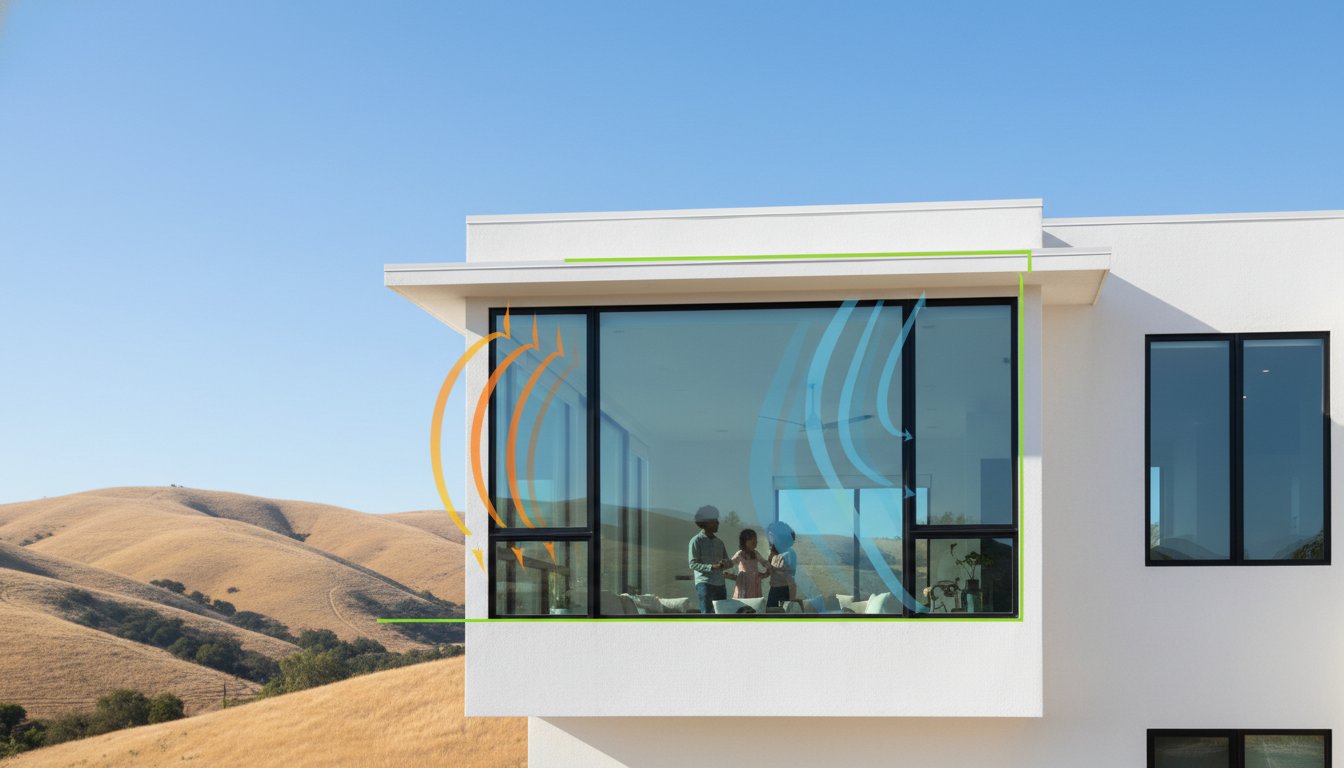
If you live in the Inland Empire, you're likely familiar with the constant hum of your air conditioner. In many homes across Riverside and San Bernardino counties, that hum doesn't stop for 12 or even 15 hours a day during the peak of summer. We define "The Bleed" as the continuous thermal transfer that forces Southern California air conditioning units to run for 12 or more hours a day just to maintain a livable temperature. It's a relentless cycle where expensive cool air escapes while outdoor heat marches inside. Choosing energy efficient windows Southern California homeowners can trust is the only way to plug this leak and protect your finances.
In cities like Temecula, Murrieta, and Corona, the UV radiation isn't just a threat to your skin. It's a direct assault on your home's efficiency. By 2026, Southern California Edison (SCE) rates have reached levels that make every watt of wasted energy feel like a penalty. When you keep 20-year-old single-pane or failing dual-pane windows, you aren't just dealing with a minor draft. You're essentially paying the equivalent of an extra mortgage payment every year just to cool the outdoors. A technical understanding window insulation reveals that old glass simply cannot compete with the modern coatings required by today's building codes.
The Science of Radiant Heat in the Inland Empire
In Lake Elsinore and Perris, 100-degree days are the standard, not the exception. Standard glass acts as a thermal bridge, allowing outdoor heat to conduct directly into your living room. It isn't just the air temperature that changes. Infrared light passes through untreated glass and heats up your floors, sofas, and walls. These surfaces then radiate heat back into the room long after the sun goes down. Thermal gain refers to the increase in temperature within your living space caused by the sun's rays and the transfer of heat through the building's exterior during our intense diurnal temperature shifts.
How Windows Impact Your Entire Energy Ecosystem
Your windows are the first line of defense for your entire home energy system. High-performance glass reduces the load on your HVAC, which prevents those mid-August emergency failures that leave you stranded in the heat. If you've invested in a whole home battery backup, efficient windows ensure that stored power lasts significantly longer during a grid outage because your AC doesn't have to fight "The Bleed."
There's also a powerful synergy with solar. By reducing your home's base energy load first, your SCE Marketplace incentives go further, and your solar panel installation becomes more cost-effective. You aren't just buying glass. You're buying energy autonomy and long-term stability for your family. We've seen homeowners since 2002 transform their comfort levels simply by addressing these thermal bridges. It's a practical, common-sense decision that pays dividends in both comfort and property value.
Deciphering the Labels: U-Factor and SHGC Ratings for the SoCal Climate
Choosing energy efficient windows Southern California requires more than just picking a style that matches your home. You need to understand the National Fenestration Rating Council (NFRC) label, which acts as the "nutrition label" for your home's thermal health. While many contractors focus on generic energy ratings, the 2026 Title 24 code now mandates a U-factor of 0.30 or lower and a Solar Heat Gain Coefficient (SHGC) of 0.23 or lower for most window replacements. If you're aiming for state grants like the HOMES program, you might need even stricter "Ultra-Efficient" ratings to qualify for maximum rebates. Following the latest guidelines on window replacement ensures you don't install outdated technology that leaves your money on the table.
Micro-climates matter in our region. Inland Empire homeowners in heat-traps like San Bernardino should prioritize the lowest possible SHGC, while coastal residents in Newport or Laguna may have slightly more flexibility. However, with rising utility costs, shooting for the highest efficiency standard is always the smartest financial move. You can check the SCE Marketplace to see which high-efficiency models currently qualify for additional local incentives.
SHGC: Your Shield Against the Southern California Sun
Menifee and Winchester homeowners know the brutal power of the afternoon sun. West-facing windows act like magnifying glasses without the right protection, which is why an SHGC below 0.25 is mandatory for those exposures. Modern windows use Low-E coatings to reflect infrared and UV light back to the source before it enters your home. We recommend soft-coat Low-E for residential applications because it features multiple layers of silver that provide superior heat reflection without sacrificing the natural light you love.
U-Factor: Keeping the Cool Air Inside
While SHGC blocks the sun, the U-Factor measures how well a window keeps your expensive air-conditioned air from leaking out. It is essentially the insulation value of the glass unit. Even in our hot climate, a low U-Factor is vital for those chilly high-desert nights when the temperature drops 40 degrees in a few hours. An ideal U-Factor for a home in Riverside County stays at or below 0.30 to prevent heat loss during those surprisingly cold desert winter nights.
If you're unsure which specific ratings fit your home's orientation and micro-climate, you can speak with our local experts for a personalized energy assessment.

The Homeowner’s Audit: How to Determine if You Need Replacement or Retrofitting
Before you commit to a full project, you can perform a simple DIY audit to see how your current windows are performing. We've helped local homeowners since 2002 identify the difference between a minor repair and a critical failure. Follow these five steps to evaluate your home's thermal defense and decide if you need energy efficient windows Southern California experts to step in and stop the heat bleed.
- Step 1: The Touch Test. During a peak afternoon in Lake Elsinore or Perris, place your hand on the interior glass of a west-facing window. If the glass feels hot to the touch, your windows aren't reflecting radiant heat, and your AC is fighting a losing battle.
- Step 2: Seal Inspection. Look for fogging, moisture, or a "dirty" appearance between the glass panes. This indicates a blown seal where the insulating argon gas has escaped, leaving you with almost no thermal protection.
- Step 3: The Lighter Test. Carefully hold a lighter near the window frame on a breezy day. If the flame flickers or dances, you have significant air infiltration that's forcing your HVAC system to work 12 or more hours a day.
- Step 4: Frame Evaluation. Inspect the corners of your frames for gaps, cracks, or visible warping. Older frames often lose their structural integrity after decades of intense Southern California sun exposure.
- Step 5: Utility Bill Review. Compare your summer electricity bills over the last three years. An unexplained year-over-year spike usually points to a failing thermal envelope that needs immediate attention.
When Repair is Enough vs. When Replacement is Essential
Sometimes a bit of new weatherstripping or fresh caulk can solve a minor draft. However, if you find blown seals, you're looking at a failed Insulated Glass Unit (IGU) that cannot be fixed with a simple patch. In communities like Moreno Valley, the intense UV exposure often warps older frames beyond the point of safe or effective repair. When the frame itself is compromised, replacement is the only way to meet current Department of Energy guidelines for home efficiency. Relying on 20-year-old frames to hold modern glass is often a recipe for future leaks and higher costs.
Choosing the Right Frame Material for Longevity
The frame material you choose is just as critical as the glass itself. Aluminum frames are the "thermal enemy" in our region because they conduct outdoor heat directly into your living space, making your home feel like an oven. While wood frames offer great insulation, they often struggle with the dry heat and require frequent maintenance to prevent rot. High-grade vinyl remains a top choice for the Inland Empire because it doesn't warp and provides excellent thermal resistance. By 2026, composite materials have also gained popularity for providing superior strength and longevity. If you're looking for long-term stability, we'll help you select a material that stands up to the specific climate of your neighborhood.
Stacking the Savings: Navigating 2026 SoCal Rebates and Energy Grants
The landscape for funding energy efficient windows Southern California homeowners need has shifted dramatically in 2026. Waiting for a tax refund is a thing of the past. Today, the focus is on "upfront grants" that reduce your out-of-pocket costs immediately. The High-Efficiency Electric Home Rebate Act (HEEHRA), part of the Inflation Reduction Act, now provides point-of-sale rebates that can cover a significant portion of your project if you meet specific income requirements. This shift allows you to keep your capital while still securing the long-term stability of a high-performance home.
We advocate for a "Stacking Strategy." This means combining state-level funds like the HOMES program, which offers up to $4,000 for moderate-income households and $8,000 for low-income households, with city-specific incentives. For example, residents in Ontario may qualify for a $10,000 Exterior Beautification Grant, while those in Riverside or Upland can often find localized utility boosts. You can start your search at the SCE Marketplace to identify which high-performance window models trigger these specific financial rewards. This organized approach ensures you don't leave a single dollar on the table.
State and Utility Programs to Watch
Financing your upgrade is easier than ever with GoGreen Home Energy Financing. This state-backed program offers low-interest loans specifically for energy efficiency projects, often with no money down. If you're a SoCalGas or SCE customer, check your eligibility for the Energy Savings Assistance (ESA) program. These programs are especially vital under the current "Solar Billing Plan" (NEM 3.0). By installing efficient windows, you reduce your home's base load. This ensures your whole home battery backup lasts longer during peak rate hours or grid outages, giving you true energy autonomy.
The Underline Advantage: Professional Guidance on Funding
Identifying these "hidden" pots of money in Canyon Lake or Wildomar requires a partner who knows the local territory. Most state and utility grants require work to be performed by a licensed general contractor to ensure Title 24 compliance and quality workmanship. As an employee-owned company based in Lake Elsinore since 2002, we handle the technical documentation and permitting so you don't have to. We also encourage you to join the Underline Referral Program. It's a simple way to help your neighbors achieve energy independence while earning rewards for your community.
Schedule a consultation with our experts to build your custom grant-stacking plan today.
Beyond the Glass: Integrating Windows into a Whole-Home Energy Strategy
While upgrading to energy efficient windows Southern California homeowners rely on is a massive leap forward, it's only one piece of your home's thermal envelope. Think of your house as a complete system where every component must work in harmony to achieve true energy independence. If you install high-performance glass but leave your attic under-insulated or your ventilation outdated, you're still leaving your home vulnerable to the external financial pressures of rising utility rates. True comfort comes from a holistic approach that seals your home from the roof down to the foundation.
A well-insulated home acts like a high-quality thermos. It keeps the energy you've paid for exactly where it belongs. Beyond windows, we emphasize the critical role of attic insulation and fire-coded ventilation. These elements work together to push out trapped heat that can reach 150 degrees in a typical Inland Empire summer. When your attic is cool and your windows are reflecting UV rays, your HVAC system finally gets the break it deserves, extending its lifespan and preventing emergency mid-summer failures.
The QuietCool and Window Synergy
The real magic happens when you combine your new windows with a whole house fan. We often discuss the merits of QuietCool vs Traditional AC because the two technologies serve different purposes. A whole house fan pulls in crisp evening air to flush out the day's heat. Your energy-efficient windows then act as a thermal seal, locking that cool air inside your home throughout the following day. This strategy maximizes your home's thermal mass and significantly reduces your daytime AC dependence. For a deeper look at specific models, check out our Best Whole House Fan for Cooling Guide.
Your Next Steps for a Cooler 2026
Taking control of your energy future doesn't have to be a complex venture. We recommend starting with a comprehensive energy audit that evaluates your windows, roofing, and solar together. This holistic approach ensures that every dollar you spend contributes to a safer, more reliable home. You'll see a clear cause-and-effect relationship between these upgrades and your monthly savings. It's about moving from a reactive state of "heat management" to a proactive state of energy optimization.
As an employee-owned company based in Lake Elsinore, Underline Energy Concepts has been a dedicated partner to Southern California homeowners since 2002. We prioritize your education and long-term savings over quick sales because we're invested in the well-being of our local community. Empower your home today and stop the heat bleed for good. Schedule a consultation with our specialists to build a total home energy plan that works for your family and your budget.
Take Control of Your Home’s Energy Future Today
You now have the technical knowledge to stop "the bleed" and secure your home against the relentless Southern California heat. By selecting the correct NFRC ratings and leveraging the 2026 grant-stacking strategies we've discussed, you can transform a necessary home upgrade into a savvy financial investment. High-performance glass is a powerful tool, but it achieves its full potential when integrated into a whole-home energy strategy that includes proper insulation and ventilation. We've seen how this holistic approach provides immediate relief from skyrocketing utility bills and creates lasting energy autonomy for your family.
Since 2002, Underline Energy Concepts has served as a trusted guide for homeowners across the region. As an employee-owned and operated company, we take personal pride in every project we complete. Our team carries specialized roofing, electrical, and general contracting licenses, ensuring that your installation of energy efficient windows Southern California meets every 2026 building code requirement. Don't let outdated windows dictate your comfort or your monthly budget any longer. We are ready to help you navigate the complex world of rebates and technical specifications with ease and confidence.
Schedule Your Professional Energy & Window Audit with Underline Energy Concepts Today and take the first step toward a more efficient, comfortable, and valuable home. We look forward to partnering with you on your journey toward energy independence.
Frequently Asked Questions
Are energy-efficient windows worth the cost in Southern California?
Energy efficient windows Southern California homeowners install are absolutely worth the investment because they provide a high return through immediate utility savings and long-term property value increases. According to the U.S. Department of Energy, windows can account for 30% of a home's cooling energy loss. By stopping this thermal transfer, you reduce the workload on your AC and extend the lifespan of your HVAC system. It is a practical move for long-term financial stability.
What is the best window frame material for the Inland Empire heat?
High-grade vinyl is the superior choice for the extreme heat found in the Inland Empire. Unlike aluminum, which conducts heat directly into your living space, vinyl provides excellent thermal resistance and does not warp or peel under intense UV exposure. For homeowners seeking maximum durability, composite materials are also an excellent 2026 option. These materials ensure your frames remain structurally sound despite the significant diurnal temperature swings common in our region.
Can I still get a federal tax credit for windows in 2026?
The federal 25C tax credit for residential window projects expired on January 1, 2026. However, California has shifted its focus toward upfront grants and rebates like the HOMES program and the HEEHRA. These programs provide immediate financial relief rather than a delayed tax refund. We help you navigate these local incentives to ensure you receive the maximum funding available for your energy efficient windows Southern California project.
How much can I actually save on my SCE bill with new windows?
Homeowners typically see an average energy cost reduction of 30% after upgrading to high-performance windows. Your specific savings will depend on your home's orientation and current insulation levels. By reducing your home's base energy load, you also make your solar panels and battery storage more effective. This synergy allows you to keep more of your hard-earned money instead of sending it to Southern California Edison every month.
Do I need to replace all my windows at once to see a difference?
You don't need to replace every window simultaneously to feel an improvement, but focusing on west-facing and south-facing windows first provides the most immediate relief. Keep in mind that replacing 75 square feet or more of window area triggers the strictest 2026 Title 24 compliance standards. Starting with the most problematic rooms allows you to manage your budget while still making a measurable impact on your home's overall thermal envelope.
What is the difference between Low-E2 and Low-E3 glass for SoCal homes?
Low-E3 glass features three layers of silver coating compared to the two layers found in Low-E2. This extra layer significantly improves the Solar Heat Gain Coefficient (SHGC), making it the ideal choice for blocking the intense radiant heat in Southern California. While Low-E2 is suitable for some climates, we recommend Low-E3 for most Inland Empire homes to ensure you get the highest level of protection against UV rays and infrared heat.
How long does the typical residential window replacement take in Riverside County?
Most residential window replacement projects in Riverside County are completed within one to three days once the custom-ordered units arrive. Our employee-owned team focuses on efficiency and quality workmanship to minimize disruption to your daily life. We handle all necessary local permitting and inspections required by your specific city. This streamlined process ensures your home is sealed and protected as quickly as possible without sacrificing long-term reliability.
Will new windows help reduce the noise from local Southern California freeways?
Modern energy-efficient windows provide a significant reduction in exterior noise from freeways and neighborhood traffic. The multiple panes of glass and the insulating argon gas between them act as a sound barrier. If noise reduction is a primary goal, we can discuss specialized laminated glass options that further dampen sound waves. This upgrade doesn't just save you money; it creates a quieter and more peaceful sanctuary for your family.