
Residential Ground Mounted Solar Panels: The Complete 2026 Southern California Guide
/

Article by
Jesse Malone
Jesse Malone
CEO & Partner, Underline Energy Concepts
Jesse Malone is the CEO and Partner of Underline Energy Concepts, a Southern California energy services company that has been serving homeowners since 2002. Since joining the company and becoming a partner in approximately 2015, Jesse has helped lead its growth into one of Southern California’s most trusted providers of residential energy efficiency and home improvement solutions.
Throughout his tenure, Jesse and the Underline Energy team have completed more than 2,500 energy upgrade projects for homeowners across Southern California. These projects include solar energy systems, roofing, battery storage, EV charging stations, electrical panel upgrades, water heater replacements, attic insulation, retrofit windows, and other energy-efficient home improvements designed to lower utility costs and increase property value.
Jesse holds a Bachelor’s Degree from California Southern University and brings more than 20 years of experience in emergency services through his service with the fire department. His background in public service has shaped his leadership style, emphasizing integrity, accountability, safety, and a commitment to serving the community.
A lifelong advocate for efficiency and practical solutions, Jesse is passionate about helping homeowners make informed decisions that improve both their homes and their financial future. His interests extend beyond energy efficiency into financial literacy, budgeting, investing, and long-term wealth-building strategies. He believes that reducing unnecessary expenses and maximizing efficiency are key components of financial success.
As CEO, Jesse continues to focus on delivering exceptional customer experiences, building high-performing teams, and helping Southern California homeowners achieve greater comfort, energy independence, and long-term savings through smart home investments.
If your roof isn't the perfect canvas for solar, why are you letting Southern California's 38.6 cent per kWh utility rates dictate your monthly budget? You likely already realize that the "set it and forget it" days of selling power back to the grid are over. Under NEM 3.0, your goal has shifted from simple exports to total self-consumption. For many homeowners in Riverside County, ground mounted solar panels residential systems are the most effective way to take back that control. These systems offer the freedom to position your array for maximum production without being limited by your roof's shape, age, or orientation.
We understand that the current energy market feels complex, especially with the federal tax credit for homeowner-owned systems having expired at the end of 2025. However, there's still a clear path to financial stability and autonomy. This guide will walk you through exactly how a ground-mounted array can offset those massive AC bills and provide a durable, roof-free solution for your property. We will preview the 2026 permitting landscape, discuss the urgency of the January 1, 2027 property tax exclusion deadline, and explain how battery integration creates a truly independent home energy ecosystem.
Key Takeaways
- Learn how ground mounted solar panels residential systems bypass roof limitations to provide the perfect tilt and orientation for maximum energy production.
- Understand the shift to NEM 3.0 and why optimizing for self-consumption with battery storage is now the most effective way to lower high utility bills.
- Navigate complex local zoning and permitting requirements across Riverside County and the Inland Empire with expert guidance on setbacks and soil stability.
- Discover the long-term benefits of a system that requires zero roof penetrations, preserving your home's structural integrity while easing future maintenance.
- See why choosing a local, employee-owned partner ensures your project is handled by specialists who are personally invested in your system's performance.
What Are Residential Ground Mounted Solar Panels?
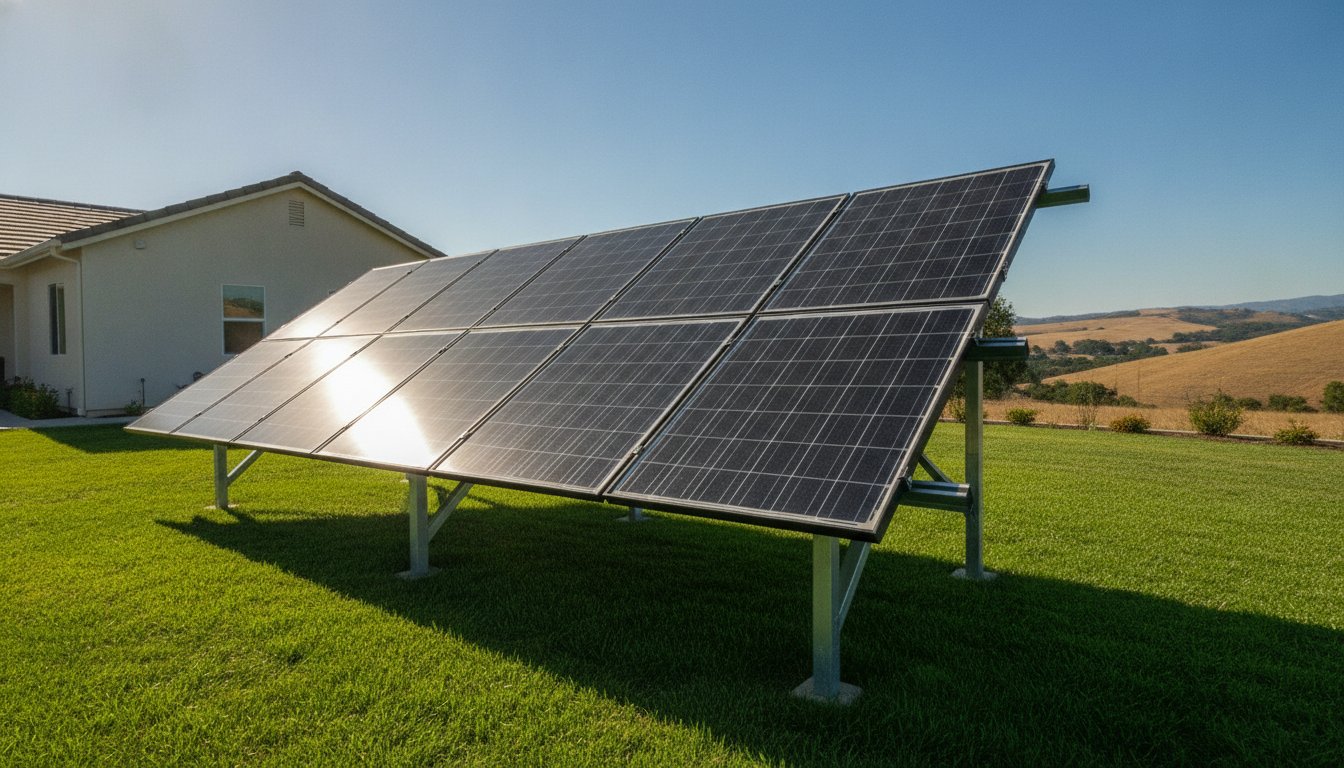
A ground-mounted solar system is a freestanding energy array anchored directly into the earth rather than being attached to your home's roof. While rooftop solar is the most common sight in Southern California neighborhoods, ground mounted solar panels residential installations offer a powerful alternative for properties with ample acreage. These systems consist of heavy-duty photovoltaic mounting systems made from galvanized steel or high-grade aluminum. They're secured by deep concrete piers and connected to your home’s electrical panel through subterranean wiring, keeping the infrastructure protected and out of sight.
You might choose this path if your roof is shaded by mature trees, faces the wrong direction, or features delicate materials like Spanish tile that you'd rather not disturb. For homeowners with massive energy demands, particularly those running large AC units or charging multiple EVs, ground mounts provide the space needed for a larger, more productive array. At Underline Energy Concepts, we've seen these systems become a preferred choice for residents in Lake Elsinore and the surrounding Inland Empire who want to maximize every square inch of their sun-drenched lots.
The Different Types of Ground Mount Racking
Standard ground mounts are the most frequent choice for residential properties. These are fixed-tilt systems where the metal frame is set at a permanent angle to capture the most sunlight possible throughout the year. If you have uneven terrain or want to use the space beneath the panels, pole mounts are an excellent option. These elevate the entire array on a single, sturdy pole. For those seeking the absolute peak of performance, solar tracking systems use active or passive technology to follow the sun's path from east to west. This movement can increase your total energy production by 25% or more compared to a stationary system, helping you reach energy independence faster.
Why Space-Rich SoCal Homeowners Are Choosing Ground Mounts
Roof penetrations are a common concern for homeowners, especially if your roof is older or features complex architectural details. Ground mounts eliminate the risk of leaks because they don't touch your home's structure. Performance is another major factor. In Menifee summers where temperatures regularly hit 100°F, panels on a hot roof can lose efficiency. Ground-mounted arrays benefit from 360-degree airflow, which keeps the equipment cooler and more productive during peak heat. Maintenance is also significantly safer and simpler. You don't need a ladder or a safety harness to clean off the Inland Empire dust; you can simply spray them down from the ground to ensure your system is always operating at its best.
Ground Mount vs. Rooftop Solar: Which Is Better for You?
Deciding where to place your solar array is one of the most critical choices you'll make for your property's energy future. While rooftop solar is the standard for most suburban homes, ground mounted solar panels residential systems are often the superior choice for those who have the available space. The primary difference lies in control. On a roof, you're forced to work with the existing pitch and orientation of your rafters. On the ground, you can engineer the system to be perfect. This choice impacts everything from your total energy harvest to the long-term maintenance of your home's structure.
Maintenance is another area where these two options diverge. Rooftop systems require installers to climb onto your home, which can be a safety concern and may lead to wear on your roofing materials over time. Ground mounts are easily accessible for cleaning Inland Empire dust or performing routine inspections. However, they do require you to manage the vegetation around the array to prevent shading. If you're weighing these factors, speak with a local expert to determine which configuration maximizes your land's potential.
Efficiency and Production Gains
Ground-mounted systems win the efficiency battle by allowing for optimized tilt and azimuth. In Southern California, the ideal setup is usually south-facing at a specific angle that captures the most year-round sun. Most roofs simply can't offer this. Additionally, ground arrays stay significantly cooler. Because air circulates freely behind the panels, they avoid the heat trap created between a panel and a hot roof deck. This lower operating temperature prevents voltage drop, ensuring you get the maximum possible wattage out of every cell. Many homeowners now opt for bifacial panels, which capture sunlight on both sides by reflecting light off the ground, a feat that's much harder to achieve on a dark roof surface.
The Cost Reality: Trenching and Racking
Performance comes with a higher initial price tag. Verified industry data shows that ground-mounted solar systems cost approximately 51% more than rooftop installations. This premium covers the galvanized steel racking, concrete foundations, and the specialized engineering required to ensure the system can withstand local wind loads. Trenching is often the largest variable in your budget. The further your array sits from your main electrical panel, the more you'll spend on labor and copper wiring. When reviewing your options, SEIA's Residential Consumer Guide to Solar provides a helpful framework for understanding how these infrastructure costs fit into your long-term return on investment.

Planning Your Ground Mount System in Southern California
Planning ground mounted solar panels residential systems starts with more than just finding a sunny patch of land. You need a site that balances solar access with strict local setback requirements. In Riverside County, for instance, you can't just place an array anywhere; it must respect property lines and existing structures to meet safety codes. We also evaluate the electrical path. Since ground mounts are often placed farther from the home, we check if your current infrastructure can handle the load. Many homes in the Inland Empire require a 200 amp or even a 400 amp electric panel upgrade to safely manage the high energy production of a modern array.
Fire safety is another non-negotiable factor in our region. California fire codes require specific clearances around your array to allow emergency access. This means keeping the area free of brush and ensuring clear pathways for first responders. Our team at Underline Energy Concepts handles these technical details during the design phase. We ensure your system is as safe as it is productive, protecting both your investment and your property.
Soil Analysis and Foundation Types
Soil stability determines the longevity of your system. In areas like Lake Elsinore and Murrieta, we often encounter rocky terrain or expansive clay. These conditions require specific foundation choices. Concrete piers are the gold standard for stability in most Southern California soils, providing a deep anchor that resists shifting over time. However, in some rocky lots, ground screws might be a more efficient alternative. We also factor in wind load engineering. If you live near Corona or the Cajon Pass, your system must be designed to withstand powerful Santa Ana winds that put immense pressure on large ground-based structures.
Permitting and HOA Navigation
Navigating the paperwork shouldn't be a headache. The California Solar Rights Act protects your right to install solar, but you still need to follow local zoning rules. We prepare all the necessary documentation, from structural calculations to detailed electrical schematics, to ensure a smooth approval process. If you live in a community with an HOA, we work directly with them to ensure the placement meets their aesthetic guidelines without compromising your energy production. Being a local Lake Elsinore company since 2002 means we've built relationships with building departments across the region. If you're ready to see how a system fits on your lot, schedule a site evaluation with our team today.
Maximizing ROI: NEM 3.0 and Battery Integration
Under NEM 3.0, the financial logic of solar has flipped. In 2026, Southern California homeowners face average electricity rates of roughly 38.6 cents per kWh, while the utility only pays back about 5 to 8 cents for the power you export. This 75% reduction from older NEM 2.0 rates means your priority is now self-consumption. Ground mounted solar panels residential systems excel here because they allow for "over-provisioning." Since you aren't constrained by a fixed roof size, you can install a larger array that generates enough surplus to fully charge a massive battery bank by mid-morning. This ensures you have plenty of stored energy to run your AC through the expensive 4:00 PM to 9:00 PM peak pricing window.
While the direct federal tax credit for homeowner-owned systems expired at the end of 2025, you can still find significant savings through third-party ownership models like leases or PPAs. These allow you to benefit from the commercial tax credit that providers pass down to you. You should also explore SCE Marketplace opportunities for local incentives that can help offset the initial investment. Because ground mounts often represent a larger upfront cost, pairing them with the right financial strategy is vital for hitting that 7 to 9 year payback period typical of modern solar-plus-storage systems.
The Role of Battery Storage
Pairing a ground-mounted array with a whole-home battery backup is the ultimate path to energy autonomy. These arrays provide the high-wattage output needed to keep large battery banks topped off even during shorter winter days. For our local clients, we often recommend Quietcool battery charge mounts as a specialized component to optimize how your system handles these loads. By storing your midday solar harvest, you protect yourself against grid outages and the rising utility rates that continue to pressure Inland Empire households. It's about keeping the power you produce rather than giving it away for pennies.
Maintenance for Long-Term Savings
Protecting your ROI requires a proactive approach to maintenance. Ground-mounted panels are easier to reach, but they also sit closer to the dust and debris of the dry Southern California landscape. Regular cleaning is essential to prevent "soiling" from reducing your production. You must also stay on top of vegetation control; weeds or tall brush can quickly shade the bottom row of panels and tank your efficiency. Finally, we recommend annual electrical inspections. Underground conduits are a favorite hiding spot for local rodents, and catching wire damage early prevents costly system failures down the road.
Ready to stop paying those 38.6 cent rates? Contact Underline Energy Concepts today to design a high-production ground mount system that secures your energy independence.
Why Underline Energy Concepts for Your Ground Mount Project?
Choosing the right partner for your solar journey is just as important as the technology itself. Since 2002, Underline Energy Concepts has served as a trusted home energy expert for families across the Inland Empire. We aren't a distant corporation; we're a local brick-and-mortar company based in Lake Elsinore, California. This local presence means we understand the unique challenges of our region, from the rocky soil of Temecula to the intense heat of the Menifee summers. When you invest in ground mounted solar panels residential systems with us, you're working with a neighbor who is personally invested in your long-term success.
Our technical expertise sets us apart. We hold licenses in roofing, electrical, and general contracting, which is a critical combination for complex ground-mount installations. We don't cut corners on equipment, either. Our team utilizes high-performance components from industry leaders like REC Solar and SolarEdge. By combining superior hardware with our deep understanding of Southern California's permitting and fire codes, we build systems that stand the test of time while maximizing every watt of energy production.
Our Local, Employee-Owned Advantage
Underline Energy Concepts is proud to be employee-owned and operated. This structure creates a culture of accountability that you won't find at larger, national firms. Because our installers and consultants are also owners, they're deeply committed to quality workmanship and honest customer education. You'll notice the "Underline" difference in the precision of our subterranean wiring and the durability of our concrete foundations. We also believe in the power of community. Our referral program is our way of rewarding the solar advocates who help us grow our mission of energy independence throughout Southern California.
Your Path to Energy Independence
We take a holistic approach to your home’s energy ecosystem. It isn't just about the panels; it's about how your home uses that power. We specialize in integrating ground-mounted arrays with other high-efficiency solutions like hybrid water heaters, HVAC systems, and Quietcool battery charge mounts. This comprehensive strategy ensures that the power you generate on your land is used as efficiently as possible, further insulating you from rising utility rates. Our process is transparent and methodical, starting with a thorough site evaluation and continuing through final utility interconnect. Take the first step toward a more secure financial future today. Schedule your professional ground mount consultation today with our expert team.
Secure Your Energy Autonomy Today
Transitioning to solar is a practical decision for long-term stability. You've seen how ground mounted solar panels residential systems provide the orientation and airflow needed to maximize production, especially when paired with battery storage under NEM 3.0. By utilizing your property's open space, you bypass roof limitations and secure a durable energy source that can handle the Inland Empire’s toughest heatwaves. This investment is about more than just electricity; it's about gaining relief from external financial pressures and taking back control of your monthly expenses.
Underline Energy Concepts has been a dedicated partner for Southern California homeowners since 2002. As a licensed roofing, electrical, and general contractor, we manage every technical detail of your installation with professional precision. We are proud to be an employee-owned and operated company, which means every member of our team is personally invested in the quality and performance of your system. We understand the specific needs of our local community and provide the expert guidance required to navigate the 2026 energy landscape.
Stop letting rising utility rates dictate your household budget. Get a Free Ground Mount Evaluation from Underline Energy Concepts and start your journey toward true energy independence. Your property has the potential to power your life; let’s build the system that makes it happen.
Frequently Asked Questions
Do I need a special permit for ground-mounted solar panels in Riverside County?
Yes, you must obtain both building and electrical permits before starting your installation. Riverside County requires detailed site plans and structural engineering calculations to ensure the array is safe and compliant with local zoning laws. While California law caps permit fees for standard residential systems, ground mounts often incur slightly higher costs due to the specialized engineering required for foundations and soil stability.
How much space do I need for a residential ground-mounted solar array?
A typical residential system requires between 400 and 800 square feet of clear, unshaded land. The exact footprint depends on your energy goals and the efficiency of the panels you choose. You must also account for property line setbacks and fire department access paths required by local ordinances. Our team evaluates your lot to find the optimal balance between production and land use.
Are ground-mounted solar panels more expensive than rooftop systems?
Yes, ground-mounted systems carry a higher initial investment than traditional rooftop solar. This premium covers the cost of galvanized steel racking, concrete piers, and the trenching needed to run wiring to your home. Verified industry data indicates these systems cost roughly 51% more than roof installs. However, the increased production efficiency often leads to a strong long-term return on investment.
Can I install ground-mounted solar panels myself?
We strongly advise against DIY installation for these complex energy systems. Ground mounted solar panels residential projects involve high-voltage electrical work, deep structural concrete pouring, and precise wind-load engineering. Professional installation by a licensed contractor like Underline Energy Concepts ensures your system is safe, remains under warranty, and passes all necessary city inspections. We handle the heavy lifting so you don't have to.
Do ground-mounted solar panels affect my property taxes in California?
Currently, your solar system won't increase your property taxes thanks to a state-wide exclusion. The California active solar energy system exclusion prevents your property from being reassessed based on the value of the solar equipment. It is important to act quickly; this exclusion is set to sunset on January 1, 2027. Systems completed before this deadline maintain their tax-exempt status until the property changes ownership.
How do I clean and maintain a ground-mounted solar system?
Cleaning is much safer and simpler for ground mounts because you don't need a ladder or safety harness. You can simply use a soft brush and water to clear away Inland Empire dust and debris. Maintenance also involves keeping the area beneath the panels free of tall weeds and brush. We recommend an annual check to ensure the subterranean conduits remain free of rodent activity or damage.
Will a ground-mounted system work with my existing battery backup?
Most ground-mounted arrays are fully compatible with your existing battery storage or whole-home backup system. Our experts verify that your current inverter and wiring configuration can handle the production from the new array. If you're looking to expand your energy independence, adding a ground mount is an excellent way to provide the extra wattage needed to keep large battery banks charged during the winter.
What is the lifespan of a ground-mounted racking system vs. a roof mount?
Ground-mounted racking systems are engineered for extreme durability and often outlast the lifespan of a traditional roof. While a roof might require replacement every 20 to 30 years, a galvanized steel or aluminum ground rack can last 40 years or more. This saves you the significant expense of detaching and resetting your panels, which is a common requirement for homeowners with rooftop solar systems.