
Best Solar Panels for SoCal Homes: 2026 Buyer’s Guide
/
Article by
Jesse Malone
Jesse Malone
CEO & Partner, Underline Energy Concepts
Jesse Malone is the CEO and Partner of Underline Energy Concepts, a Southern California energy services company that has been serving homeowners since 2002. Since joining the company and becoming a partner in approximately 2015, Jesse has helped lead its growth into one of Southern California’s most trusted providers of residential energy efficiency and home improvement solutions.
Throughout his tenure, Jesse and the Underline Energy team have completed more than 2,500 energy upgrade projects for homeowners across Southern California. These projects include solar energy systems, roofing, battery storage, EV charging stations, electrical panel upgrades, water heater replacements, attic insulation, retrofit windows, and other energy-efficient home improvements designed to lower utility costs and increase property value.
Jesse holds a Bachelor’s Degree from California Southern University and brings more than 20 years of experience in emergency services through his service with the fire department. His background in public service has shaped his leadership style, emphasizing integrity, accountability, safety, and a commitment to serving the community.
A lifelong advocate for efficiency and practical solutions, Jesse is passionate about helping homeowners make informed decisions that improve both their homes and their financial future. His interests extend beyond energy efficiency into financial literacy, budgeting, investing, and long-term wealth-building strategies. He believes that reducing unnecessary expenses and maximizing efficiency are key components of financial success.
As CEO, Jesse continues to focus on delivering exceptional customer experiences, building high-performing teams, and helping Southern California homeowners achieve greater comfort, energy independence, and long-term savings through smart home investments.
The expiration of the 30% federal tax credit on December 31, 2025, did not make solar a bad investment; it simply changed the math for Southern California homeowners. If you have watched your Southern California Edison bills climb toward 34 cents per kilowatt-hour while export credits dropped under the Net Billing Tariff, you are not alone in feeling frustrated. It is exhausting to navigate a landscape where utility companies seem to hold all the cards while you are just trying to keep your home cool in the Menifee or Temecula heat.
We agree that the old way of doing solar is gone, but the new era of energy independence is actually more powerful than before. This guide will show you how to identify the best solar panels for Southern California homes that are specifically engineered for high-heat resilience and maximum efficiency. You will discover how to maximize your ROI in a post-tax-credit market by focusing on self-consumption and smart storage solutions that provide relief from rising rates.
We will walk you through the top-performing panels for 2026, explain why a battery is now a necessity rather than an luxury, and show you how a local, employee-owned partner ensures your system stays productive for the next 25 years.
Key Takeaways
- Learn why the temperature coefficient is the most vital specification for the best solar panels for Southern California homes in high-heat cities like Corona and Perris.
- Discover how to offset the loss of the federal tax credit by prioritizing high-efficiency panels and battery storage to maximize your self-consumption.
- Understand why a holistic installation that includes an electric panel upgrade and a smart inverter is critical for your system's long-term safety.
- Find out how to utilize current SCE rebates and financial assistance to reduce your initial investment and speed up your ROI.
- Learn why choosing an employee-owned, local contractor ensures your roof's integrity and provides reliable support long after the installation's done.
The 2026 SoCal Solar Landscape: Why Quality Matters Now
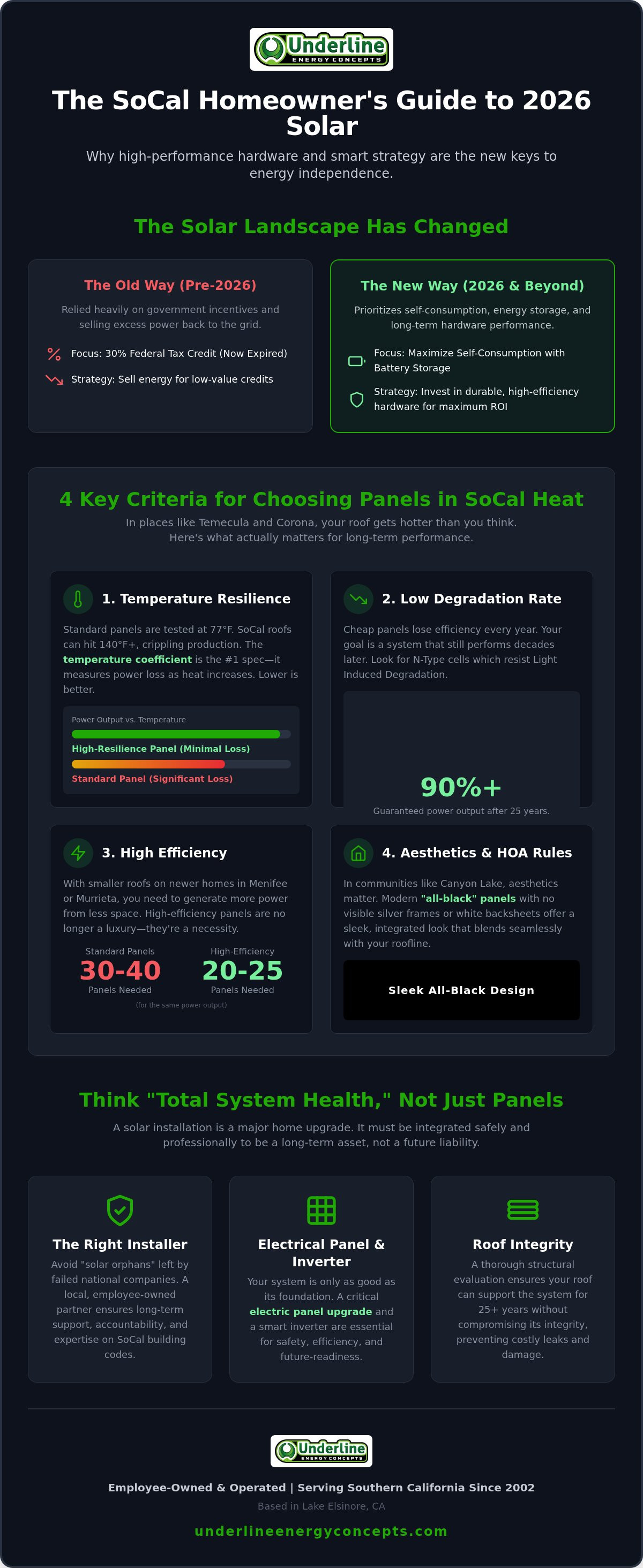
The solar market in 2026 looks very different than it did just two years ago. The expiration of the 30% federal residential clean energy credit on December 31, 2025, removed a major financial cushion for many families. Now, every watt counts. You can't rely on government incentives to bail out a mediocre system. Finding the best solar panels for Southern California homes now requires a focus on long-term performance and hardware that survives our intense heat. High-efficiency panels are no longer a luxury for those with large budgets; they're a necessity to ensure your system pays for itself in a post-incentive world.
The "national company graveyard" of 2024 and 2025 also changed how we look at installers. Many big-name solar firms went out of business during that period, leaving thousands of "solar orphans" with broken systems and voided warranties. This instability highlights why a local, employee-owned partner is your safest bet. Based in Lake Elsinore since 2002, Underline Energy Concepts focuses on "Total System Health." We don't just slap glass on a roof. We evaluate your roof’s structural integrity and your electrical panel’s capacity to ensure your energy upgrade is a permanent asset, not a future liability.
Navigating the Post-Tax Credit Era
Without the 30% tax credit to offset upfront costs, your ROI depends entirely on hardware durability. You need to prioritize panels with the lowest possible degradation rates. If a panel loses 1% of its efficiency every year, your savings will vanish long before the system is paid off. Look for hardware guaranteed to maintain at least 90% of its original power output after 25 years. This is especially vital under the Net Billing Tariff (NBT), which reduces the value of exported energy by about 75% compared to older policies, making it more profitable to store and use your own power rather than selling it back to SCE.
The Shift Toward High-Efficiency Hardware
In newer developments across Menifee, Murrieta, and Temecula, roof space is often limited by complex designs or smaller lot sizes. You likely don't have the room for 30 or 40 standard-grade panels. High-efficiency hardware allows you to generate the same amount of power with a much smaller footprint. Modern solar panel technology has pivoted toward N-Type cell construction because it offers superior resistance to Light Induced Degradation. These cells are specifically designed to maximize energy production even when the Southern California sun pushes ambient temperatures into the triple digits, ensuring your home stays powered during the most demanding summer afternoons.
Top Criteria for Choosing the Best Panels for SoCal Heat
Most solar panels are tested in laboratories at a cool 77°F. In the real world of Riverside County, specifically in sun-drenched areas like Corona and Perris, roof temperatures can easily soar past 140°F on a standard 100°F summer day. This "SoCal Factor" is the silent killer of solar ROI. When solar cells get too hot, their ability to conduct electricity drops. This physical reality makes the temperature coefficient the most critical specification for the best solar panels for Southern California homes. It measures exactly how much production you lose for every degree the temperature rises above that laboratory baseline.
You also need to look at the degradation rate. While many panels start strong, cheap hardware can lose significant capacity every year. By year 25, you want a system that still produces at least 90% of its original rated power. If your panels degrade too quickly, you'll find yourself buying expensive peak-hour power from the grid much sooner than you planned. Aesthetics also play a major role in our local communities. If you live in Canyon Lake or Temecula, your HOA likely has strict rules about "all-black" panels that blend seamlessly into your roofline rather than standing out with silver frames and white backsheets.
Temperature Resilience and Performance
Heat causes a voltage drop that can cripple a standard solar system right when you need your air conditioning most. Premium manufacturers like REC Group have engineered solutions for this specific problem. Their panels use half-cut cell technology, which literally splits the solar cells in half. This design reduces the electrical current flowing through each cell, which lowers resistance and minimizes heat buildup. This keeps the panel cooler and ensures more consistent energy production during a Riverside County heatwave. If you aren't sure how your specific roof orientation handles the sun, it's wise to request a professional thermal assessment before choosing your hardware.
Warranty and Manufacturer Longevity
A 25-year warranty is a standard industry promise, but it's only as reliable as the company that signs it. You should distinguish between three types of coverage: product, performance, and labor. The product warranty covers manufacturing defects, while the performance warranty ensures the electricity output stays high over time. Many national companies offer these warranties but don't include the labor costs to actually replace a failed panel. As an employee-owned local specialist, we prioritize brands with proven financial stability. You don't want a warranty from a company that might not exist in five years. Choosing established hardware ensures that your energy independence remains secure for decades to come.
Beyond the Glass: Inverters, Batteries, and Your Electric Panel
The glass on your roof is only half of the story. Even the best solar panels for Southern California homes need a robust electrical foundation to convert sunlight into savings. Many national installers ignore the "guts" of your home's energy system, but we know that your inverter and electric panel are what actually dictate your daily autonomy. A smart inverter like SolarEdge has become a standard for our region because it optimizes the performance of each individual panel while providing the sophisticated grid interaction required by modern utility standards.
Under the current Net Billing Tariff, the grid is no longer a cost-free storage solution. This policy shift makes whole-home battery backup a mandatory component for anyone seeking a true return on investment. Without storage, you are forced to export your excess energy for pennies and buy it back for much more during the evening. We utilize specialized hardware like Quietcool Battery Charge Mounts to maximize the efficiency of these systems, ensuring your backup power is ready when the grid fails or when SCE rates skyrocket between 4 PM and 9 PM.
The Necessity of Main Panel Upgrades
Many older homes in Lake Elsinore and Wildomar were built with electrical panels that simply aren't equipped for the demands of 2026. If your home still has a 100 amp service, adding solar and an EV charging station can quickly overwhelm your system. We often recommend an Electric Panel Upgrade to a 200 amp or 400 amp service as part of your installation. This modernization provides a safer, more reliable hub for your home's energy. It prevents circuit overloads and ensures your new technology operates at peak capacity without risking damage to your appliances or the home itself.
Pairing Storage for Maximum Savings
A Whole Home Battery Backup allows you to "time-shift" your energy production. You can store the power your panels generate during the sunny morning hours and use it during the expensive peak evening window. This strategy is the only way to effectively lower your monthly bills under the current rate structures. For residents with larger rural properties in Riverside County, we often combine solar ground mounts with high-capacity battery systems. This pairing provides total energy autonomy, allowing you to maintain a fully functional home even during extended grid outages or public safety power shutoffs.
Calculating ROI and Savings in Southern California (2026)
ROI in 2026 is no longer about waiting for a big check from the IRS. It is about defense. With SCE rates sitting at approximately 34.4 cents per kWh, the best solar panels for Southern California homes act as a hedge against inevitable utility inflation. Even without the federal tax credit, generating your own power is significantly cheaper than buying it from the grid. In cities like Temecula, where summer temperatures frequently break records, your air conditioning is your biggest expense. By producing your own power for a fixed cost, you effectively freeze your electricity rate for the next 25 years. This stability turns a volatile monthly expense into a predictable home improvement asset.
The "Avoided Cost" model is your new best friend. Every kilowatt-hour you produce and use is a kilowatt-hour you don't buy at retail price. In high-usage areas like Menifee and Murrieta, the savings add up fast. Protecting this ROI requires consistent maintenance; dirt and desert dust can drop your production by 20% or more. Professional solar cleaning services ensure your system hits its performance targets every month, preserving the financial integrity of your investment.
Maximizing Local Rebates and Incentives
Identifying local incentives is key to lowering your initial investment. Riverside and San Bernardino County homeowners can still find specialized assistance. Use SCE Rebates and Financial Assistance to find programs like DAC-SASH for income-qualified households or battery-specific incentives in high fire-threat zones. Our team at Underline Energy Concepts handles the heavy lifting of these applications, ensuring you don't leave money on the table during the complex SCE filing process.
The Impact of NEM 3.0 on Payback Periods
NEM 3.0 has shifted the math for every homeowner in Southern California. A solar-only system now has a payback period of roughly 8 to 12 years because export credits have dropped to about 5 to 8 cents per kWh. However, adding a battery brings that payback back down to the 7 to 9 year range. The "Self-Consumption" strategy for SoCal homeowners involves storing your daytime solar energy to power your home during the expensive 4 PM to 9 PM peak window. To maximize your return, focus on these three factors:
- System Sizing: Properly sizing your system to cover 100% of your usage plus future EV needs.
- Battery Capacity: Ensuring you have enough storage to bridge the entire peak-rate window.
- Hardware Efficiency: Using premium panels that maintain high output even as they age.
Schedule a custom ROI consultation to see exactly how these 2026 numbers apply to your specific roof and energy needs.
The Underline Advantage: Why a Local Specialist Beats a National Brand
National solar giants often treat Southern California as just another territory on a map. They use sub-contractors who might not be there when you need service in five years. We take a different approach. Based in Lake Elsinore since 2002, Underline Energy Concepts is an employee-owned, brick-and-mortar company. We live in the same communities we serve. This local roots approach ensures that when we talk about the best solar panels for Southern California homes, we aren't just reading from a brochure. We're recommending hardware that we know can handle the Santa Ana winds and the relentless Inland Empire sun.
Choosing a local specialist means you get personalized education instead of a high-pressure sales pitch. Our goal is your long-term relief from utility bills, not a quick signature. We walk you through every step of the process, from the initial energy audit to the final SCE interconnection. Because our team owns the company, we're personally invested in the quality of every wire we pull and every bracket we secure.
The Importance of Integrated Roofing and Solar
A solar installation is only as good as the roof beneath it. Many solar-only companies ignore existing roof damage or use mounting hardware that compromises your home's structural integrity. This leads to a frustrating game of finger-pointing if a leak occurs. Our Roofing and Solar Bundle eliminates this risk. As licensed roofing, electrical, and general contractors, we provide a single point of accountability. We ensure your roof is ready for a 25-year solar commitment before we ever install a single panel.
Serving Our Community Since 2002
We've spent over two decades building trust in Canyon Lake, Winchester, and Moreno Valley. Our reputation is our most valuable asset. We don't rely on massive advertising budgets; we grow through the satisfaction of our neighbors. Our Referral Program is a testament to this trust. It allows our existing clients to share the benefits of energy independence with their friends and family while being rewarded for their advocacy.
Ready to take control of your energy future? Stop reacting to utility rate hikes and start building your own power plant. Contact Underline Energy Concepts today to schedule your comprehensive 2026 energy audit and discover how the right hardware and a local partner can secure your home for decades.
Take Control of Your Home's Energy Destiny
The rules of solar have changed in 2026, but the opportunity for energy independence has never been clearer. Finding the best solar panels for Southern California homes now requires looking past the glass to prioritize heat resilience and smart battery integration. You've learned that high-efficiency hardware and localized storage are the only ways to beat rising utility rates and maximize your return on investment in the post-tax-credit era. These upgrades don't just lower bills; they provide the peace of mind that comes from true autonomy.
Don't leave your home's structural and electrical health to chance with a national company that might not be here tomorrow. Underline Energy Concepts has served our neighbors from Lake Elsinore to Menifee since 2002. As an employee-owned business and a licensed roofing, electrical, and general contractor, we ensure your system is built for the long haul. We are here to help you navigate the complexities of the current grid with honesty and local expertise.
It's time to stop reacting to utility inflation and start investing in your own energy future. Schedule Your 2026 Home Energy Audit with Underline Energy Concepts today. We look forward to building a more resilient and sustainable home for you and your family.
Frequently Asked Questions
Is solar still worth it in Southern California now that the tax credit has expired?
Solar remains a strong investment because utility rates continue to climb. While the 30% federal credit is gone, the "avoided cost" of not paying 34 cents per kWh to SCE provides immediate relief. For homeowners in Menifee or Murrieta, solar is a hedge against the 2.6% to 2.7% annual rate increases already approved for 2027 and 2028. You're essentially locking in your energy costs for the next 25 years.
Which solar panel brands are most resistant to the high heat in Riverside County?
High-heat resilience is non-negotiable in Riverside County. Brands like REC Group are among the best solar panels for Southern California homes because they utilize N-Type cell technology and half-cut cells. These features minimize the efficiency loss that occurs when ambient temperatures hit triple digits in cities like Corona or Perris. We prioritize hardware with low temperature coefficients to ensure your system produces maximum power during the hottest summer afternoons.
Do I really need a battery backup with my solar system in 2026?
A battery is practically essential under the 2026 Net Billing Tariff. Without storage, you export excess daytime energy for a fraction of its value and buy it back at peak rates in the evening. A whole-home battery backup allows you to store that energy for use between 4 PM and 9 PM. This strategy significantly shortens your payback period and provides critical energy independence during grid outages or public safety power shutoffs.
How long does a typical solar installation take in cities like Temecula or Murrieta?
The physical installation of the panels usually takes only one to three days. However, the total timeline in Murrieta or Temecula involves permitting through the city and final interconnection approval from SCE. This administrative phase can take several weeks. As a local brick-and-mortar company based in Lake Elsinore, we manage every step of this process to ensure your system is turned on as quickly and safely as possible.
What happens if my roof needs repair before I install solar panels?
We recommend addressing roof issues before or during the solar installation. Since Underline Energy Concepts is a licensed roofing and general contractor, we can perform necessary repairs or a full replacement as part of an integrated project. This ensures your roof's structural integrity is preserved and prevents future leaks. Combining these services provides a single point of accountability, so you don't have to worry about two different companies blaming each other.
Can I add more panels to my existing Southern California solar system later?
Adding panels is possible, but it requires a professional evaluation of your existing inverter capacity and electrical panel. If your current system was installed under NEM 2.0, adding significant capacity might trigger a transition to the 2026 Net Billing Tariff. We analyze your current production and future needs, such as an EV charging station or a hybrid water heater, to determine the most cost-effective way to expand your clean energy footprint safely.
How does the 2026 SCE Net Billing Tariff affect my monthly savings?
The Net Billing Tariff (NBT) reduces the credit you receive for sending energy back to the grid by roughly 75%. Instead of a one-to-one credit, you receive an "avoided cost" rate which is much lower. This policy makes the best solar panels for Southern California homes even more valuable when paired with storage. Your monthly savings now come primarily from self-consumption; using your own solar power instead of buying it from the utility company.
What is the difference between a roof mount and a ground mount solar system?
Roof mounts are the most common choice for residential properties because they utilize existing space and are typically more cost-effective. Solar ground mounts are an excellent alternative for large rural properties in Riverside County where roof space is limited or shaded. Ground-mounted systems allow for optimal orientation and tilt, which can maximize energy production. Both options require a licensed general contractor to ensure the mounting hardware is secure and meets local safety codes.