
Cost of Ground Mounted Solar Panels in California: 2026 Price & ROI Guide
/

Article by
Jesse Malone
Jesse Malone
CEO & Partner, Underline Energy Concepts
Jesse Malone is the CEO and Partner of Underline Energy Concepts, a Southern California energy services company that has been serving homeowners since 2002. Since joining the company and becoming a partner in approximately 2015, Jesse has helped lead its growth into one of Southern California’s most trusted providers of residential energy efficiency and home improvement solutions.
Throughout his tenure, Jesse and the Underline Energy team have completed more than 2,500 energy upgrade projects for homeowners across Southern California. These projects include solar energy systems, roofing, battery storage, EV charging stations, electrical panel upgrades, water heater replacements, attic insulation, retrofit windows, and other energy-efficient home improvements designed to lower utility costs and increase property value.
Jesse holds a Bachelor’s Degree from California Southern University and brings more than 20 years of experience in emergency services through his service with the fire department. His background in public service has shaped his leadership style, emphasizing integrity, accountability, safety, and a commitment to serving the community.
A lifelong advocate for efficiency and practical solutions, Jesse is passionate about helping homeowners make informed decisions that improve both their homes and their financial future. His interests extend beyond energy efficiency into financial literacy, budgeting, investing, and long-term wealth-building strategies. He believes that reducing unnecessary expenses and maximizing efficiency are key components of financial success.
As CEO, Jesse continues to focus on delivering exceptional customer experiences, building high-performing teams, and helping Southern California homeowners achieve greater comfort, energy independence, and long-term savings through smart home investments.
What if the best place for your solar panels isn't on your roof at all? For many Southern California homeowners, an aged roof or heavy shading makes traditional solar feel like a non-starter. You've likely felt the sting of Southern California Edison rates climbing toward 34.4¢ per kWh, yet you're hesitant to install a system that doesn't perform at its peak. We understand that frustration. At Underline Energy Concepts, we've helped our neighbors in Lake Elsinore and the surrounding region take control of their energy since 2002.
If you're researching the cost of ground mounted solar panels California requires for true energy independence, you're looking for more than just a generic estimate. You want to know if the extra investment in trenching and racking actually delivers. This guide reveals the real-world factors involved in ground-mounted systems in 2026 and how they maximize ROI under NEM 3.0 regulations. We'll show you how positioning your panels for perfect sun exposure can lead to a faster payback period than a standard roof mount. We'll also cover why a 200 amp or 400 amp panel upgrade is often the secret to a high-performance system that keeps your home powered even when the grid fails.
Key Takeaways
- Learn why positioning your array for maximum sun exposure can bypass roof limitations and deliver higher efficiency for Southern California homes.
- Understand the specific factors that influence the cost of ground mounted solar panels California homeowners face, from specialized steel racking to necessary 200 amp or 400 amp panel upgrades.
- Discover how to navigate NEM 3.0 by pairing your ground mount with battery storage to protect your energy independence against rising utility rates.
- Compare the long-term maintenance benefits of ground-level systems, which often offer easier cleaning and cooling than rooftop alternatives.
- Identify why working with a local, employee-owned contractor in Lake Elsinore ensures your system is built to last and remains supported for decades.
Why Ground Mounted Solar Panels are the Choice for Southern California Autonomy
A ground mount is a free-standing photovoltaic power system anchored to the earth with a dedicated racking structure. While rooftop solar is the standard for suburban tracts, many homeowners in Riverside and San Diego counties have a better option. In communities like Menifee, Temecula, and Winchester, larger lot sizes make ground-mounted arrays the premier choice for energy independence. These systems allow you to step away from the limitations of your home's architecture and build a power plant designed for one thing: maximum performance.
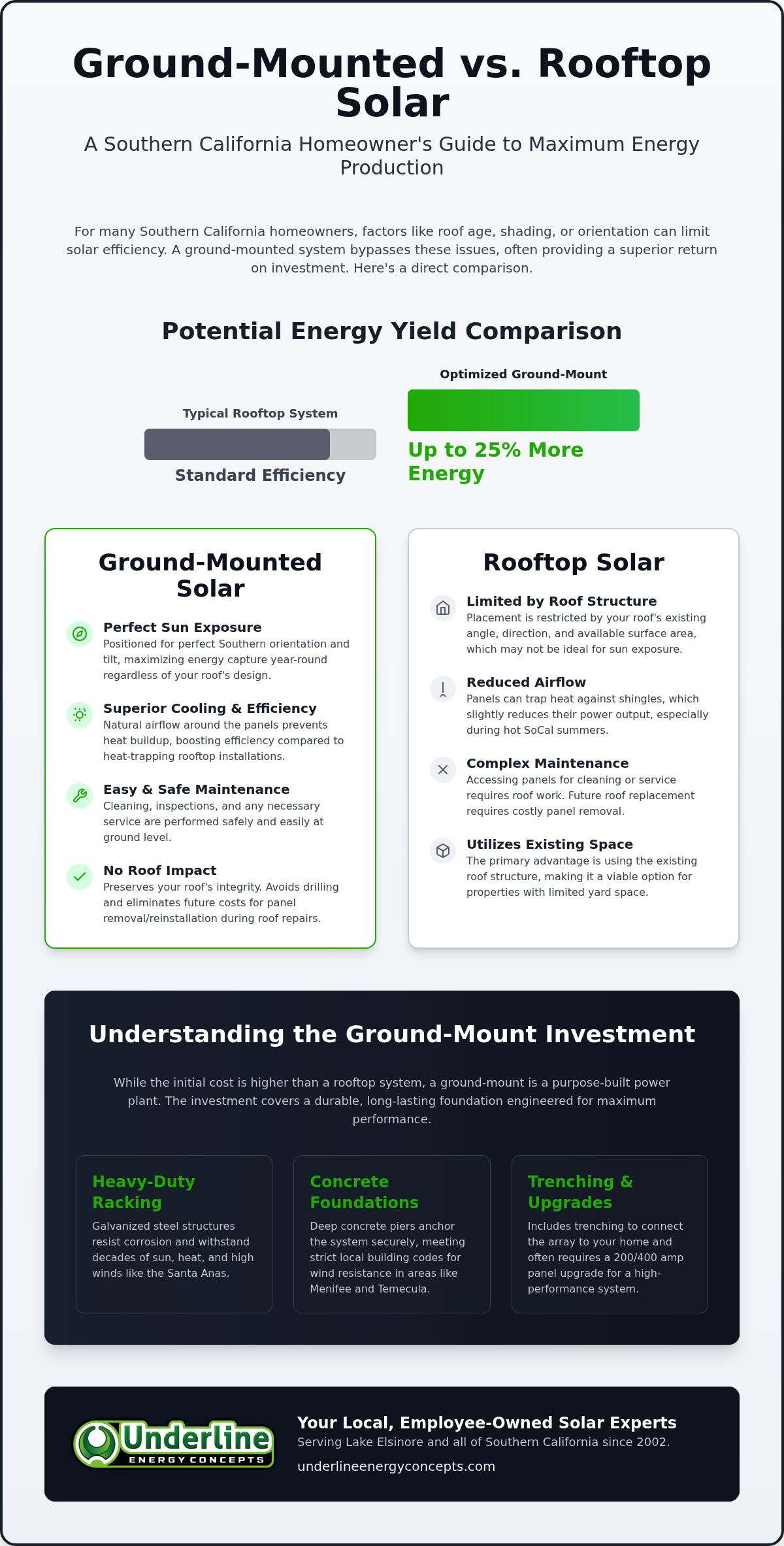
When evaluating the cost of ground mounted solar panels California residents often discover that the "Maximum Yield" potential justifies the investment. Because these arrays aren't confined by your roof's surface area or pitch, they can produce up to 25% more energy than a comparable rooftop system. This efficiency is vital under current utility structures where every kilowatt-hour counts. At Underline Energy Concepts, we prioritize this level of optimization to ensure your transition to solar feels like a smart, common-sense financial decision rather than a compromise.
Bypassing Roof Limitations
Your roof age shouldn't dictate your energy future. If your shingles are nearing the end of their lifespan or your roof design is overly complex with multiple peaks and valleys, a rooftop install becomes a liability. You'll eventually face "remove and reinstall" costs when it's time for roof maintenance, which can add thousands to your long-term expenses. By choosing a ground mount, you bypass these issues entirely. While the initial cost of ground mounted solar panels California homeowners see might be higher than a roof mount, the lack of roof-related maintenance creates significant savings. Maintenance becomes a breeze when you can clean your panels or inspect the racking without ever leaving the safety of the ground. This setup preserves your home's structural integrity while offering a clear, unobstructed path to lower bills. You can even use our referral program to help offset the installation by sharing your experience with neighbors.
Optimizing for the Southern California Sun
The sun hits Southern California with incredible intensity, but a roof doesn't always face the right way to catch it. A ground-mounted system allows for perfect Southern orientation, ensuring your panels are active during the most productive hours of the day. We utilize adjustable racking systems that can be calibrated to maximize production regardless of the season. Beyond that, these systems benefit from superior natural airflow. Rooftop panels often trap heat against the shingles, which actually reduces their efficiency. Ground mounts stay cooler because air circulates freely around the entire array. This cooling effect, combined with perfect sun angles, ensures your system operates at peak capacity year-round. This is the level of reliability we've provided from our Lake Elsinore base since 2002.
Breaking Down the Cost of Ground Mounted Solar in California
Building a solar array from the ground up involves more than just panels. When we talk about the cost of ground mounted solar panels California homeowners must prepare for what we call the "Standard Premium." Unlike a rooftop system that utilizes your home’s existing skeleton, a ground mount requires its own foundation and framing. While national solar system cost benchmarks provide a baseline, our local terrain and labor rates in Riverside and San Diego counties add specific layers to the budget. You're investing in a permanent structure that must withstand decades of sun and wind.
Racking and Foundation Expenses
The foundation is where your system's longevity begins. Most residential projects in Southern California use fixed-tilt racking made of heavy-duty galvanized steel. We choose steel because it resists the corrosive nature of our soil and the high-heat cycles of the Inland Empire. Because these systems act like giant sails in the wind, building codes in areas like Menifee require deep concrete piers. These piers ensure your investment stays anchored during Santa Ana wind events. While advanced tracking systems that follow the sun exist, fixed-tilt racking usually offers the best balance of reliability and performance for most local lots.
Trenching, Electrical, and Panel Upgrades
Distance is a major factor in your final invoice. We have to run heavy-gauge conduit from the array back to your home's electrical service. This requires precision trenching, which varies in cost based on the distance and the hardness of the ground. If your array is 100 feet away, the labor and material costs increase accordingly. Most importantly, a large ground-mounted system often pushes an older electrical system to its limit. You may need a 200 amp or 400 amp electric panel upgrade to safely handle the high power output. We often pair these systems with SolarEdge inverters to manage voltage drop over these long distances, ensuring every watt reaches your home efficiently.
Soft Costs: Permits and Inspections
Permitting in Lake Elsinore, Corona, or Temecula involves more than a simple signature. Ground mounts require structural engineering stamps to prove the racking can handle local wind loads. As a licensed general contractor based in Lake Elsinore, we handle this "red tape" for you. We coordinate with city inspectors and utility companies to ensure your system meets every safety standard. This local expertise prevents costly delays and ensures your project moves quickly from design to power generation. If you're ready to see how these factors apply to your specific property, request a detailed site assessment from our employee-owned team.
Ground Mount vs. Roof Mount: A 2026 Cost-Benefit Analysis
Choosing between a roof and a ground mount isn't just about the check you write today. It's about the next 25 years of energy production and home maintenance. While the upfront cost of ground mounted solar panels California homeowners pay is typically higher, the performance gap often closes that financial distance quickly. Rooftop systems are limited by the size and shape of your home. If your roof faces north or is broken up by dormers, you're leaving energy on the table. A ground mount ignores these hurdles, allowing for a layout that captures every possible ray of sunlight.
The 25-Year ROI Comparison
Think about your roof's lifespan. Most solar panels are rated for 25 to 30 years. If your roof is already a decade old, you'll likely need a replacement before your solar system retires. This requires paying a crew to uninstall your panels and reinstall them later, a hidden cost that can wipe out years of savings. Ground mounts eliminate this risk entirely. They also offer unmatched flexibility for future growth. If you buy an EV or add a pool later, expanding a ground array is a simple matter of adding more racking. This scalability makes the solar panel ground mount vs roof debate a clear win for homeowners with extra space.
Maintenance is another area where ground systems shine. Panels stay more efficient when they're clean. Dragging a ladder out to wash rooftop panels is a chore most people skip. With a ground mount, you can rinse your panels in minutes with a garden hose. This ease of care ensures your system always produces at its peak. When calculating the long-term cost of ground mounted solar panels California property owners often find that easier cleaning and higher yields result in a better overall value than roof-bound alternatives.
Aesthetic and Land Use Considerations
Don't assume a ground mount will ruin your backyard's look. We often use a "dead space" approach, placing arrays on sloped land or far corners of the property that aren't being used. This preserves your home's curb appeal, which is especially important in gated communities like Canyon Lake. For buyers looking at acreage in Southern California, a professionally installed ground mount is a high-value asset. It signals that the property is energy-independent and ready for the future. We design these systems to feel like a natural part of your landscape, providing "Invisible Solar" that powers your life without cluttering your roofline.
Maximizing Your Investment: NEM 3.0 and California Incentives
Under the current Net Billing Tariff, often called NEM 3.0, the financial strategy for solar has shifted. The days of earning high retail rates for the energy you send back to the grid are over. For Southern California Edison (SCE) customers, export rates now average between $0.05 and $0.09 per kWh. This means your goal isn't to sell power; it's to keep every watt you produce. While the upfront cost of ground mounted solar panels California residents encounter is a significant commitment, the right incentives and a "self-consumption" model can secure a payback period of 6 to 9 years when paired with storage.
As of 2026, the residential federal tax credit (Section 25D) has expired. However, you can still capture a 30% reduction in your system's impact through third-party ownership models like leases or Power Purchase Agreements (PPAs). These options utilize the commercial solar tax credit, passing the savings to you through lower monthly payments. Additionally, you should check for SCE marketplace incentives that may offer rebates for smart home technology and energy-efficient upgrades that complement your new array.
The Battery Storage Revolution
Storage is no longer an optional luxury; it's the engine that drives your ROI. Because ground mounts often have more space and flexibility than roof systems, they are perfect candidates for a whole home battery backup installation. By storing the excess energy your ground mount produces during the day, you can power your home during the peak evening hours when utility rates are highest. We specialize in integrating Quietcool battery charge mounts to ensure your storage system operates at peak efficiency. This strategy allows you to bypass the low export rates and use your own clean energy to achieve true autonomy from utility price hikes.
California-Specific Financial Protections
California provides a powerful shield for your home's value through the solar property tax exclusion. This regulation ensures that adding a high-value ground-mounted system won't trigger a reassessment of your property taxes. You must act quickly, as this exclusion is set to expire on January 1, 2027. Systems completed before this date are protected until the property changes ownership. At Underline Energy Concepts, we help you navigate these deadlines from our home base in Lake Elsinore. We also offer an employee-owned Referral Program that can further lower your net investment by rewarding you for helping your neighbors go solar. If you want to lock in these protections before the 2027 deadline, request a personalized ROI analysis from our local experts.
Choosing the Right Partner for Your SoCal Ground Mount
Investing in a ground-mounted system is a long-term commitment to your property's value and your family's autonomy. While understanding the initial cost of ground mounted solar panels California residents pay is essential, choosing who installs that system is equally vital. You don't want a "solar-only" company that treats your project like a one-size-fits-all assembly line. You need a licensed general contractor who understands the structural, electrical, and environmental nuances of Southern California terrain. At Underline Energy Concepts, we bring a level of professional advocacy that national installers simply can't match.
The Importance of a Multi-Licensed Contractor
We hold licenses in roofing, electrical, and general contracting because we believe your home is a single, integrated system. This multi-disciplinary approach is critical for ground mounts. Our roofing expertise ensures that even while we're trenching across your yard, we're protecting the long-term integrity of your property's drainage and landscape. Our electrical mastery means your necessary panel upgrades are handled with precision, ensuring your home is ready for the high-capacity output of a ground array. Once your system is live, our relationship is just beginning. We provide comprehensive support, from routine solar cleaning to emergency inspections after a heavy storm. This integrated service model is why we've remained a trusted name in the region for over two decades.
Lake Elsinore Pride: Our Local Commitment
We've called Lake Elsinore home since 2002. Our employee-owners live and work in the same Menifee, Temecula, and Murrieta neighborhoods we serve. This local presence isn't just about pride; it's about accountability. When you have a question or need service, you aren't calling a distant corporate office. You're calling a local partner who can be at your door quickly. Being employee-owned means every member of our team is personally invested in your system's performance. We don't use aggressive sales tactics because our reputation depends on your long-term satisfaction. We're here to empower you with the facts so you can make a common-sense decision for your family's future.
The first step toward energy independence is a professional site inspection. We'll evaluate your soil, measure sun exposure, and provide a transparent breakdown of how the cost of ground mounted solar panels California homeowners face translates into real-world savings for your specific lot. We'll walk you through the entire process, from the first trench to the final permit. Schedule your Southern California solar consultation today and take the first step toward a more stable, self-sufficient home.
Take Control of Your Energy Future
Choosing a ground-mounted system is a bold step toward true energy independence. You've seen how these arrays bypass roof limitations to deliver maximum yields and how pairing them with storage is the key to beating NEM 3.0 export rates. While the initial cost of ground mounted solar panels California property owners pay reflects a premium for durability and performance, the long-term stability it offers against rising utility costs is a common-sense financial decision.
At Underline Energy Concepts, we're more than just installers. We're your local partners in Lake Elsinore, serving Southern California since 2002. As an employee-owned company licensed in roofing, electrical, and general contracting, we ensure your project is handled with expert care from trenching to the final inspection. Don't let your energy future be dictated by utility hikes or a complex roof. Take the next step toward a more resilient home.
Get Your Free Ground Mount Site Evaluation Today
Frequently Asked Questions
Do ground-mounted solar panels cost more than roof-mounted ones?
Yes, ground-mounted systems involve a higher upfront investment because they require independent structural support. Unlike rooftop installs that use your home’s existing frame, ground mounts need specialized steel racking and concrete foundations. When calculating the total cost of ground mounted solar panels California homeowners should account for these structural components and the labor for site preparation. While the initial price is higher, the increased efficiency often leads to a more favorable long-term energy yield.
How much space do I need for a ground-mounted solar system in California?
You generally need between 400 and 600 square feet for a standard residential 8 kW system. However, the total footprint depends on the efficiency of your panels and the spacing required to prevent row-to-row shading. Local setbacks in Riverside County also play a role in where you can place the array. We evaluate your specific lot in Lake Elsinore or Menifee to ensure you have enough clear, unshaded land to maximize your production.
Is trenching included in the cost of ground-mounted solar?
Trenching is a specific labor and material cost that depends entirely on the distance between your array and your home's electrical service. While some installers provide a base estimate, the final price is determined by the length of the conduit run and the hardness of the soil on your property. At Underline Energy Concepts, we provide a detailed breakdown of these infrastructure costs during our site assessment to ensure there aren't any surprises during the installation process.
Does a ground mount increase my property taxes in California?
No, solar installations are currently excluded from property tax assessments under California law. This exclusion means you can add significant value to your home without seeing an increase in your annual tax bill. It's important to know that this protection is set to expire on January 1, 2027. Systems completed and operational before that date will maintain their exempt status until the property is sold or changes ownership, protecting your long-term financial stability.
Can I install a ground mount myself with a kit?
We strongly advise against DIY solar kits for ground mounts in Southern California. These systems require precise structural engineering to withstand local wind loads and complex electrical work that must meet strict California building codes. Without professional installation from a licensed contractor, you'll likely struggle with permitting and utility interconnection. Our employee-owned team handles the engineering stamps and red tape to ensure your system is safe, reliable, and fully compliant with local regulations.
What is the lifespan of a ground-mounted solar racking system?
The heavy-duty steel racking used for ground mounts is designed to last 25 to 35 years or more. Because these structures are built with galvanized materials, they resist the high-heat cycles and soil corrosion common in the Inland Empire. The racking often outlasts the solar panels themselves, providing a stable foundation for your energy independence. This durability is why we prioritize high-quality materials that can withstand the unique environmental pressures of the Southern California climate.
How does NEM 3.0 affect the ROI of ground-mounted solar?
NEM 3.0 has shifted the focus from selling power to the grid to self-consumption. Because export rates have dropped by approximately 75%, the return on investment for the cost of ground mounted solar panels California residents buy now depends on battery storage. By storing excess daytime energy to use during expensive peak evening hours, you can still achieve a payback period of 6 to 9 years. This strategy protects you from rising utility rates and maximizes your system's value.
Are ground-mounted panels easier to clean and maintain?
Yes, ground-mounted arrays offer significantly better access for routine maintenance than rooftop systems. You don't need a ladder or safety harness to rinse off the dust that accumulates during Southern California's dry season. Keeping your panels clean is essential for maintaining peak efficiency, especially under NEM 3.0 where every watt counts. The ability to perform quick inspections and cleaning from the ground level ensures your system produces the maximum amount of energy throughout its lifespan.