
Attic Ventilation Fire Code Upgrade: 2026 Southern California Homeowner’s Guide
/
Article by
Jesse Malone
Jesse Malone
CEO & Partner, Underline Energy Concepts
Jesse Malone is the CEO and Partner of Underline Energy Concepts, a Southern California energy services company that has been serving homeowners since 2002. Since joining the company and becoming a partner in approximately 2015, Jesse has helped lead its growth into one of Southern California’s most trusted providers of residential energy efficiency and home improvement solutions.
Throughout his tenure, Jesse and the Underline Energy team have completed more than 2,500 energy upgrade projects for homeowners across Southern California. These projects include solar energy systems, roofing, battery storage, EV charging stations, electrical panel upgrades, water heater replacements, attic insulation, retrofit windows, and other energy-efficient home improvements designed to lower utility costs and increase property value.
Jesse holds a Bachelor’s Degree from California Southern University and brings more than 20 years of experience in emergency services through his service with the fire department. His background in public service has shaped his leadership style, emphasizing integrity, accountability, safety, and a commitment to serving the community.
A lifelong advocate for efficiency and practical solutions, Jesse is passionate about helping homeowners make informed decisions that improve both their homes and their financial future. His interests extend beyond energy efficiency into financial literacy, budgeting, investing, and long-term wealth-building strategies. He believes that reducing unnecessary expenses and maximizing efficiency are key components of financial success.
As CEO, Jesse continues to focus on delivering exceptional customer experiences, building high-performing teams, and helping Southern California homeowners achieve greater comfort, energy independence, and long-term savings through smart home investments.
Did you know that wind-blown embers, not direct flames, are responsible for 60% to 90% of home ignitions during a wildfire? For many Southern California families, the need for an attic ventilation fire code upgrade is no longer optional; it's a vital step to prevent losing homeowners insurance in a hardening market. You want to protect your property, but the shift from Chapter 7A to the new California Wildland-Urban Interface Code (CWUIC) can feel overwhelming. We understand that you need clear, actionable answers to keep your home safe and compliant.
Since 2002, our team at Underline Energy Concepts has helped Lake Elsinore and Temecula homeowners build more resilient properties. This guide will show you exactly how to meet the 2026 standards, including the specific mesh sizes and ASTM testing required to keep embers out of your attic. You'll learn how to harden your home against fire while simultaneously improving airflow to lower your energy costs and satisfy your insurance provider's latest requirements. By the end of this article, you'll have a clear roadmap to a safer, more efficient, and fully protected home.
Key Takeaways
- Understand how an attic ventilation fire code upgrade protects your home by using ASTM E2886 tested vents that block wind-blown embers and direct flames.
- Learn why standard mesh screens fail and how the new 1/16-inch to 1/8-inch corrosion-resistant standards safeguard your roof's concealed spaces from ignition.
- Discover how to balance fire safety with proper airflow to ensure your attic remains cool and energy-efficient during intense Southern California heat waves.
- Navigate the 2026 California Wildland-Urban Interface Code (CWUIC) requirements to help maintain your homeowners insurance and increase long-term property value.
- Explore the benefits of a holistic home hardening strategy that combines fire-rated ventilation with high-performance solutions like QuietCool whole house fans.
Understanding Attic Ventilation Fire Code Upgrades in Southern California
An attic ventilation fire code upgrade is a specialized home improvement designed to stop a wildfire in its tracks before it ever enters your living space. This process involves swapping out traditional attic vents for units that have been tested to resist ember penetration and flame impingement. For Southern California families, this isn't just a safety trend. It's a practical response to the current insurance crisis. Since January 2026, many carriers now require proof of home hardening before they'll renew a policy. Taking this step gives you back a sense of control over your home's future.
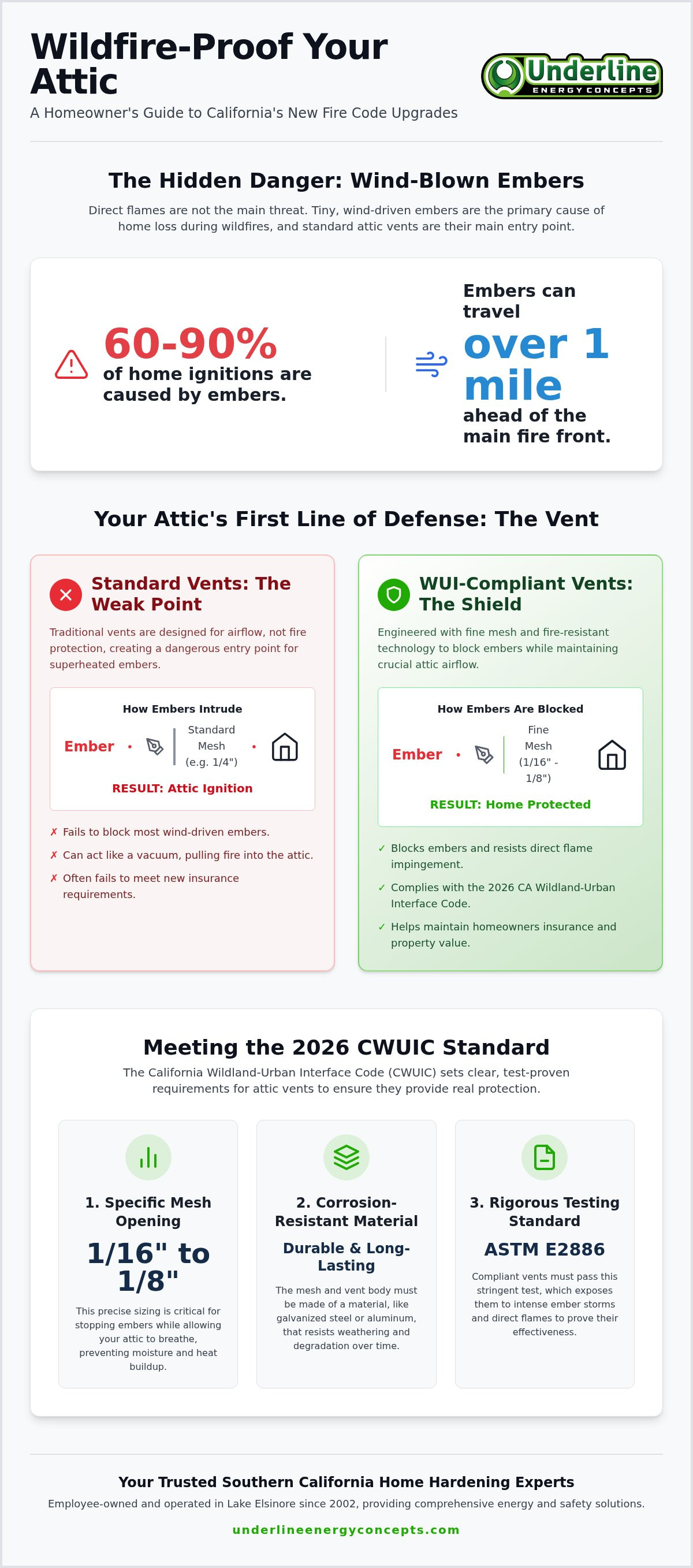
The 2026 standards prioritize stopping embers because they're the primary cause of residential loss. Research shows that wind-blown embers cause 60% to 90% of home ignitions during wildfires. Standard vents are often the weakest link in a home's exterior. They're designed to move air, but without the right barriers, they also move fire. By investing in an attic ventilation fire code upgrade, you're sealing those gaps while maintaining the airflow your home needs to stay cool in the Lake Elsinore heat.
What is the Wildland-Urban Interface (WUI)?
The Wildland-Urban Interface (WUI) is the zone where homes and wildland vegetation meet. In Riverside County, cities like Temecula and Menifee are prime examples of WUI communities. These areas are beautiful, but they come with a higher risk of ember storms. Embers are small, burning pieces of wood or vegetation that can travel over a mile ahead of a fire front. Understanding The Science of Ember Intrusion helps explain why WUI homes are so vulnerable. When wind pushes embers against your house, standard vents pull them into the attic. Once inside, those embers can ignite insulation or wooden rafters, destroying the home from the inside out before flames even reach your yard.
The 2026 Regulatory Landscape for SoCal Homeowners
The regulatory environment changed significantly on January 1, 2026. The California Wildland-Urban Interface Code (CWUIC) now governs fire-resistant construction. While many people still refer to "Chapter 7A," the CWUIC is the current authority. This code requires vents to have specific mesh openings between 1/16-inch and 1/8-inch. It also mandates that vents pass the rigorous ASTM E2886 test to be considered compliant. These aren't just suggestions; they're the new standard for safety and insurability.
At Underline Energy Concepts, we've been a local brick-and-mortar partner in Lake Elsinore since 2002. We understand how local building departments throughout Southern California interpret these new state laws. We don't just install vents; we provide a comprehensive plan to harden your home against external threats. This approach helps you satisfy insurance requirements and protects your property's long-term value. Taking control of your home's fire resistance is a common-sense move that provides immediate relief and long-term stability for your family.
The Science of Ember Intrusion: Why Chapter 7A Standards Matter
Traditional attic vents were designed for one job: moving air. In a Southern California wildfire, that airflow becomes a dangerous vacuum. High winds create pressure differences around your roof, sucking tiny, superheated embers into your attic through standard openings. This "concealed space" ignition is terrifying because you can't see the fire until it's too late. By the time smoke appears from the eaves, the internal structure of your roof is already compromised. An attic ventilation fire code upgrade replaces these vulnerable entry points with engineered barriers that prioritize your home's survival.
How Embers Bypass Traditional Attic Vents
Ember intrusion is the primary cause of home loss in SoCal wildfires. When wind hits the side of your house, it creates a vortex effect that swirls embers directly into gable and soffit vents. Older homes often rely on gable vents, which act like open windows for fire debris. Soffit vents aren't much safer; they can trap embers against the wooden eaves. Even if you have standard 1/8-inch mesh, research from the National Institute of Standards and Technology (NIST) shows that small, burning embers can still pass through and ignite dry insulation or stored items.
The challenge for homeowners is maintaining the delicate balance between fire protection and attic health. If you simply seal your vents, you'll trap heat and moisture, leading to mold and high cooling costs. Modern fire-rated vents solve this by using multi-layered designs that allow air to pass while stopping fire in its tracks.
ASTM E2886: The Standard for Fire-Resistant Vents
To meet the 2026 California Wildland-Urban Interface Code (CWUIC), vents must be "listed" and tested to the ASTM E2886 standard. This isn't just a simple screen. These vents use multi-layer baffle technology or intumescent materials that expand when exposed to heat, sealing the vent completely. The testing criteria are rigorous and include:
- Ember Resistance: Evaluating the ability to block burning embers during high-wind simulations.
- Flame Impingement: Testing the vent's structural integrity when exposed to direct flames.
- Corrosion Resistance: Ensuring the mesh and housing don't degrade under intense Southern California UV exposure or coastal salt air.
Since these high-tech vents often have a lower Net Free Area (NFA), you might need more of them to keep your attic cool. At Underline Energy Concepts, we use our 20 years of experience in Lake Elsinore to calculate exactly how many vents your specific roof needs for both safety and efficiency. You can reach out for a professional WUI assessment to ensure your home is ready for the next fire season without sacrificing your comfort.
Comparing Standard Vents vs. WUI-Compliant Ember-Resistant Vents
Standard attic vents are often made of thin aluminum or plastic. These materials are designed for basic airflow, but they fail quickly when exposed to the intense heat of a wildfire. In contrast, an attic ventilation fire code upgrade utilizes vents built from heavy-gauge galvanized steel or specialized alloys. These materials don't melt or warp easily, providing a critical barrier between your home's interior and the outside elements. While standard vents are "set and forget," WUI-compliant versions are engineered components that contribute to your home's overall structural integrity.
Homeowners in Lake Elsinore and Menifee often worry that fire-resistant vents will "choke" their attic and increase cooling costs. In reality, high-quality WUI vents are designed to maintain high airflow efficiency. They allow your home to breathe during our 100-degree summer days, which keeps your HVAC load manageable and your energy bills lower. Because these vents sometimes have a slightly lower Net Free Area (NFA) due to their protective baffles, our team at Underline Energy Concepts ensures your home has the correct number of units to balance safety with ventilation. This professional approach protects your roof from moisture buildup while meeting the 2026 insurance requirements.
Leading Fire-Rated Baffle-Style Solutions
Baffle-style vents are the gold standard for Wildland-Urban Interface (WUI) zones. These units use a "tortuous path" design that forces air to turn multiple corners. While air can navigate these turns easily, heavy embers get trapped in the baffles and burn out before they can enter your attic. There are specific designs tailored for every Southern California home style, from Mediterranean tile roofs to traditional shingles. These vents are built to withstand flame impingement, meaning they won't let fire pass through even if flames are licking at the roofline. Choosing the right style ensures your home stays protected without sacrificing its curb appeal.
The Myth of the 1/4-Inch Mesh
Many older homes in Riverside County still have vents with 1/4-inch mesh screens. These are effectively "fire highways" that allow wind-blown embers to fly directly into your attic. Simply stapling a smaller screen over an old vent is a dangerous DIY mistake. This unauthorized retrofit can significantly reduce your ventilation, leading to mold or shingle damage. It also won't satisfy insurance companies looking for "listed" vents that pass the ASTM E2886 test. As an employee-owned, local brick-and-mortar company, we've seen how professional installation ensures these vents are properly integrated into your roofing system. This keeps your fire rating intact and your home's value protected for the long term.
How to Navigate the Fire Code Upgrade Process for Your Home
Achieving a fire-hardened home doesn't have to be a source of stress. While the 2026 CWUIC regulations are strict, the path to compliance is a straightforward series of improvements that prioritize your safety and financial security. A professional attic ventilation fire code upgrade typically takes only one to two days to complete, but the peace of mind it provides lasts for decades. We've refined a three-step process that ensures your property meets every local and state requirement while maximizing your home's energy efficiency.
Step 1: The Attic and Roof Fire-Safety Inspection
Every successful project begins with a detailed WUI assessment. During a local Southern California inspection, our team at Underline Energy Concepts examines your roofline for "low-hanging fruit" like damaged screens or gaps in your eaves. We evaluate the current condition of your shingles or tiles to ensure the new vents will integrate seamlessly. This inspection is often performed alongside our Roof Repair and Maintenance Services to ensure your entire roofing system is structurally sound before we begin the upgrade. Identifying these vulnerabilities early prevents costly surprises and ensures your home is ready for the next fire season.
Step 2: Selecting and Installing Compliant Vents
Once we understand your home's unique architecture, we help you select the right ASTM E2886 tested vents. Whether you have a Mediterranean-style tile roof in Temecula or a traditional shingle roof in Menifee, the vent must match the pitch and material of your structure. Precision is vital during installation. We use specialized sealing techniques to prevent embers from bypassing the vent housing. We also ensure these new units work in harmony with your attic insulation for heat reduction. This integrated approach keeps your attic cool during a Riverside County heatwave while maintaining a solid fire barrier.
Step 3: Certification and Insurance Notification
The final step is the most important for your wallet. After the installation is complete, we provide a Certificate of Compliance for your records. This documentation is essential when communicating with insurance providers, including the California FAIR Plan and private carriers. Many insurers now offer premium discounts or policy renewals specifically for homes that have documented fire-hardening upgrades. Our local expertise in Lake Elsinore and Corona means we know exactly what documentation your agent needs to see. By presenting a professional certification of your attic ventilation fire code upgrade, you demonstrate a proactive commitment to risk reduction that insurers value.
Don't wait for a non-renewal notice to arrive in your mailbox. You can schedule your professional WUI assessment today to take control of your home’s safety and insurability.
Hardening Your Home with Underline Energy Concepts’ Integrated Solutions
Choosing a holistic approach to home maintenance isn't just about checking a box for a permit. It's about creating a unified system that protects your family while lowering your monthly overhead. When you invest in an attic ventilation fire code upgrade, you're securing the perimeter of your home's most vulnerable area. However, the most successful Southern California homeowners don't stop there. They integrate these safety features with performance-driven technology to maximize their return on investment and long-term property value.
Fire Safety Meets Energy Efficiency
By pairing fire-rated vents with a QuietCool whole house fan installation, you gain the ability to flush out hot air safely and efficiently. This combination is particularly effective in the Inland Empire, where evening temperatures drop but the daytime heat lingers in the attic. The fire-rated vents provide the necessary Net Free Area for the fan to operate at peak performance without compromising your safety standards. This synergy reduces the load on your HVAC system and protects other high-value assets, such as your solar panel installation, by preventing excessive heat buildup under the roof deck.
Your Local Partner in Southern California
At Underline Energy Concepts, we believe in the power of local expertise. We've been a brick-and-mortar part of Lake Elsinore since 2002, serving our neighbors in Menifee, Temecula, and beyond. As an employee-owned and operated company, every member of our team is personally invested in the quality of your home's workmanship. We don't just provide a service; we act as your trusted guide through the complexities of an attic ventilation fire code upgrade. Our 20-plus years of experience in Riverside County mean we understand the specific environmental pressures your home faces every year.
Taking control of your home's safety and energy efficiency is a common-sense decision that pays dividends in comfort and security. Whether you're facing insurance renewal pressure or simply want to optimize your property's value, we're here to help. You can schedule your comprehensive home energy and safety audit today to start your journey toward a more resilient future. Let's work together to ensure your Southern California home is fire-hardened, energy-independent, and ready for whatever the future holds.
Secure Your Home’s Future and Financial Stability
Protecting your property from the increasing threat of wildfires is a proactive choice that offers immediate relief. By prioritizing an attic ventilation fire code upgrade, you're closing the most dangerous entry point for wind-blown embers while ensuring your home remains cool and energy-efficient. As a Licensed Roofing and General Contractor serving Riverside County since 2002, Underline Energy Concepts brings deep expertise in Chapter 7A compliance to every project. We understand that meeting these 2026 standards is about more than just passing an inspection; it's about preserving your family's legacy and maintaining your homeowners insurance in a shifting market.
Don't let confusing regulations or rising utility costs dictate your home's future. You have the power to harden your structure with proven, baffle-style technology that stands up to the toughest conditions. We're proud to be your local Lake Elsinore partner in building a more resilient Southern California community. Take the first step toward long-term peace of mind by contacting our employee-owned team for a professional assessment.
Protect Your Home Today — Schedule a Fire Code Upgrade Consultation
Your safety and comfort are our top priorities, and we look forward to helping you optimize your home for the years ahead.
Frequently Asked Questions
Is an attic ventilation fire code upgrade mandatory for all SoCal homes?
An attic ventilation fire code upgrade isn't mandatory for every existing home, but it's required for new construction and re-roofing projects in Fire Hazard Severity Zones. As of January 1, 2026, the California Wildland-Urban Interface Code (CWUIC) governs these standards. Many homeowners in high-risk areas like Menifee choose to upgrade voluntarily to ensure their property remains insurable and to protect against the increasing threat of wind-blown embers.
Can I just install fine mesh over my existing attic vents to meet code?
No, simply stapling mesh over an old vent doesn't satisfy the current 2026 fire safety standards. To be fully compliant, you must install a "listed" vent that has passed the rigorous ASTM E2886 testing for ember and flame resistance. DIY mesh retrofits often fail because they don't include the internal baffle technology required to stop heat transfer, and they can dangerously restrict the airflow your attic needs.
How much does it cost to upgrade attic vents to fire-rated standards?
The investment for an attic ventilation fire code upgrade depends on your roof's pitch, the material type, and the total number of vents required for proper airflow. While fire-rated vents have a higher unit cost than standard aluminum versions, they provide a critical layer of protection that standard vents lack. We recommend a professional assessment to determine the specific requirements for your home's architecture and to ensure long-term safety.
Will fire-rated vents reduce the airflow and make my attic hotter?
Fire-rated vents may have a slightly lower Net Free Area due to their protective internal baffles, but they won't make your attic hotter when installed correctly. Our team calculates the precise number of vents your home needs to maintain balanced ventilation. This ensures your home stays cool during a Lake Elsinore summer while providing a robust defense against embers, effectively balancing energy efficiency with fire safety.
Do insurance companies give discounts for fire-rated attic vents?
Yes, many insurance carriers, including the California FAIR Plan, offer discounts or renewal incentives for documented home hardening measures. Since embers are responsible for 60% to 90% of home ignitions during wildfires, insurers prioritize these upgrades. Installing compliant vents demonstrates that you're proactively reducing risk, which can be a deciding factor in maintaining your policy and securing lower premiums in a challenging insurance market.
What is the difference between a WUI vent and a standard vent?
A standard vent is designed only to move air and often uses thin materials that melt or warp under intense heat. A WUI-compliant vent is built with non-combustible materials and features a specialized internal baffle system. This design creates a "tortuous path" that allows air to pass through while trapping burning embers before they can enter your home. These units must pass ASTM E2886 testing to be certified.
How do I know if my home is in a California WUI zone?
You can identify your risk level by reviewing the CAL FIRE Fire Hazard Severity Zone maps for your specific neighborhood. Many communities across Southern California, including Temecula and Corona, fall within these designated State or Local Responsibility Areas. If you're unsure about your home's status, our team can help you verify your zone during a professional consultation to ensure your property meets all current 2026 fire safety requirements.
Can Underline Energy Concepts install fire-rated vents during a roof repair?
Yes, we can perform an attic ventilation fire code upgrade as a seamless part of our roof repair and maintenance services. As a licensed roofing and general contractor serving Riverside County since 2002, we understand how to integrate these vents without compromising your roof's integrity. Combining these services ensures your home is watertight, energy-efficient, and fully protected against wildfire threats, all while improving your property's long-term value and safety.