
Cost of Whole House Fan Installation in California: 2026 Homeowner’s Guide
/
Article by
Jesse Malone
Jesse Malone
CEO & Partner, Underline Energy Concepts
Jesse Malone is the CEO and Partner of Underline Energy Concepts, a Southern California energy services company that has been serving homeowners since 2002. Since joining the company and becoming a partner in approximately 2015, Jesse has helped lead its growth into one of Southern California’s most trusted providers of residential energy efficiency and home improvement solutions.
Throughout his tenure, Jesse and the Underline Energy team have completed more than 2,500 energy upgrade projects for homeowners across Southern California. These projects include solar energy systems, roofing, battery storage, EV charging stations, electrical panel upgrades, water heater replacements, attic insulation, retrofit windows, and other energy-efficient home improvements designed to lower utility costs and increase property value.
Jesse holds a Bachelor’s Degree from California Southern University and brings more than 20 years of experience in emergency services through his service with the fire department. His background in public service has shaped his leadership style, emphasizing integrity, accountability, safety, and a commitment to serving the community.
A lifelong advocate for efficiency and practical solutions, Jesse is passionate about helping homeowners make informed decisions that improve both their homes and their financial future. His interests extend beyond energy efficiency into financial literacy, budgeting, investing, and long-term wealth-building strategies. He believes that reducing unnecessary expenses and maximizing efficiency are key components of financial success.
As CEO, Jesse continues to focus on delivering exceptional customer experiences, building high-performing teams, and helping Southern California homeowners achieve greater comfort, energy independence, and long-term savings through smart home investments.
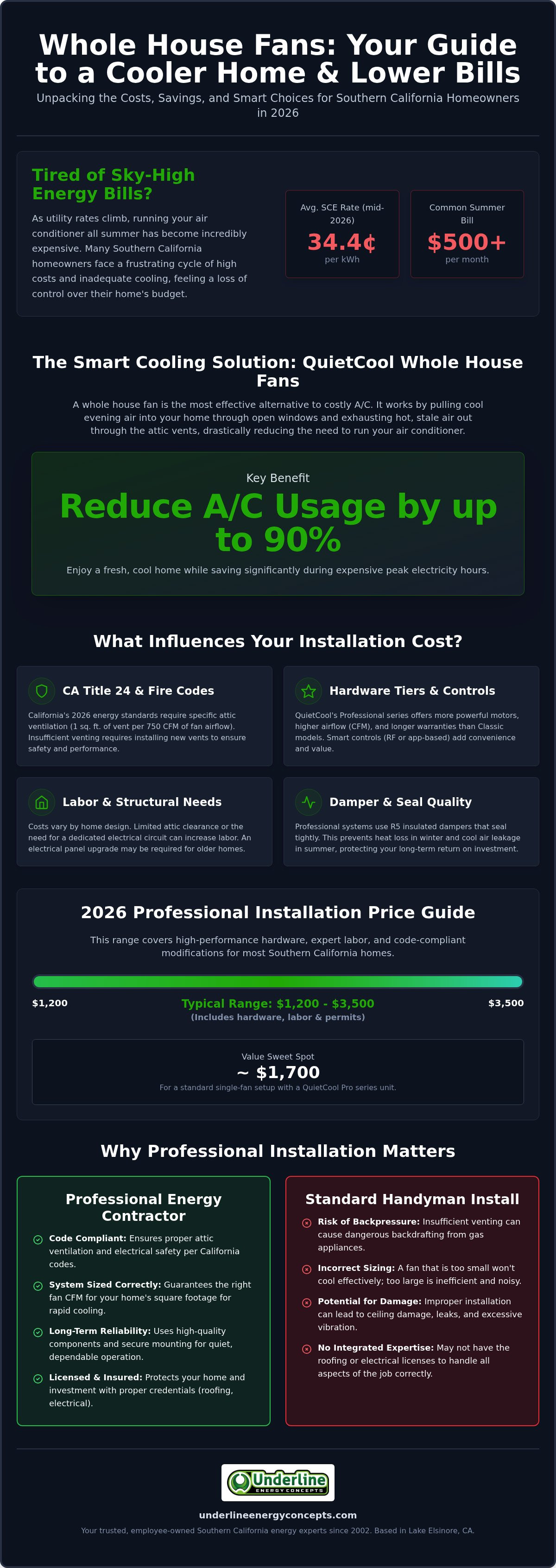
Southern California Edison residential rates reached a staggering average of 34.4¢/kWh in mid-2026, but your air conditioner doesn't have to be the reason your summer budget collapses. You're likely tired of $500 monthly electric bills and an A/C unit that runs 24/7 without ever truly refreshing your indoor air. It's frustrating to feel like you're losing control over your home's expenses while utility rates continue to climb. At Underline Energy Concepts, we believe you deserve a more efficient way to stay cool and comfortable.
Understanding the total cost of whole house fan installation California homeowners should expect is the first step toward reclaiming your financial autonomy. This guide provides a clear look at the factors influencing your investment, including QuietCool technology, energy savings, and Southern California specific ROI. We'll explore how professional installation can reduce your A/C usage by up to 90%, meet strict California fire codes, and deliver the rapid cooling your family needs. From our home base in Lake Elsinore, our employee-owned team has helped neighbors across the region transition to smarter energy solutions that prioritize long-term stability over temporary fixes.
Key Takeaways
- Understand how California's 2026 Title 24 standards and local fire codes influence the structural requirements and final investment of your project.
- Learn how a QuietCool system targets thermal mass to reduce air conditioning usage by up to 90%, providing a faster ROI than many other home upgrades.
- Discover why the cost of whole house fan installation California residents pay is offset by significant savings during expensive peak Time-of-Use utility hours.
- Identify the critical differences between a standard handyman install and a professional energy-efficiency upgrade that ensures proper attic ventilation and long-term reliability.
- Prepare for your 2026 upgrade by learning how to size your fan correctly and integrate it with your existing solar or insulation for maximum home comfort.
What Influences the Cost of Whole House Fan Installation in California?
California’s 2026 energy standards make home cooling more than just a matter of comfort; it’s a matter of compliance and strategic planning. Determining the total cost of whole house fan installation California homeowners face requires looking beyond the price tag of the unit itself. Before diving into the numbers, it helps to understand what a whole house fan is and why it remains the most effective alternative to traditional A/C. Several variables dictate your final investment, from the physical dimensions of your attic to the state of your electrical panel. At Underline Energy Concepts, we take a whole-home approach to ensure your system integrates perfectly with your existing roofing and insulation.
Compliance with the 2026 Title 24 Building Energy Efficiency Standards is a primary cost driver. These regulations require specific attic ventilation ratios, often referred to as the 1:750 rule. This means for every 750 CFM of fan airflow, you must have one square foot of net free vent area. If your home lacks sufficient venting, our team must install additional dormer or gable vents to prevent backpressure and ensure safety. As an employee-owned contractor based in Lake Elsinore, we specialize in these fire code compliant upgrades to protect your property value and safety.
Hardware Tiers: Classic vs. Professional Series
The hardware you choose significantly impacts your long-term results. The QuietCool lineup offers various tiers, with Professional series models typically requiring a higher upfront investment than the Classic or Stealth series. Pro models often feature more robust motors, higher CFM (Cubic Feet per Minute) ratings, and extended warranties that provide peace of mind. For a standard Southern California home, we calculate the CFM based on your square footage to ensure the air turns over quickly enough to drop indoor temperatures. You also have choices regarding controls. While traditional timers are functional, many homeowners now opt for RF controllers or smart-home integrations that allow you to manage your cooling from a smartphone, adding a small but worthwhile hardware cost.
Labor and Structural Requirements in Southern California
Labor complexity varies based on your home's age and design. Retrofitting a system into an older Riverside home might require more structural prep than a newer build in Menifee. If your attic has limited clearance, the installation becomes more labor-intensive. Additionally, your electrical system must be up to the task. While whole house fans are incredibly efficient, they still require a dedicated circuit. If your existing 100 amp panel is maxed out, you might need a 200 amp or 400 amp electric panel upgrade to handle the new load safely. Because we are licensed electrical and roofing contractors, we handle these complexities in-house, ensuring that every wire and vent meets strict California fire codes without the need for outside subcontractors.
The Price Guide: Average Installation Ranges for 2026
Understanding the average cost of whole house fan installation California homeowners experience in 2026 helps you plan a smarter energy budget. While every home is unique, industry data shows that most professional installations range from $1,200 to $3,500. This investment covers the high-performance hardware, specialized labor, and the structural modifications necessary to meet California's strict building codes. The typical "sweet spot" for value often lands around $1,700 for a standard single-fan setup. This price point usually includes a QuietCool Professional series unit, which offers superior airflow and a longer warranty than entry-level retail models.
You should also prepare for 'invisible' costs that DIY estimates often overlook. These include city permit fees, which vary by municipality, and minor drywall repairs if your ceiling requires a new cutout. Another critical factor is the quality of the damper. Cheaper, non-insulated fans might save you money today, but they lead to massive heat loss in the winter and cool air leakage in the summer. We prioritize Professional series units with R5 insulated dampers. They seal tightly when not in use, preserving your home's conditioned air and protecting your long-term ROI.
Estimated Cost Breakdown by Home Square Footage
Home size is the most direct influencer of your total project scope. For smaller residences under 1,500 square feet, a single high-efficiency fan is often sufficient to cycle the air effectively. Mid-range SoCal homes between 2,000 and 2,500 square feet typically require either a single high-capacity Pro series unit or a dual-fan configuration to handle the larger volume of air. Large multi-story properties often benefit from a multi-fan "zoned" system. This allows you to cool the upstairs bedrooms independently from the downstairs living areas, maximizing comfort while keeping wattage low. If you're ready to see how these ranges apply to your specific floor plan, reach out to our local team for a detailed evaluation.
Permitting and Compliance Costs in SoCal Cities
Navigating local building permits in cities like Corona, Temecula, and Lake Elsinore is a non-negotiable part of a professional installation. While permit fees add to the initial cost, they ensure your system is inspected for safety and code compliance. This is especially important for attic ventilation fire code upgrades. California's 1:750 rule requires adequate venting to prevent heat buildup and backpressure. Skipping this step to save a few dollars can lead to motor burnout or, worse, issues during a future home inspection when you try to sell your property. As an employee-owned contractor, we handle the permitting process for you, ensuring your upgrade is a documented asset to your home’s value.
Calculating ROI: How a Whole House Fan Pays for Itself
Investing in a whole house fan is one of the most effective ways to reclaim your energy independence in Southern California. While traditional central air conditioning only cools the air inside your rooms, a QuietCool system targets your home's thermal mass. It pulls massive volumes of cool evening air through your living space and pushes it into the attic, cooling the actual structure of your home, including the drywall, framing, and furniture. This prevents your house from acting like a giant heat battery that radiates warmth long after the sun goes down.
Consider the power consumption. A standard 5-ton central A/C unit can consume over 5,000 watts per hour. In contrast, a high-efficiency QuietCool fan often operates on just 200 to 600 watts. By running the fan during the evening and early morning, you effectively 'pre-cool' your home for pennies. This strategy allows you to keep the A/C off during the most expensive hours of the day. By slashing cooling costs by up to 90%, most homeowners see a full return on the cost of whole house fan installation California residents pay within a three-to-five-year payback period.
Utility Savings with SCE and SDG&E
Southern California Edison and SDG&E utilize Time-of-Use (TOU) rates that punish homeowners for using power between 4 PM and 9 PM. This is exactly when your home is hottest. A whole house fan allows you to bypass these peak prices by cooling your home once the outside temperature drops below the indoor temperature. You can often find additional financial relief through SCE Marketplace rebates for energy-efficient models. Many homeowners overlook the importance of attic ventilation fire code upgrades, such as those required by local Southern California ordinances. If your attic lacks the proper net free venting area, the hot air cannot escape quickly enough, which chokes the fan and reduces your ROI. Our team ensures your installation meets these safety standards, protecting your home while maximizing energy savings.
Synergy with Solar and Battery Backup
If you have already invested in solar, a whole house fan is the perfect companion. By reducing your overall cooling load, you can often downsize the solar array needed or redirect that power to other needs like EV charging. For those with battery storage, the low wattage of a QuietCool system is a game changer. It allows you to maintain a comfortable indoor temperature during a power outage without draining your entire battery reserve in a matter of hours. Integrating Quietcool battery charge mounts further enhances your energy autonomy. This whole-home approach ensures that your Lake Elsinore or Temecula residence remains a sanctuary of efficiency, regardless of what the utility companies do with their rates.
Choosing the Right Installer in Southern California
Selecting an installer is as critical as the hardware itself. While a handyman might offer a lower initial quote, the total cost of whole house fan installation California homeowners face increases exponentially if the job isn't done right. Professional installers understand the nuances of Southern California attic structures, which vary significantly by decade and local city code. You need a partner who knows how to handle clay tile roofs in Temecula just as well as asphalt shingles in Riverside without compromising the structural integrity of your home.
Before hiring anyone, ask specific questions about attic ventilation and fire safety. If an installer cannot explain the 1:750 venting rule or doesn't check your existing net free vent area, they are likely cutting corners. Watch for red flags like under-sized fans that won't provide enough air turns to cool your thermal mass. Another major warning sign is the absence of R5 insulated dampers. Without these, your expensive air-conditioned air will leak into the attic all day, forcing your A/C to work harder and negating your energy savings.
Licensed vs. Unlicensed: The True Cost of Risk
Cutting corners on licensing creates significant liability for your property. An improper ceiling cutout can lead to structural issues, while poor wiring poses a legitimate fire hazard in a dry attic environment. Professional installation protects your home's resale value and ensures you remain compliant with 2026 building standards. When you eventually sell your home, inspectors will look for permitted, code-compliant work. Choosing a local brick-and-mortar company also gives you access to a comprehensive warranty. You deserve a partner who will be there to support you years after the installation is complete.
The Underline Energy Concepts Difference
Since 2002, our team has served Lake Elsinore and the broader Southern California region with a focus on holistic energy efficiency. We aren't just fan installers; we are licensed roofing, electrical, and general contractors. This multi-trade expertise allows us to integrate your QuietCool system into a broader energy plan that might include solar panels or high-performance insulation. As an employee-owned and operated business, we take personal pride in every project. We prioritize homeowner education, ensuring you understand exactly how to operate your system for maximum savings. Schedule a professional home energy audit today to ensure your installation meets every safety and efficiency standard.
Next Steps: Planning Your 2026 Energy Upgrade
Taking control of your home’s climate starts with a clear plan. While the initial cost of whole house fan installation California residents consider might seem like a standalone project, it’s most effective when viewed as part of a total energy strategy. Your first step should always be a professional home energy audit. Our specialists evaluate your home's square footage, attic volume, and existing ventilation to determine the precise CFM needed for optimal cooling. We also inspect your electrical panel to ensure it can handle the new circuit; if your system is outdated, we can facilitate a 200 amp or 400 amp upgrade simultaneously.
Preparation is key to a seamless installation day. Clear a path to your attic access and ensure your electrical panel is accessible for our technicians. If your home currently lacks sufficient insulation, 2026 is the perfect time to address it. Combining a QuietCool fan with fresh attic insulation creates a powerful barrier against the Inland Empire heat, keeping the cool air in and the summer sun out. Use this final checklist to prepare for your upgrade:
- Verify your attic's "net free vent area" meets the 1:750 rule.
- Ensure your electrical panel has space for a dedicated circuit.
- Select a QuietCool Professional series model with an R5 insulated damper.
- Confirm the installation includes all necessary city permits and fire code compliance.
Bundle and Save: The Whole-Home Approach
Maximizing your return on investment often means looking at how different systems work together. For instance, pairing a fan with a solar panel installation is the ultimate utility-bill-hacking tool. By using the fan to slash your A/C load, your solar array can cover a much larger percentage of your home's remaining energy needs. You can also gain further autonomy by integrating hybrid water heaters, which pull heat from your garage or utility room to warm your water with incredible efficiency. Once you experience the relief of a lower bill, you can share the savings with neighbors through our referral program, helping your entire community become more energy independent.
Contact Our Lake Elsinore Experts
Underline Energy Concepts is a local, employee-owned brick-and-mortar company based right here in Lake Elsinore. When you consult with us, you aren't talking to a remote call center; you're speaking with specialists who understand the specific heat challenges of the Riverside and San Bernardino regions. During your initial consultation, we provide a transparent assessment of your home's needs and explain exactly how a QuietCool system will integrate with your roofing and electrical infrastructure. Our goal is to empower you with the knowledge needed to make a common-sense decision for your family’s comfort. Schedule your whole house fan inspection today and start your journey toward a cooler, more affordable home.
Take Control of Your Home's Energy Future
Securing your home against rising utility rates is a strategic move that pays dividends for years. By cooling your structure’s thermal mass and slashing A/C usage by up to 90%, you aren't just buying an appliance; you're investing in long-term financial relief. While the initial cost of whole house fan installation California homeowners face depends on specific attic requirements, the rapid ROI and improved air quality make it one of the smartest upgrades available in 2026.
At Underline Energy Concepts, we bring over two decades of local expertise to every project. As an employee-owned business based in Lake Elsinore, we take personal pride in providing quality workmanship that meets every safety standard. Our team consists of QuietCool Authorized Installers who are fully licensed and insured, ensuring your upgrade is handled with professional care since 2002. Don't let another summer of high electric bills drain your budget. Get a Professional Quote from Underline Energy Concepts today and start enjoying a cooler, more efficient home.
Frequently Asked Questions
Is a whole house fan cheaper than running an air conditioner?
Yes, operating a whole house fan typically costs between $0.05 and $0.15 per hour. In contrast, a central A/C unit consumes significantly more power due to its heavy wattage requirements. By utilizing a fan during cool evening hours, you can reduce your cooling costs by up to 90%. This shift allows you to bypass expensive peak utility rates while maintaining a fresh, comfortable indoor environment throughout the night and early morning.
How much does a QuietCool whole house fan cost with installation in SoCal?
While we do not quote specific prices here, professional installation in California typically ranges from $1,200 to $3,500 depending on your home's unique needs. Factors like fan capacity, attic clearance, and electrical panel status influence the total investment. The cost of whole house fan installation California residents pay often reflects the complexity of meeting 2026 Title 24 energy standards and ensuring proper fire code compliant ventilation for long-term safety.
Do whole house fans work in high humidity areas of California?
Whole house fans are most effective when the outdoor temperature and humidity levels drop in the evening. While they perform exceptionally well in the dry heat of the Inland Empire, they can also work in coastal areas during periods of low humidity. It's important to monitor the outdoor air; if it is muggy or damp, running the fan might pull that moisture inside. Always wait for a crisp, dry breeze before activating your system.
Can I install a whole house fan myself to save money?
DIY installation is possible but carries significant risks regarding structural integrity and fire safety. California’s 2026 building codes require specific attic venting ratios that are difficult for non-professionals to calculate accurately. Improperly cutting into your ceiling or incorrectly wiring the motor can lead to roof leaks or electrical hazards. Hiring a licensed contractor ensures your system is permitted, code-compliant, and covered by a professional warranty that protects your property value and peace of mind.
Will a whole house fan help reduce the dust and allergens in my home?
Yes, these systems improve indoor air quality by rapidly exhausting stale air, pet dander, and cooking odors. By creating a complete air exchange every few minutes, the fan replaces trapped pollutants with fresh outdoor air. This process is particularly beneficial in Southern California, where indoor air can become stagnant during long heatwaves. However, you should avoid running the fan during high pollen counts or wildfire smoke events to keep external irritants out of your living space.
What happens if I run my fan while the A/C is on?
Running both systems simultaneously is counterproductive and wastes significant energy. The whole house fan will immediately pull your expensive, air-conditioned air out through the attic vents, forcing your A/C to work harder without cooling the home effectively. Only use your QuietCool system when the outdoor air is cooler than your indoor temperature. This strategy allows you to turn the A/C off completely, saving money and reducing wear on your expensive HVAC equipment.
Does a whole house fan require a lot of maintenance?
QuietCool systems are designed for low maintenance and long-term reliability. Unlike central A/C units, they don't require refrigerant recharges or complex compressor servicing. You should periodically check your attic vents for obstructions and ensure the intake grille is clean. Because these fans utilize high-quality motors, they operate quietly and efficiently for many years. Our employee-owned team in Lake Elsinore can provide a quick inspection if you ever notice changes in performance or airflow.
Are there any rebates available for whole house fans in 2026?
Local utility incentives vary, so you should always check with your specific provider before starting your project. For example, the LADWP offers a $200 rebate for qualifying installations in 2026. While some federal programs are currently waitlisted, Southern California Edison customers may still find localized efficiency credits. Researching these options can help offset the cost of whole house fan installation California homeowners invest in, making the transition to energy independence even more affordable.