
Attic Insulation Cost in Canyon Lake: 2026 Homeowner Buying Guide
/

Article by
Jesse Malone
Jesse Malone
CEO & Partner, Underline Energy Concepts
Jesse Malone is the CEO and Partner of Underline Energy Concepts, a Southern California energy services company that has been serving homeowners since 2002. Since joining the company and becoming a partner in approximately 2015, Jesse has helped lead its growth into one of Southern California’s most trusted providers of residential energy efficiency and home improvement solutions.
Throughout his tenure, Jesse and the Underline Energy team have completed more than 2,500 energy upgrade projects for homeowners across Southern California. These projects include solar energy systems, roofing, battery storage, EV charging stations, electrical panel upgrades, water heater replacements, attic insulation, retrofit windows, and other energy-efficient home improvements designed to lower utility costs and increase property value.
Jesse holds a Bachelor’s Degree from California Southern University and brings more than 20 years of experience in emergency services through his service with the fire department. His background in public service has shaped his leadership style, emphasizing integrity, accountability, safety, and a commitment to serving the community.
A lifelong advocate for efficiency and practical solutions, Jesse is passionate about helping homeowners make informed decisions that improve both their homes and their financial future. His interests extend beyond energy efficiency into financial literacy, budgeting, investing, and long-term wealth-building strategies. He believes that reducing unnecessary expenses and maximizing efficiency are key components of financial success.
As CEO, Jesse continues to focus on delivering exceptional customer experiences, building high-performing teams, and helping Southern California homeowners achieve greater comfort, energy independence, and long-term savings through smart home investments.
Rolling out new attic batting without sealing air leaks is like running your air conditioner with the front door wide open. If you live in Canyon Lake, you already know the frustration of an upstairs floor that turns into an oven by late afternoon while Southern California Edison rates drive your utility bills higher. Real efficiency requires a smarter thermal barrier, which is why evaluating the attic insulation cost Canyon Lake homeowners face involves much more than basic square footage.
You deserve an indoor environment that stays reliably cool without running your equipment into the ground. In this 2026 buying guide, you'll discover what truly shapes your insulation investment, how modern materials perform across Inland Empire heatwaves, and how to capture lasting utility savings under updated California Title 24 standards. We'll break down the complete scope of work from old material removal to custom air sealing, giving you the practical insight needed to regain control over your home comfort.
Key Takeaways
- Attic square footage, existing material condition, and accessibility dictate the true attic insulation cost Canyon Lake homeowners should anticipate.
- Matching the right material, such as dense-pack cellulose or high-performance spray foam, to local Inland Empire climate extremes delivers superior thermal resistance.
- Comprehensive air sealing and safe extraction of degraded materials prevent thermal bypasses that can waste up to half of your potential energy savings.
- Strategic attic upgrades lower air conditioning runtime during peak Southern California Edison rate windows and extend the operational life of your HVAC equipment.
- Partnering with an employee-owned contractor ensures integrated whole-home building envelope solutions across insulation, roofing, and ventilation systems.
Key Factors That Determine Attic Insulation Cost in Canyon Lake
Every home presents unique structural traits that influence your thermal upgrade. While lead aggregators treat pricing as simple math, evaluating the true attic insulation cost Canyon Lake homeowners encounter requires analyzing the whole building envelope. The physical volume of your attic, existing material wear, and Inland Empire summer heat cycles all play decisive roles in shaping your project scope.
Attic Accessibility, Dimensions, and Architectural Complexity
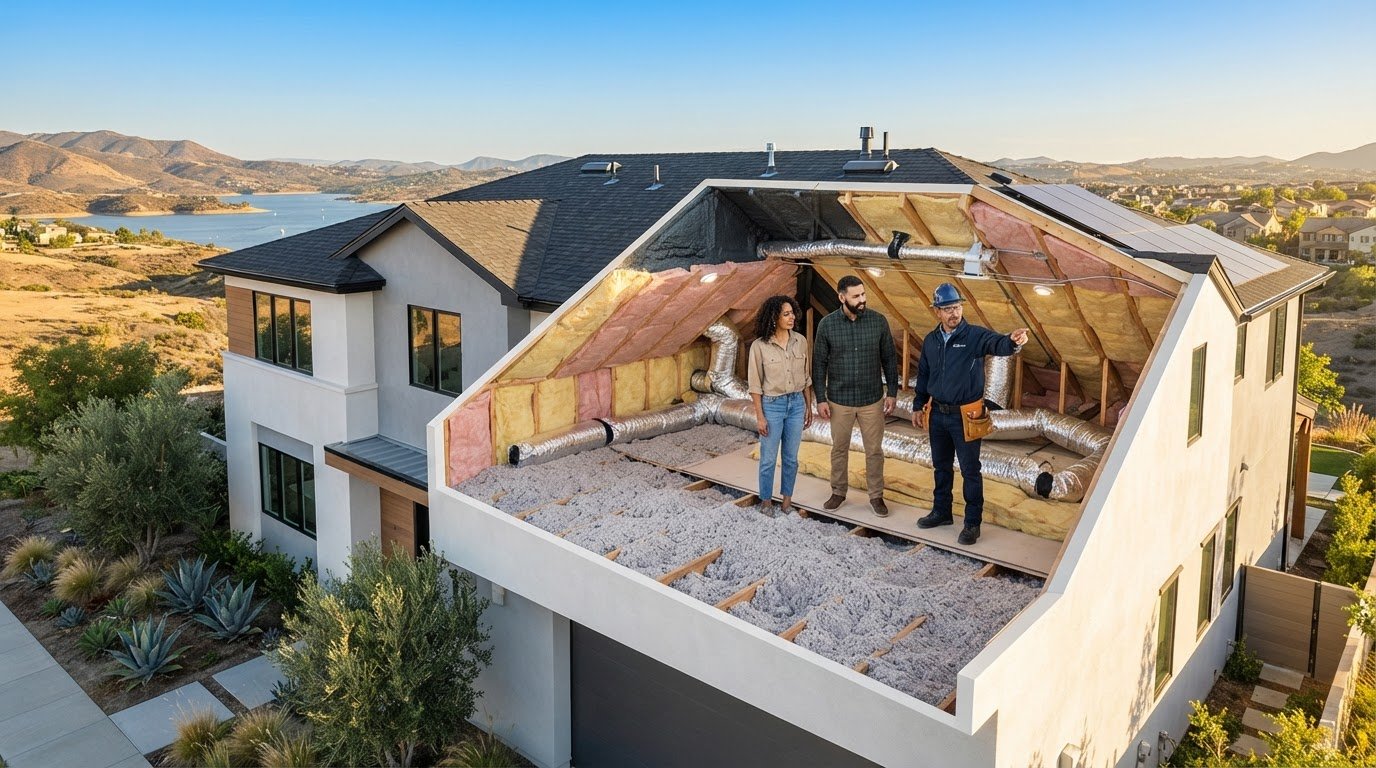
Square footage alone never tells the whole story. Vertical pitch and accessibility dictate how crews move through the space. Low-pitch rooflines, vaulted ceiling transitions, and tight truss systems require specialized installation methods and extra care around wiring. Technicians must also carefully work around recessed lighting and complex HVAC duct runs to prevent heat bridges, ensuring complete coverage without disrupting essential electrical connections.
Target R-Values for California Climate Zone 10
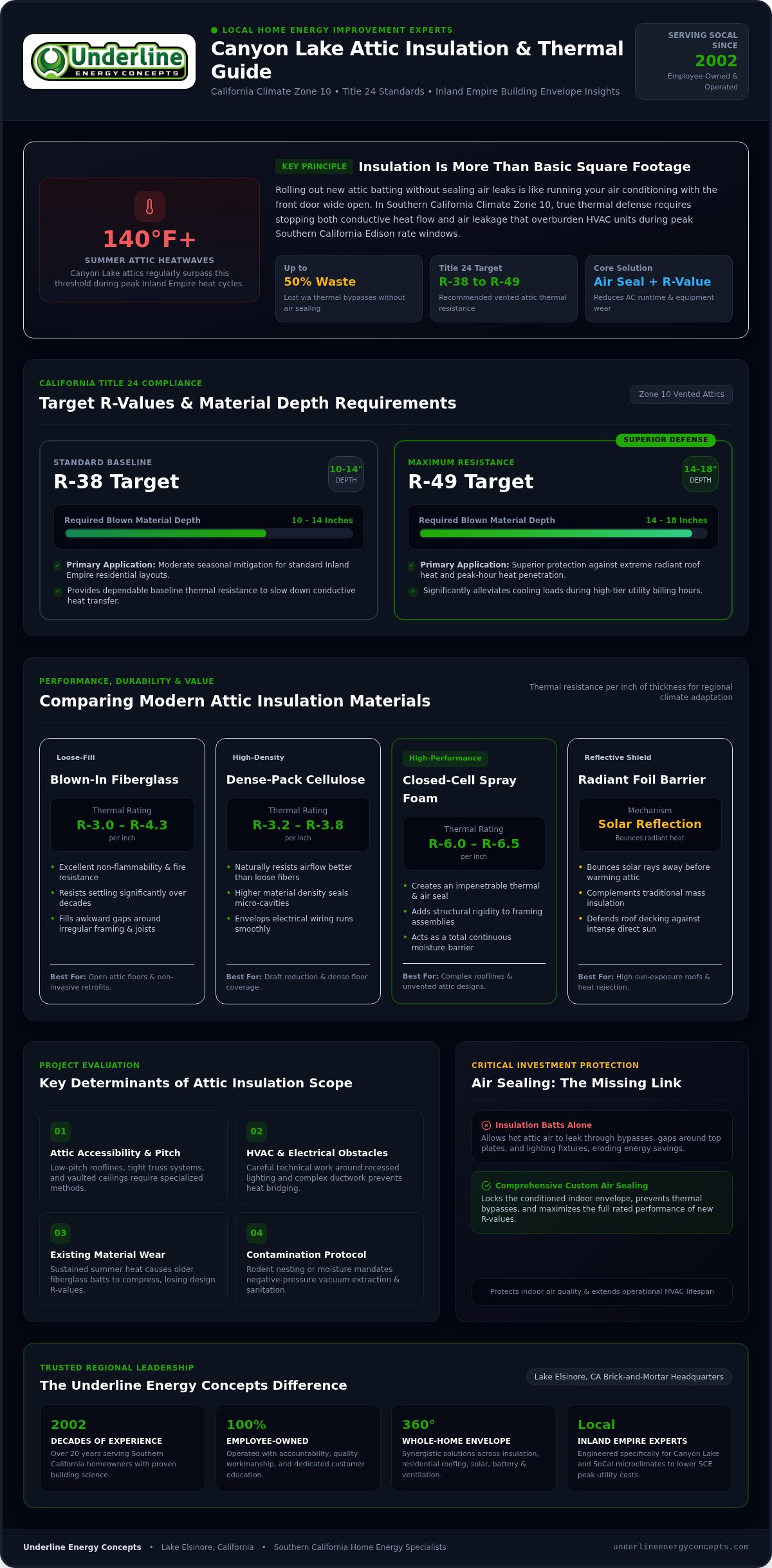
Thermal resistance requirements directly dictate how much material your space needs. Principles of modern building insulation rely on R-values to quantify resistance to conductive heat flow. Because Canyon Lake attics regularly surpass 140 degrees during peak summer heatwaves, meeting California Title 24 standards often means aiming for R-38 to R-49 in vented attic spaces. Achieving that target requires specific material depth:
- R-38 Coverage: Requires roughly 10 to 14 inches of blown-in material depending on density, ideal for moderate seasonal mitigation.
- R-49 Coverage: Demands 14 to 18 inches of depth, offering superior resistance against intense radiant roof heat and peak-hour heat penetration.
Condition of Existing Insulation and Contamination Issues
Existing materials set the baseline for your installation scope. Years of sustained heat cycles cause older fiberglass batts to compress, shedding substantial thermal resistance. If your attic suffered rodent nesting, droppings, or moisture infiltration, capping over the old material is never viable. Safe extraction using negative-pressure vacuum equipment becomes mandatory, followed by complete sanitation before fresh material is installed.
When the original barrier remains clean, dry, and structurally sound, adding high-performance blown-in material over the top can achieve required R-values efficiently. A thorough structural inspection confirms whether you need a clean-slate extraction or a precision top-off, protecting both indoor air quality and your bottom line.
Comparing Attic Insulation Materials: Performance, Durability, and Value
Selecting insulation involves balancing initial investment against long-term thermal resistance. In our regional climate, your choice dictates how effectively your home handles brutal summer heat spikes. Understanding material characteristics helps clarify what shapes the attic insulation cost Canyon Lake families budget for when upgrading their thermal defense.
Blown-In Cellulose and Fiberglass Insulation
Loose-fill materials represent the most popular choice for open attic floors. Fiberglass delivers roughly R-3.0 to R-4.3 per inch of thickness, offering excellent fire resistance without settling significantly over decades. Dense-pack cellulose provides R-3.2 to R-3.8 per inch and naturally resists airflow better than loose fibers because of its higher density. Both materials fill awkward gaps around irregular framing, joists, and wiring runs without requiring custom cutting.
Open-Cell and Closed-Cell Spray Polyurethane Foam
Spray polyurethane foam creates a seamless air and thermal seal directly against roof decking or framing cavities. Open-cell foam expands rapidly to seal complex voids at a lower density. Closed-cell formulations yield an impressive R-6.0 to R-6.5 per inch, adding structural rigidity while acting as a total moisture barrier. While chemical formulation and specialized rig operations require a larger upfront investment, spray foam delivers unmatched defense for complex rooflines and unvented attic assemblies.
Radiant Barriers and Thermal Reflection Shields
Radiant barriers work fundamentally differently than traditional mass insulation. Instead of slowing conductive heat transfer, highly reflective foil sheets bounce radiant solar energy away from your roof structure before it warms the attic air mass. Installing a radiant barrier creates a valuable shielding layer, especially when paired with bulk insulation on the attic floor:
- Solar Heat Rejection: Deflects radiant roof heat, lowering raw attic air temperatures during peak summer afternoons.
- Maintenance Needs: Surfaces must remain free of dust accumulation to maintain peak reflective capability over years of service.
- Ventilation Coordination: Requires unobstructed airflow channels from soffit to ridge vents to flush captured heat out of the roof cavity safely.
Every home requires a custom thermal balance rather than a one-size-fits-all product. If you want to assess how these materials align with your specific framing and budget, you can schedule a home energy consultation to evaluate your current attic structure.
Prep Work and Air Sealing: The Overlooked Cost Factors That Protect Your Investment
Skipping site preparation to trim upfront expenses compromises your entire project. Insulation regulates conductive heat, but air leaks carry thermal energy directly past it through convection. When budgeting the overall attic insulation cost Canyon Lake homeowners should treat air sealing and site prep as essential foundations rather than optional upgrades. Without them, conditioned indoor air slips away while dust and superheated attic air infiltrate your living space.
Old Insulation Removal and Sanitization Processes
Commercial extraction utilizes high-powered vacuum machinery situated outside the home. This negative-pressure process pulls contaminated, degraded fibers through sealed hoses without distributing dust throughout your living rooms. Once crews strip the space down to the bare joists, they apply an antimicrobial treatment to neutralize rodent droppings, mold spores, and allergen particles. Clearing the attic deck also uncovers hidden structural gaps and wiring concerns that require attention before new material goes in.
Precision Air Sealing of Thermal Bypasses
Small cracks around ceiling penetrations quietly drain your conditioned air all year long. Experienced technicians apply expanding foam and specialized sealants across top plates, electrical junction boxes, plumbing chases, and recessed lighting fixtures. Sealing these hidden thermal bypasses eliminates the stack effect, which pulls blistering attic air down into your living areas during Inland Empire heatwaves. Completing this step guarantees that your new insulation performs at its full engineered rating.
Attic Ventilation Upgrades and Fire Safety Codes
Proper airflow balance works hand in hand with thermal resistance. Intake soffits and exhaust vents must remain open to flush out trapped moisture and reduce heat build-up. In wildfire-prone areas across Riverside County, upgrading to ember-resistant vents protects your home by blocking flying embers during dry wind events. Learn more about regional ventilation standards in our guide on attic ventilation fire code upgrades in SoCal to keep your home comfortable, safe, and code-compliant.
Return on Investment: Energy Bill Relief, Rebates, and Whole-Home Synergy
Attic upgrades deliver immediate, measurable relief against rising utility expenses. When evaluating your attic insulation cost Canyon Lake financial calculations look far more compelling once you factor in lower monthly cooling demand and reduced wear on equipment. Treating the attic space as part of an integrated energy network maximizes every dollar you invest.
Slashing Southern California Edison Electric Bills
Air conditioning consumes the largest share of household power across the Inland Empire. Under Southern California Edison time-of-use rate structures, peak afternoon electricity costs climb substantially between 4 p.m. and 9 p.m. A dense, properly engineered thermal cap prevents stored attic heat from radiating through your ceilings during these exact hours. As a direct result, your air conditioning compressor cycles less frequently, stabilizing indoor comfort and preventing expensive peak-rate energy draws.
Available Utility Rebates and Energy Efficiency Credits
Utility incentive programs help offset your initial thermal investments. The EPA estimates that homeowners save an average of 15% on heating and cooling costs through combined air sealing and insulation upgrades. While previous federal tax credits wrapped up at the close of 2025, regional support remains strong. Homeowners can discover current qualifying programs through the SCE energy rebates portal, where targeted efficiency initiatives provide direct financial relief. Working with a licensed contractor ensures your project documentation aligns with utility compliance requirements from day one.
Maximizing Savings with Whole House Fans and Roofing Systems
Insulation functions best when supported by coordinated whole-home ventilation. Installing a whole house fan alongside fresh insulation allows you to flush superheated air from living areas and attic cavities during cool evening hours. Learn how unified envelope design transforms utility dependence in our review on integrated roofing and solar installation. This synchronized strategy delivers powerful home performance advantages:
- Extended Equipment Life: Curtails daily runtime on air conditioning compressors, preventing premature HVAC failure.
- Passive Evening Cooling: Replaces trapped indoor heat with crisp outdoor air for pennies per hour.
- Balanced Attic Temperatures: Lowers the thermal gradient pressing down onto your living space throughout hot afternoons.
Take charge of your monthly energy budget today. You can reach out to our local team to calculate your home's thermal requirements and claim available utility incentives.
Selecting a Canyon Lake Insulation Contractor: The Underline Advantage
Blowing insulation across ceiling joists addresses only one layer of your home's thermal performance. Your attic space protects vital electrical wiring, air distribution ducts, and critical roof framing. Evaluating the true attic insulation cost Canyon Lake property owners face requires partnering with a specialist who understands how these interconnected systems function together, rather than relying on a single-trade blowing outfit.
The Value of an Employee-Owned, Multi-License Contractor
Single-trade crews often overlook roof deck issues or inadvertently damage junction boxes during installation. As an employee-owned company holding licenses across roofing, electrical, and general contracting, Underline Energy Concepts treats your attic as an integrated building envelope. Every employee-owner maintains a personal stake in the quality of your installation, guaranteeing meticulous craft standards, thorough cleanup, and careful protection of your existing ductwork and wiring runs.
Local Lake Elsinore Heritage Serving Canyon Lake
We have served Inland Empire homeowners from our Lake Elsinore headquarters since 2002. That long-standing presence gives us practical familiarity with local architectural styles, regional heat cycles, and Canyon Lake community guidelines. We focus on homeowner education rather than high-pressure sales pitches, helping you make practical upgrades that generate lasting property value. Homeowners can also share these efficiency upgrades with neighbors and earn rewards through the Underline referral program.
Next Steps: Schedule Your Canyon Lake Attic Evaluation
A comprehensive site inspection eliminates guesswork from your upgrade. Our team examines existing material depth, tests for air leakage bypasses, inspects duct insulation, and checks ventilation pathways to construct a clear action plan:
- Targeted Assessment: Pinpoints thermal weak spots and safety hazards before installation begins.
- Transparent Proposals: Outlines an itemized scope tailored directly to your home's floor plan.
- Integrated Execution: Delivers coordinated air sealing, insulation, and ventilation in a single streamlined project.
Take control of your indoor temperatures and protect your monthly energy budget. Reach out to our employee-owners today to schedule your attic inspection and consultation.
Upgrade Your Thermal Defense and Cut Cooling Costs
Upgrading your attic remains one of the single most effective ways to shield your household from punishing Inland Empire heatwaves while keeping utility bills in check. Factoring in the real attic insulation cost Canyon Lake property owners navigate means looking beyond basic material blowing. Prioritizing airtight ceiling sealing, matching R-values to Title 24 standards, and coordinating your airflow delivers lasting relief and protects expensive air conditioning equipment from premature wear.
Since 2002, Underline Energy Concepts has guided Southern California families toward greater energy independence and whole-home resilience. As an employee-owned team based right next door in Lake Elsinore, we bring combined licensing across roofing, electrical, and general contracting to ensure your building envelope is protected from every angle. You don't have to endure unbearable second-story rooms or surging summer electric rates. Schedule your Canyon Lake attic inspection and consultation today, and take the first step toward a consistently comfortable, energy-efficient home.
Frequently Asked Questions
How much attic insulation do I need for my Canyon Lake home?
Under California Title 24 guidelines for Climate Zone 10, homes in Canyon Lake generally need between R-38 and R-49 insulation depth in vented attics. That translates to roughly 10 to 18 inches of loose-fill blown-in material depending on whether fiberglass or cellulose is selected. Reaching these targeted thermal depths buffers against 140-degree summer roof conditions and prevents radiant heat from invading upper-level ceilings.
Is it necessary to remove old attic insulation before adding new material?
Full extraction isn't always mandatory, but it becomes essential if previous materials suffered pest infestation, water leaks, or severe compression. When evaluating overall attic insulation cost Canyon Lake homeowners find that capping clean, dry insulation saves money, while contaminated batts must be extracted with negative-pressure vacuums to sanitize the attic deck and preserve indoor air quality. An on-site inspection determines whether a complete removal or a top-off makes technical sense.
How long does a professional attic insulation installation take?
Most residential installations wrap up within one to two working days. A straightforward blown-in top-off often takes four to six hours. If your project involves extensive prep work, old material vacuum extraction, sanitizing, and comprehensive perimeter air sealing, crews typically require two full days to complete the work thoroughly. Multi-trade contractors ensure electrical boxes and duct runs remain protected throughout the entire installation timeline.
What is the difference between blown-in fiberglass and cellulose insulation?
Blown-in fiberglass consists of spun glass fibers that resist fire naturally and settle very little over decades. Dense-pack cellulose consists of recycled paper fibers treated with borate for fire and pest resistance. Cellulose boasts higher material density, which helps block convective air drafts better than loose fiberglass. Both deliver dependable thermal defense across Inland Empire weather patterns when installed to proper manufacturer depth and R-value specifications.
Can proper attic insulation help reduce wear on my air conditioning unit?
Yes, proper attic insulation dramatically cuts down your air conditioning runtime by slowing the transfer of solar heat into your living spaces. When your attic holds a dependable thermal barrier, your indoor thermostat reaches its set temperature much quicker and stays there longer. This reduced thermal load prevents continuous compressor cycling during peak afternoon heatwaves, which helps avoid unexpected mechanical breakdowns and significantly prolongs system lifespan.
Are there energy rebates available for insulating my attic in Southern California?
Yes, Southern California Edison offers energy efficiency rebates for qualifying attic upgrades through local efficiency programs. While the previous federal tax credit expired at the end of 2025, regional utility programs continue to offset installation investments for homeowners who upgrade their building envelope. Managing the total attic insulation cost Canyon Lake families face becomes much easier when working with a licensed contractor who provides the precise project documentation needed for utility applications.
Why should air sealing be completed prior to blowing in new insulation?
Air sealing blocks thermal bypasses that traditional loose-fill materials cannot stop on their own. Standard insulation slows conductive heat transfer, but heated air can still escape through open wiring gaps, plumbing chases, and recessed lighting fixtures. Sealing these hidden gaps with expanding foam creates an airtight thermal envelope, stopping the chimney effect that pulls attic heat into your home and ensuring you receive full rated energy performance.